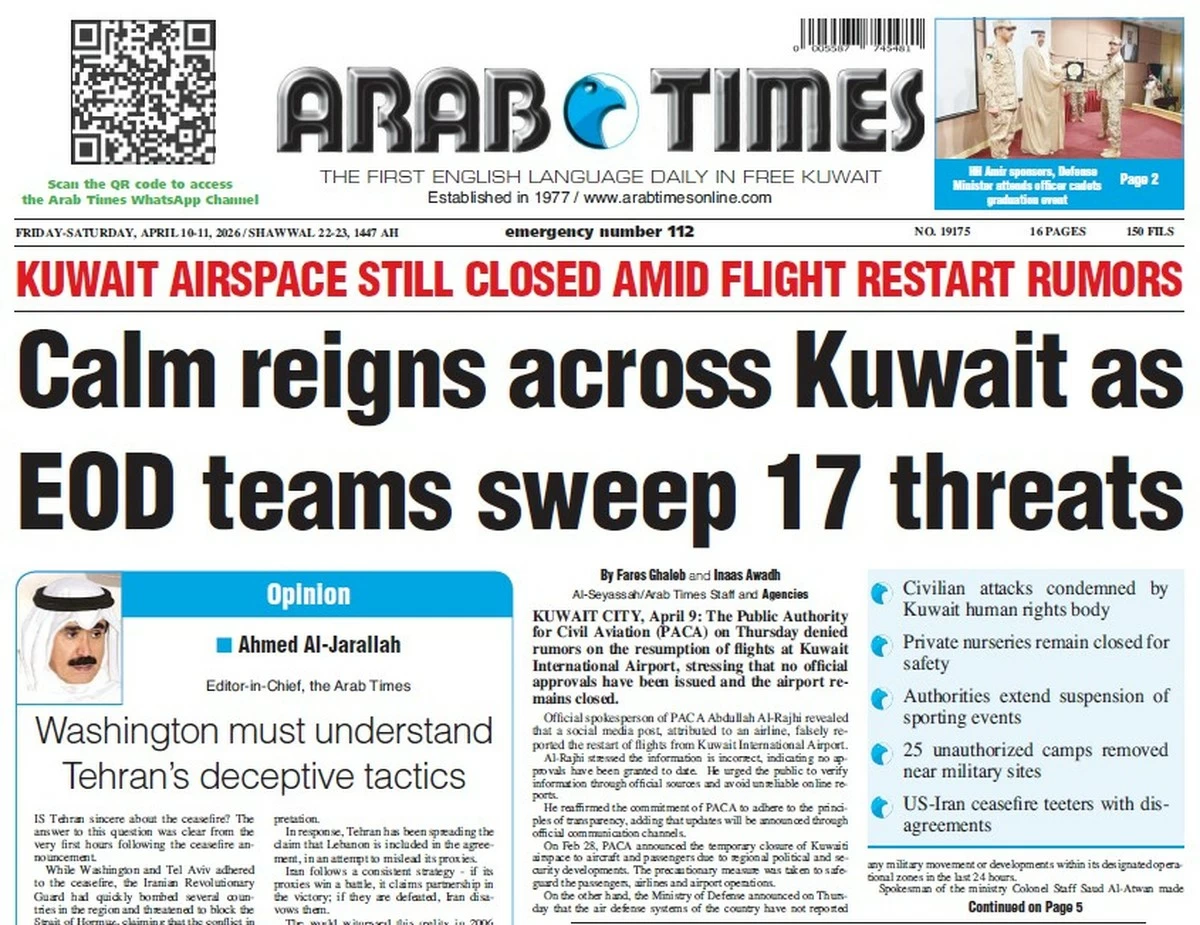




Is Tehran sincere about the ceasefire? The answer to this question was clear from the very first hours following the ceasefire announcement. While Washington and Tel Aviv adhered to the ceasefire, the Iranian Revolutionary Guard had quickly bombed several countries in the region and threatened to block the Strait of Hormuz, claiming that the conflict in Lebanon had not ended.
Anyone familiar with the Iranian mindset knows that Iranian promises are often a tactic to buy time. This is their modus operandi, even in trade and public relations. Therefore, the negotiations are nothing more than an opportunity for Iran to prepare for a second round of war, or at the very least, to get ready for dealing with potential domestic developments. Perhaps it has other objectives that will become clear in time.
Iranian calculations differ sharply from those in Washington, Tel Aviv, and the Gulf states, which were most affected by the recent war. Given their deep understanding of Persian culture, the Gulf states, when warning against a lack of decisive action in the current war, knew exactly what a truce would mean for Iran and were certain that Iran would not honor it.
Iran is now seeking to evade the ceasefire, first by claiming that the agreement does not cover Lebanon, and then by arguing that it does not guarantee the Gulf states, among other justifications. It is clear that the statements of Iranian officials, regardless of their wording, imply that Iran is not serious about committing to the ceasefire agreement.
Thus, the Iranian regime is attempting to back out of the agreement by placing the blame on the United States or Israel. The U.S. Vice President made it clear recently by stating, “If Iran is using Lebanon as a pretext for withdrawing from the agreement, that is their prerogative. Lebanon is not part of the agreement, and Iran knows this very well.” This unequivocal statement from the U.S. Vice President leaves no room for misinterpretation. In response, Tehran has been spreading the claim that Lebanon is included in the agreement, in an attempt to mislead its proxies.
Iran follows a consistent strategy - if its proxies win a battle, it claims partnership in the victory; if they are defeated, Iran disavows them. The world witnessed this reality in 2006 when the former Secretary-General of Hezbollah Hassan Nasrallah launched attacks on Israel, ostensibly to secure the release of Lebanese prisoners. Hezbollah succeeded in capturing two Israeli soldiers. However, faced with Israel’s response, widespread destruction, and the number of Lebanese casualties, Nasrallah famously admitted, “Had I known these consequences, I would not have ordered this operation.”
Today, Naim Qassem, Nasrallah’s successor, who remains hidden deep underground, has followed a similar path. When Israeli-American attacks targeted Iran, Hezbollah launched missiles from Lebanon. Yet, witnessing the Israeli retaliation and the resulting casualties among his own community, Qassem shifted the blame to the Lebanese government, accusing it of failing to protect its people and thereby absolving himself of responsibility for the harm inflicted. As the saying goes, “If a person lives among a people for forty days, he will either become one of them or leave them.” So what about someone who has been tied to the Iranian regime for 44 years, repeatedly claiming full support from Iran?
He will inevitably mirror the Persian in behavior and character, ultimately becoming a puppet in the hands of his handlers. As long as Iran continues to benefit from this puppet, it will keep investing in him, even if only through the media. Nevertheless, tomorrow may see the first direct talks between Americans and Iranians in Islamabad. We can expect considerable Iranian stalling. The American negotiators must understand that decisive action is the only solution. In short, the Iranian regime is like a rotten tooth that must be extracted.