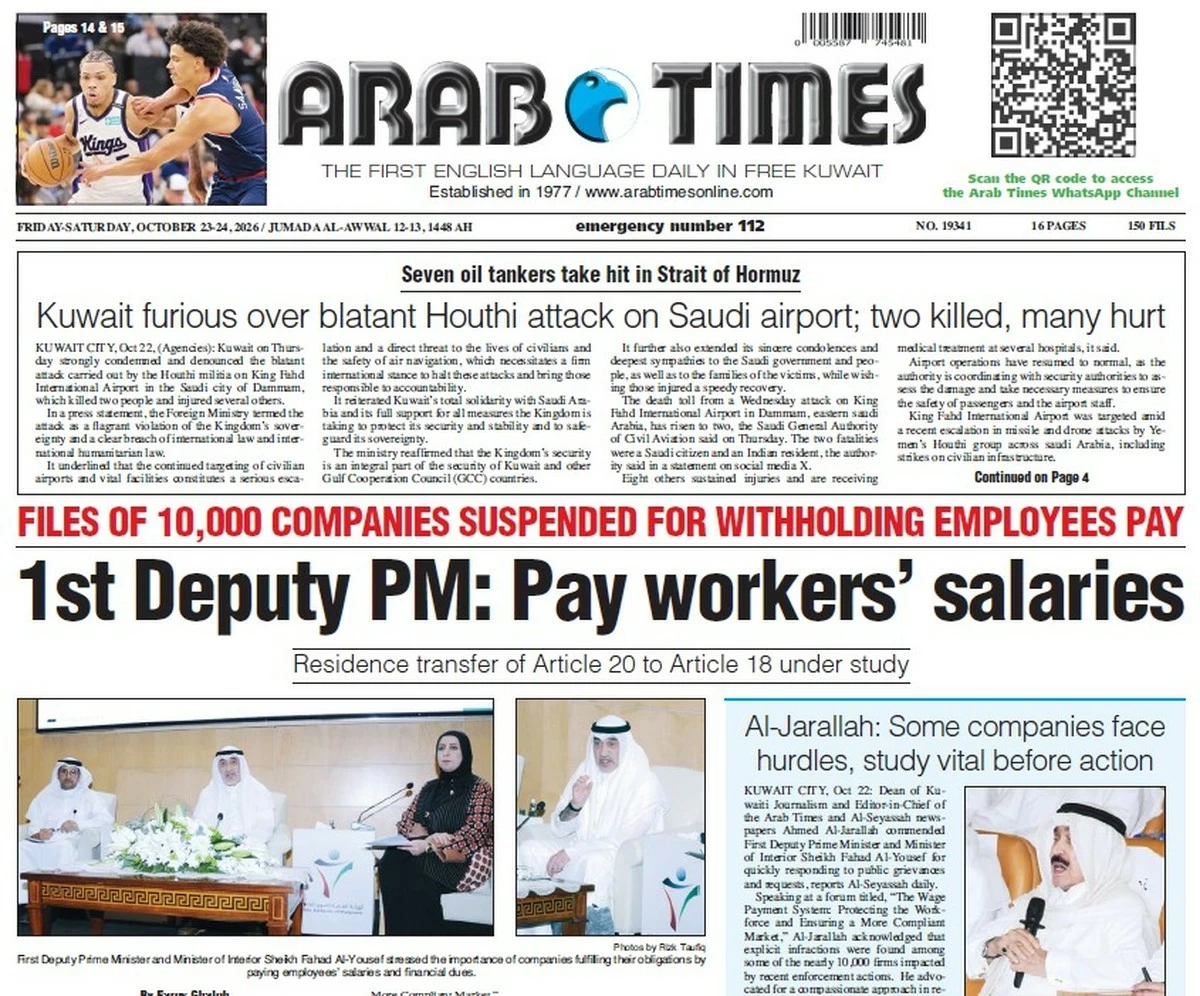





Your Excellency Sheikh Fahad Al-Yousef, First Deputy Prime Minister and Minister of Interior, we acknowledge your dedication to uphold the law with rigor and compassion. We also appreciate your commendable principles, particularly the belief that “no injustice befalls anyone in Kuwait if he is innocent,” and we trust that you handle matters with careful consideration to ensure that justice prevails. In light of this, we wish to bring the following to your attention: Last Thursday, the first of the month, at 3:28 pm, we received a message stating, “Please report to the Criminal Investigation General Department, Department 13, Section B, on Thursday, Oct 1, 2026, at 5:00 pm sharp. This is an urgent matter in accordance with Ministerial Decree No. 39/2024. This message serves as an official summons; failure to comply will lead to all applicable legal actions being taken.” Your Excellency, we must admit that we were left feeling quite confused and anxious. The ambiguous nature of the message raised questions about what offense may have been committed.
The authority that issued the summons is not ordinary; it is the Criminal Investigation General Department, yet there was no clarification regarding the urgency of the request, which was made outside the regular working hours. Had we, God forbid, disobeyed the leadership, breached the laws of the country or engaged in a serious crime?
We pondered these questions and many others at length, particularly given the timing of the summons— issued after the official workday, preceding the weekend holiday. We spent 50 minutes or more reviewing the issue, hoping to reach a convincing conclusion, yet we found no satisfactory answer.
We made inquiries to clarify the matter, but the responses were vague, which only exacerbated our frustration. After minutes fraught with uncertainty and questions, we finally found the reason: an inquiry regarding a non-Arab who had been under our sponsorship until 1997—a relationship that ceased after that year. They asked about him and his whereabouts. Your Excellency, the Minister, as previously stated, our association with this individual concluded at that time. I estimate he was about 40 to 45 years old then, which means he could be above 70 years old now. We are uncertain about his current status. Since our relationship with him ended, we have not received updates. We do not know if he is still in the country, has relocated to another nation, returned to his homeland or passed away.
The concern here is the vagueness of the language. It suggests that we may have committed a crime, transforming what should have been a straightforward issue into a complex one, or at least, that is how it may be perceived by anyone receiving such a notification. In the past, notifications were much clearer, offering the recipient a thorough understanding of the situation. Upon receiving such a notice, an average citizen, without access to reliable information, would likely experience enormous distress. If that citizen has a chronic condition, such as hypertension, the shock could trigger a serious health crisis or even result in death before the nature of the situation is clarified.
Your Excellency, First Deputy Prime Minister, the emotional state of a citizen in such circumstances is regrettable. Based on our experience, we are aware of your attention to every detail and your inclination to emphasize the intent of the law over its literal interpretation to ensure that no one is treated unfairly during your tenure. You maintain an open-door policy, carrying out your responsibilities in a manner that protects the mental and social well-being of the public, while maintaining security.
Thus, we were confident that once the details were presented to you, you would address the issue with the highest level of seriousness. We trust that you will revise the language of public notifications, especially considering that, as noted earlier, these alerts are sent after the official working hours. It is unreasonable for a citizen to ascertain the correct course of action within just one hour and 32 minutes, especially when the notification suggests that the issue pertains to a serious crime. Your Excellency, Minister of Interior, we stress that while we acknowledge your commitment to uphold the law, you will not endorse, even in written form, language that is severe or threatening.
This is particularly important when interacting with citizens who may have certain health conditions. Even for those in good health, such vague and distressing language could have serious negative health effects. Your Excellency, the First Deputy Prime Minister, as we bring this issue to your attention, we are aware of your dedication to the welfare of your fellow citizens. An unclear summons led to major anxiety. We experienced moments of dread that felt interminable, as if we had committed a serious offense—an experience that tormented our minds and bodies.
We trust that you do not want such anguish to befall your citizens. Your Excellency, consider this instance: a citizen was called to a police station. When he asked about the reason, he was informed, “You will find out upon arrival.” Upon reaching the station and discovering the nature of the matter, he collapsed and passed away, having endured a period of excruciating uncertainty that overwhelmed his mind and body.