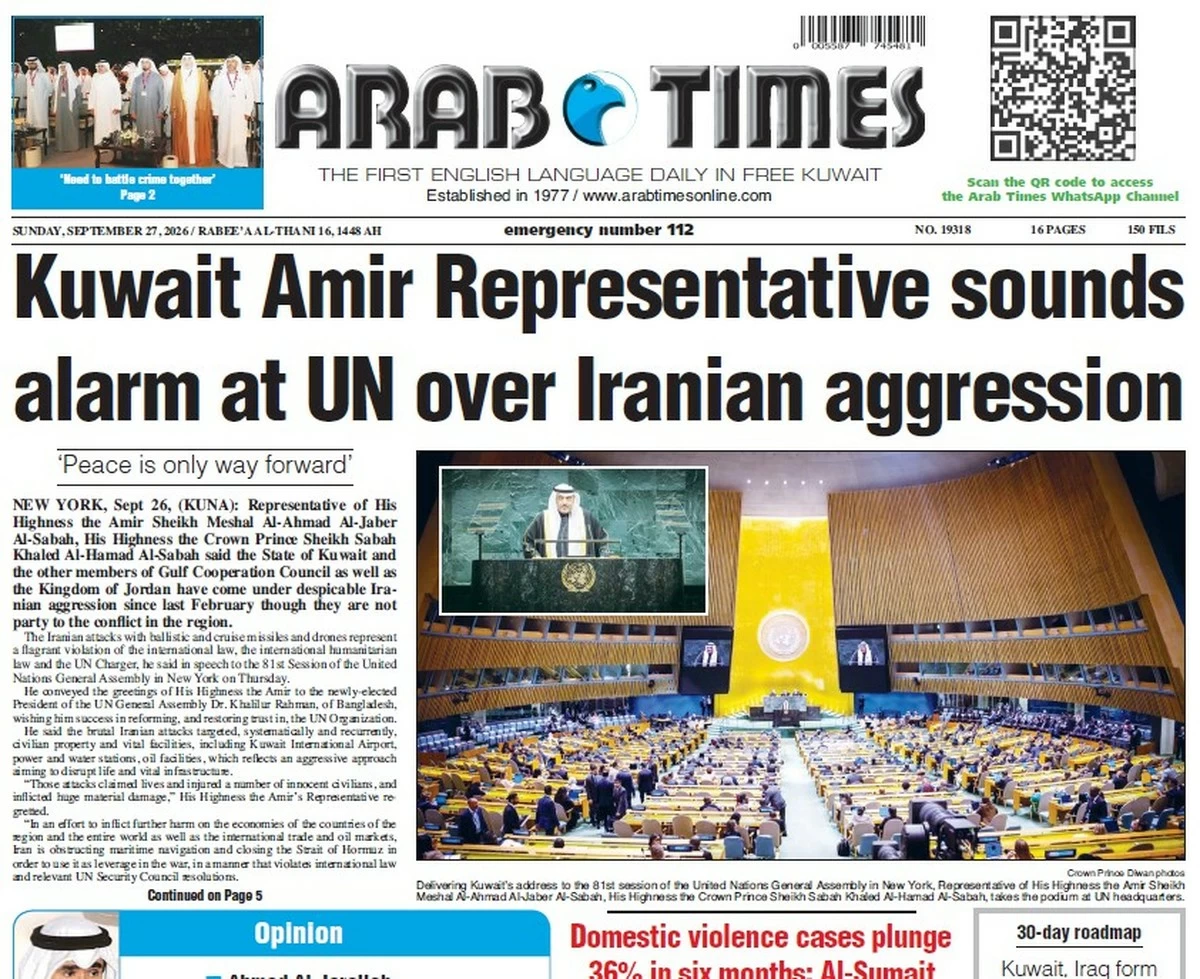




A well-known Arab is saying, “From what you say, I’d believe you. But looking at what you do, I’m baffled.” This sentiment perfectly captures the nature of the Iranian regime, whose president addressed the UN General Assembly on the subject of terrorism while pointing fingers at numerous other nations. His speech brings to mind another familiar saying - “People who live in glass houses shouldn’t throw stones.” It is a reminder of how remarkably persuasive a liar can sound when preaching about honor. President Pezeshkian has conveniently overlooked 47 years of Iranian-backed global terrorism.
This history includes the establishment of proxy militias across Lebanon, Iraq, and Yemen, as well as crucial support for the former Syrian regime as it massacred civilians striving for freedom. Moreover, since last February, Tehran has attempted to orchestrate global economic instability by threatening to shut down the Strait of Hormuz and directing its Yemeni proxy to blockade the Bab al-Mandab Strait. The Iranian president also turned a blind eye to decades of relentless aggression against the Gulf states, which has persisted in various forms from 1980 to the present day. In recent escalations, the regime laid bare its true intentions by launching missile and drone strikes against civilian populations and critical energy infrastructure across Kuwait, Saudi Arabia, the UAE, Qatar, Bahrain, and even Oman, a nation actively mediating between Washington and Tehran to reduce tensions.
Masoud Pezeshkian’s appearance at the United Nations exemplifies the double-dealing that has defined Iranian foreign policy for decades. When the Revolutionary Guard openly boasts in daily communications of its support for the Houthi militia’s war on Saudi Arabia, its targeting of holy sites, and its disruption of Red Sea commerce, it explicitly confirms its own state-sponsored terrorism and that of its regional proxies. Early in the conflict, the Iranian president offered apologies for attacks on Gulf nations; yet, on that exact same day, the Revolutionary Guard proceeded to bombard Kuwait and Bahrain.
This glaring contradiction illustrates that power does not reside with diplomatic figures in “tailored suits,” nor with the Supreme Leader, who remains hidden from the public eye and issues only written statements. Real authority belongs to a militant apparatus headquartered at “Khatam al- Anbiya” - an organization that effectively dominates the entire state apparatus.
This dynamic explains the chaotic signals originating from Tehran’s decisionmaking structure. As observed repeatedly, the regime’s ultimate goal remains regional dominance and the fundamental alteration of the Middle East’s cultural, social, and economic landscape. For nearly seven months, official statements claimed that strikes were directed solely at U.S. military positions.
In reality, Iranian weapons targeted residential neighborhoods, power grids, water desalination plants, commercial airports, and shipping vessels across Kuwait, Saudi Arabia, Bahrain, and the UAE. Simultaneously, regime spokespersons preached neighborly goodwill, peaceful coexistence, and regional partnership along both shores of the Arabian Gulf. This facade fell apart completely when the Speaker of the Iranian Parliament displayed a map labeling the area as the “Persian Gulf” during an official visit to Baghdad.
This gesture served as a clear attempt to dictate the identity of the Gulf, reflecting an ingrained Persian superiority complex that has lingered since the defeat of the Sasanian Empire at the Battle of Dhi Qar. When a country is governed by shadowy factions, internal instability is inevitable. Power fractures into competing centers of authority, fragmenting the nation into semi-autonomous entities with conflicting agendas. If the international community continues to offer this regime lifelines through endless negotiation and compromise, violent proxy networks will continue to terrorize Yemen, Iraq, and Lebanon. The threat of extremism will endure, masked by a deceitful diplomacy that preaches peace while waging war. It remains deeply ironic that a rogue state- internationally condemned for its aggressive exploits - claims the moral high ground on the United Nations stage.