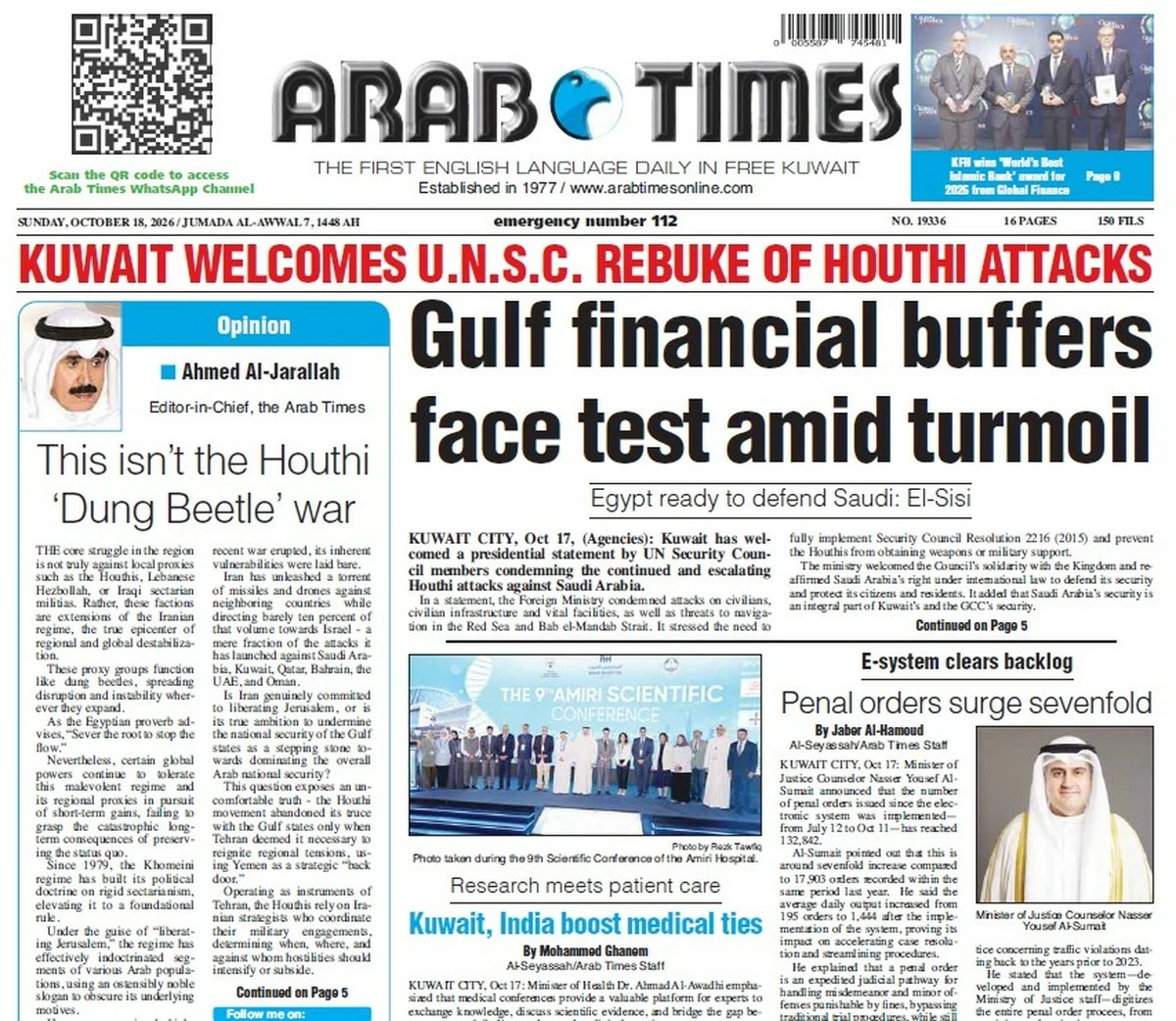
The core struggle in the region is not truly against local proxies such as the Houthis, Lebanese Hezbollah, or Iraqi sectarian militias. Rather, these factions are extensions of the Iranian regime, the true epicenter of regional and global destabilization. These proxy groups function like dung beetles, spreading disruption and instability wherever they expand.
As the Egyptian proverb advises, “Sever the root to stop the flow.” Nevertheless, certain global powers continue to tolerate this malevolent regime and its regional proxies in pursuit of short-term gains, failing to grasp the catastrophic long-term consequences of preserving the status quo. Since 1979, the Khomeini regime has built its political doctrine on rigid sectarianism, elevating it to a foundational rule. Under the guise of “liberating Jerusalem,” the regime has effectively indoctrinated segments of various Arab populations, using an ostensibly noble slogan to obscure its underlying motives.
However, as previously highlighted, this righteous posture masks a profound falsehood. Throughout the regional conflicts that have unfolded since 1979, particularly those involving Israel, the regime has consistently avoided confrontation. When the most recent war erupted, its inherent vulnerabilities were laid bare. Iran has unleashed a torrent of missiles and drones against neighboring countries while directing barely ten percent of that volume towards Israel - a mere fraction of the attacks it has launched against Saudi Arabia, Kuwait, Qatar, Bahrain, the UAE, and Oman.
Is Iran genuinely committed to liberating Jerusalem, or is its true ambition to undermine the national security of the Gulf states as a stepping stone towards dominating overall Arab national security? This question exposes an uncomfortable truth: the Houthi movement abandoned its truce with the Gulf states only when Tehran deemed it necessary to reignite regional tensions, using Yemen as a strategic “back door.” Operating as instruments of Tehran, the Houthis rely on Iranian strategists who coordinate their military engagements, determining when, where, and against whom hostilities should intensify or subside.
Unable to prevail against Israel or the United States, Iran shifted its strategy towards undermining global stability. Its campaign began with efforts to exert control over vital energy routes through the Strait of Hormuz, while leveraging the Houthis to disrupt maritime navigation in the Bab al-Mandeb Strait. Furthermore, as economic pressures mounted, culminating in the grounding of its commercial airline fleet worldwide, Tehran threatened to halt air traffic across neighboring states.
To enforce this threat, it directed Houthi forces to launch missile strikes against airports in the Kingdom of Saudi Arabia. This strategy reflects Iran’s long-standing pattern of initiating conflicts, prolonging them, and ultimately facing defeat. Historical encounters, including the battles of Dhi Qar, Dhat al-Salasil, and al-Qadisiyyah, are often cited as illustrations of this pattern. During the Battle of al-Qadisiyyah, a relatively modest force helped bring about the collapse of the Sassanid Persian Empire, overcoming a formidable power that had long rivaled the Byzantine Empire under Emperor Heraclius.
Throughout nearly two millennia, Persian history has been marked by repeated military defeats. Much like the dynamics observed today, Persian rulers have often relied on regional allies and proxies, yet their efforts have not always translated into decisive victories in war. Although modern technology and advanced weaponry have transformed the contemporary battlefield, the underlying cultural framework and customs remain unchanged. In the end, everyone reverts to their fundamental character - those driven by spite are ultimately consumed by their own animosity, while those serving as external agents are inevitably relegated to the dustbin of history. Such a fate awaits the Houthis, Hezbollah (the “Party of Satan”), Iranian-backed militias across Iraq, and the hostile Iranian regime itself.