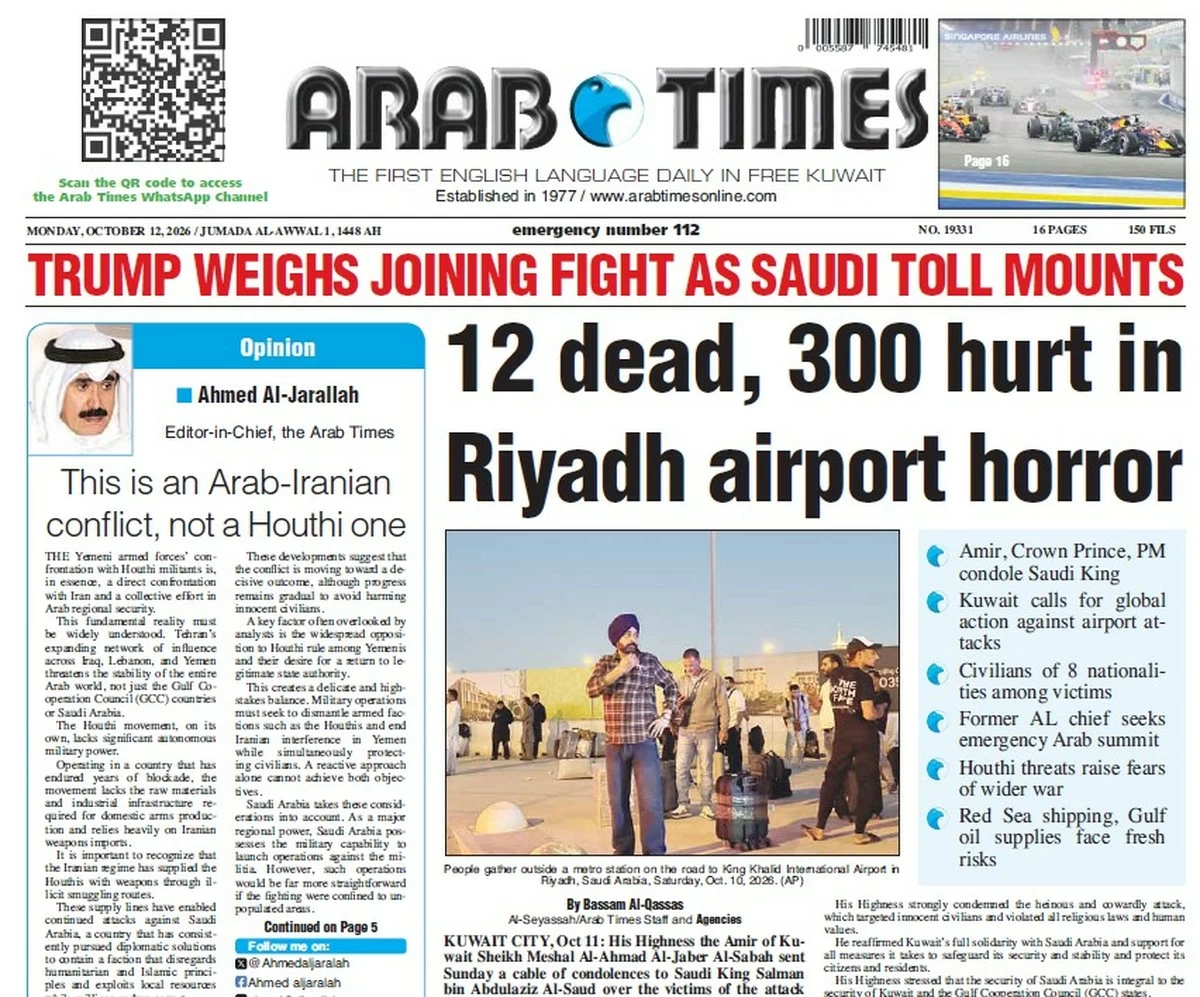





The Yemeni armed forces’ confrontation with Houthi militants is, in essence, a direct confrontation with Iran and a collective effort in Arab regional security. This fundamental reality must be widely understood. Tehran’s expanding network of infl uence across Iraq, Lebanon, and Yemen threatens the stability of the entire Arab world, not just the Gulf Cooperation Council (GCC) countries or Saudi Arabia. The Houthi movement, on its own, lacks significant autonomous military power. Operating in a country that has endured years of blockade, the movement lacks the raw materials and industrial infrastructure required for domestic arms production and relies heavily on Iranian weapons imports. It is important to recognize that the Iranian regime has supplied the Houthis with weapons through illicit smuggling routes.
These supply lines have enabled continued attacks against Saudi Arabia, a country that has consistently pursued diplomatic solutions to contain a faction that disregards humanitarian and Islamic principles and exploits local resources while millions endure poverty. Legitimate government forces have recently made significant advances in Bab al-Mandab and other key areas, forcing Houthi militias to retreat. These developments suggest that the confl ict is moving toward a decisive outcome, although progress remains gradual to avoid harming innocent civilians. A key factor often overlooked by analysts is the widespread opposition to Houthi rule among Yemenis and their desire for a return to legitimate state authority.
This creates a delicate and highstakes balance. Military operations must seek to dismantle armed factions such as the Houthis and end Iranian interference in Yemen while simultaneously protecting civilians. A reactive approach alone cannot achieve both objectives. Saudi Arabia takes these considerations into account. As a major regional power, Saudi Arabia possesses the military capability to launch operations against the militia. However, such operations would be far more straightforward if the fighting were confined to unpopulated areas.
In 2018, forces supporting the legitimate government, alongside the Arab Coalition, advanced to the perimeter of Sana’a, pushing the “Ansar Allah” movement to the edge of defeat. The offensive near Sana’a was strategically halted to redirect efforts toward the west coast, safeguard vital shipping lanes through the Bab al- Mandab Strait, and protect the coastal region, including Hodeidah and its strategically important port. Protecting civilian lives was - and remains - the top priority for both the legitimate government and the Coalition. Although political and military circumstances have changed considerably, we are currently navigating a comparable situation. This shift is particularly evident as attacks have breached every boundary, directly targeting sacred sites and densely populated civilian areas.
These escalations underscore an undeniable truth - Tehran has failed to gain any leverage in its standoff with Washington. A decisive collapse of the Iranian regime and its regional network is now unavoidable. This trajectory is driven by the depletion of Iran’s internal resources, the systematic dismantling of Hezbollah in Lebanon, Syria’s emancipation from the oppressive rule of the mullahs, and the Iraqi public’s growing awareness of the destruction caused by Tehran’s deep-rooted hostility. As a result, the campaign led by the legitimate government’s armed forces in Yemen will serve as the decisive blow to permanently dismantle Iranian dominance across the region.