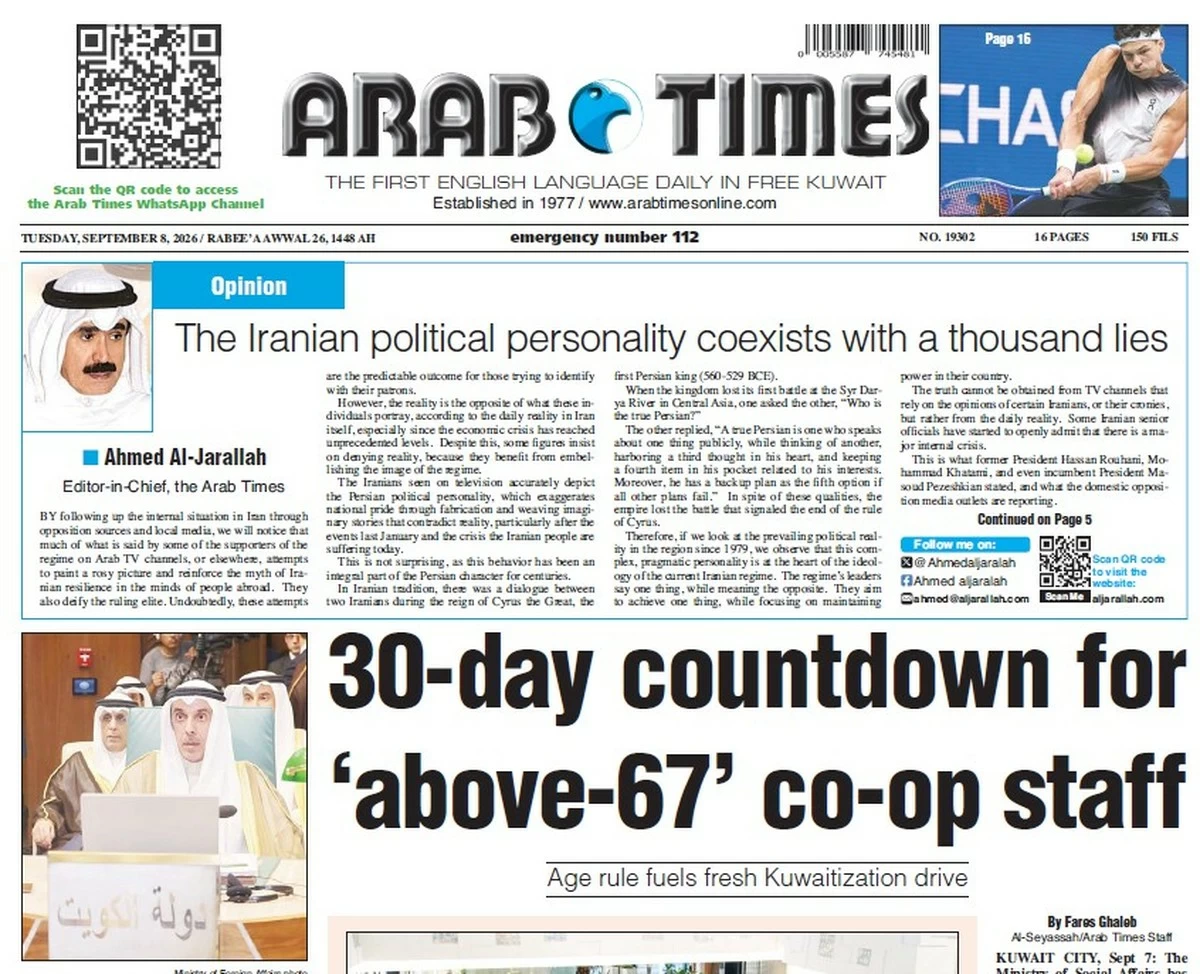




They also deify the ruling elite. Undoubtedly, these attempts are the predictable outcome for those trying to identify with their patrons. However, the reality is the opposite of what these individuals portray, according to the daily reality in Iran itself, especially since the economic crisis has reached unprecedented levels.
Despite this, some figures insist on denying reality because they benefit from embellishing the image of the regime. The Iranians seen on television accurately depict the Persian political personality, which exaggerates national pride through fabrication and weaving imaginary stories that contradict reality, particularly after the events last January and the crisis the Iranian people are suffering today. This is not surprising, as this behavior has been an integral part of the Persian character for centuries.
In Iranian tradition, two Iranians had a dialogue during the reign of Cyrus the Great, the first Persian king (560-529 BCE). When the kingdom lost its first battle at the Syr Darya River in Central Asia, one asked the other, “Who is the true Persian?”
The other replied, “A true Persian speaks about one thing publicly, while thinking of another, harboring a third thought in his heart, and keeping a fourth item in his pocket related to his interests. Moreover, he has a backup plan as the fifth option if all other plans fail.”
Despite these qualities, the empire lost the battle that signaled the end of Cyrus's rule. Therefore, if we look at the prevailing political reality in the region since 1979, we observe that this complex, pragmatic personality is at the heart of the ideology of the current Iranian regime. The regime’s leaders say one thing, while meaning the opposite.
They aim to achieve one thing, while focusing on maintaining power in their country. The truth cannot be obtained from TV channels that rely on the opinions of certain Iranians, or their cronies, but rather from the daily reality. Some Iranian senior officials have started to openly admit that there is a major internal crisis. This is what former President Hassan Rouhani, Mohammad Khatami, and even incumbent President Masoud Pezeshkian stated, and what the domestic opposition media outlets are reporting.
The true nature of the Iranian regime emerged with the tightening of international sanctions, the weakness it displayed in the recent war, the escalating internal crises—the most severe of which occurred last January, the hunger of about 95 percent of the population, and the unprecedented inflation rate. The attempts of Iranian or Arab analysts to whitewash the image of this crumbling regime and the threatening rhetoric adopted by some officials will be futile. The cry of hunger will continue to be louder than any political statements.