


16/09/2026

Share:
16/09/2026
Share:

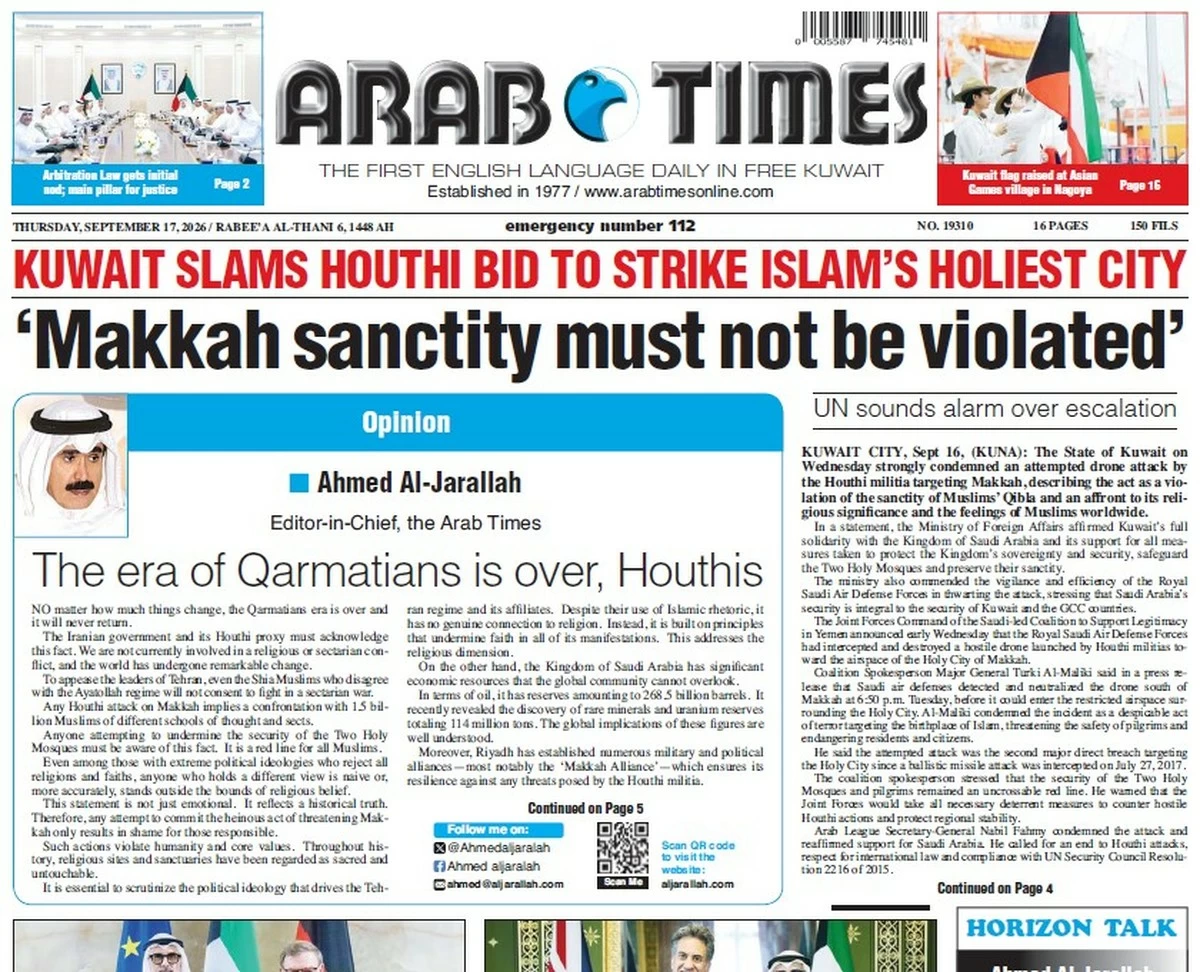
No matter how much things change, the Qarmatians era is over and it will never return. The Iranian government and its Houthi proxy must acknowledge this fact. We are not currently involved in a religious or sectarian conflict, and the world has undergone remarkable change. To appease the leaders of Tehran, even the Shia Muslims who disagree with the Ayatollah regime will not consent to fight in a sectarian war. Any Houthi attack on Makkah implies a confrontation with 1.5 billion Muslims of different schools of thought and sects.
Anyone attempting to undermine the security of the Two Holy Mosques must be aware of this fact. It is a red line for all Muslims. Even among those with extreme political ideologies who reject all religions and faiths, anyone who holds a different view is naive or, more accurately, stands outside the bounds of religious belief. This statement is not just emotional. It reflects a historical truth. Therefore, any attempt to commit the heinous act of threatening Makkah only results in shame for those responsible. Such actions violate humanity and core values.
Throughout history, religious sites and sanctuaries have been regarded as sacred and untouchable. It is essential to scrutinize the political ideology that drives the Tehran regime and its affiliates. Despite their use of Islamic rhetoric, it has no genuine connection to religion. Instead, it is built on principles that undermine faith in all of its manifestations. This addresses the religious dimension. On the other hand, the Kingdom of Saudi Arabia has significant economic resources that the global community cannot overlook.
In terms of oil, it has reserves amounting to 268.5 billion barrels. It recently revealed the discovery of rare minerals and uranium reserves totaling 114 million tons. The global implications of these figures are well understood. Moreover, Riyadh has established numerous military and political alliances—most notably the ‘Makkah Alliance’—which ensures its resilience against any threats posed by the Houthi militia.
This militia faced disciplinary action several times during ‘Operation Decisive Storm’ due to attempts to attack the Kingdom and other Gulf states. During that period, the Gulf Cooperation Council (GCC) forces were mobilized to counter the Houthis, leading to a prolonged retreat. It is crucial to recognize that the Strait of Hormuz and the Bab al-Mandab Strait are vital for maritime navigation and global supply chains.
This issue transcends being solely a Gulf or Saudi concern, as it is a global matter. When the Houthis jeopardized the security of the Red Sea, they inadvertently tightened the noose around themselves, as such action primarily endangers Egypt’s national security and global supply chains.
Thus, the visit of Saudi Crown Prince Mohammed bin Salman to Cairo is of great importance. Any threat to Egypt equates to a threat to Saudi Arabia and the entire GCC—a consideration that the Houthis overlooked. Contemporary warfare is fundamentally different from that of centuries or even decades past. Today, conflicts are conducted using missiles, cutting-edge technology, and artificial intelligence, rather than just mobilizing large armies. Modern warfare no longer relies solely on mobilizing vast armies. It is now driven by advanced technology, precision missiles, and artificial intelligence. Failing to grasp this shift, the Houthis leaned on an Iranian regime whose perceived strength is largely an illusion built on media exaggeration.
This fragile state, convincing itself of its own greatness, perfectly embodies psychological hubris—much like the proverbial cat that looks into a mirror and imagines a lion. Tehran now finds itself trapped: Syria has escaped its influence, Hezbollah in Lebanon stands diminished, and the Iraqi government is dismantling the sectarian militias planted after 2003. History moves forward, and the Two Holy Mosques will never serve as a stage for Houthi or Iranian provocations. A nation that flawlessly manages three million Hajj pilgrims at once and welcomes 36 million Umrah visitors each year holds the power to act decisively if patience runs out.