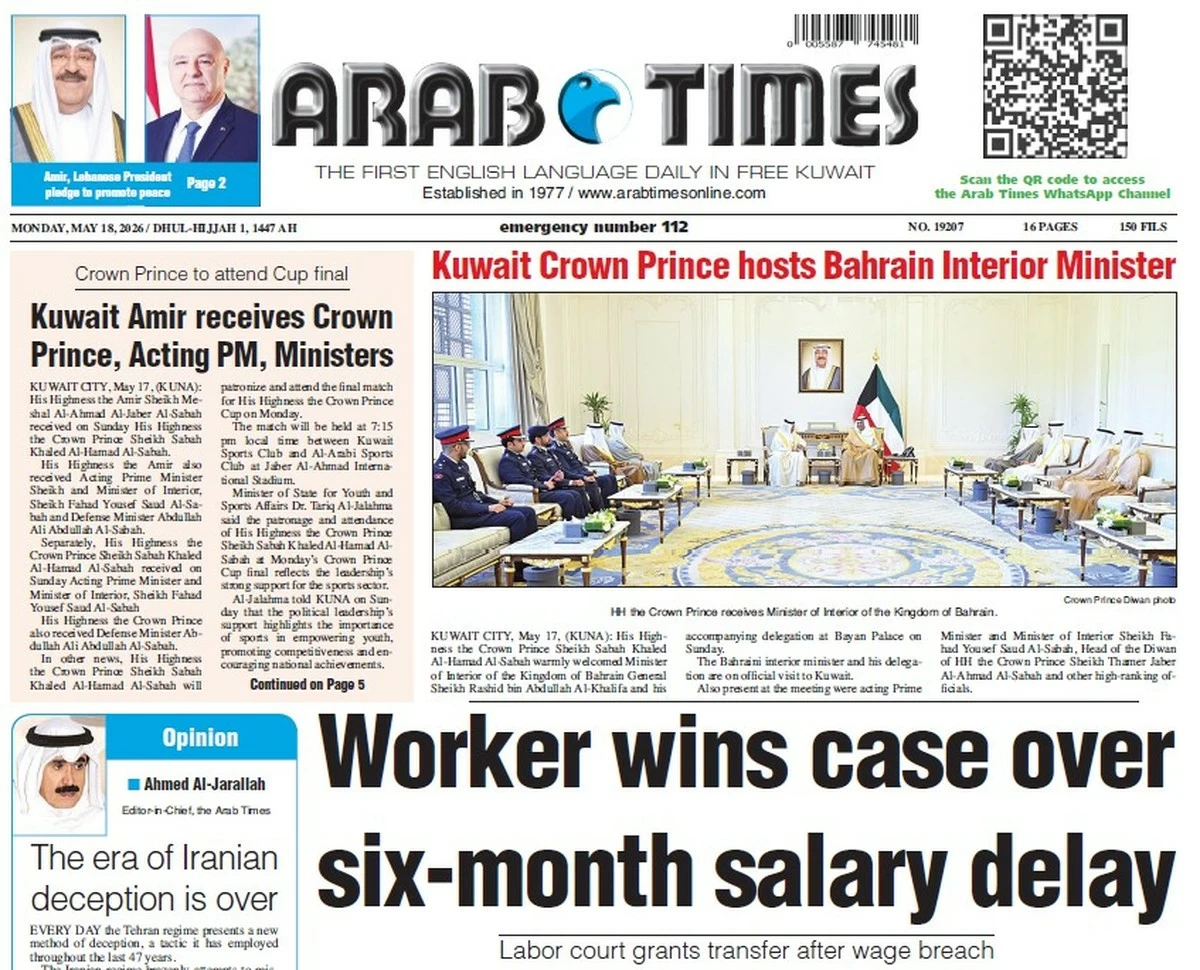
Every day, the Tehran regime presents a new method of deception, a tactic it has employed throughout the last 47 years. The Iranian regime brazenly attempts to mislead its own public and obscure the truth about its relations with the regional countries. The regime accepts the facts while claiming it is under attack from neighboring countries.
Recently, the Kuwaiti army intercepted a group linked to the Revolutionary Guard - more accurately, high-ranking officers - attempting to infiltrate Boubyan Island, which resulted in a confrontation with the island’s security forces. Instead of addressing the incident directly, Iran’s Foreign Minister rushed to threaten Kuwait, claiming those individuals were fishermen, and demanding their release.
Looking back at events since 1979, it has always been evident that the Iranian expansionist regime has sought to destabilise the region and export its so-called revolution, which is why it planted its cells in all the Gulf states. These facts are well-known. The argument has always been that the Gulf states are hostile to Iran, when the opposite is true. In reality, the Gulf states have sought to open channels of dialogue with Tehran over the past decades, undertaking numerous visits and demonstrating considerable goodwill.
What has been the result? The result has been bombings, attacks, and assassination attempts in the Gulf states, with Iran claiming they were perpetrated by non-Iranian actors. However, overwhelming evidence and undeniable testimonies confirm that Iran has been responsible for these attacks.
Therefore, the statement of Abbas Araghchi was misleading. He was also aiming to mislead when he said diplomacy is the only solution to the region’s problems with Iran. In the recent war, Tehran revealed its ugly face and malicious intentions towards the people of the Gulf. Araghchi is trying to absolve himself of a long history of systematic aggression against the Gulf states by offering flimsy excuses.
Therefore, if we were to accept Araghchi’s statement, he must understand that two wrongs do not make a right. This will not produce the right outcome. If Iran wants sound and healthy relations with the Gulf states, it must acknowledge all the criminal acts it has committed against the region over the past 47 years, especially the crimes committed during the last war. Iran must agree to pay reparations, and then it must strive to build trust between the two parties.
In reality, Tehran cannot achieve this, as it would require changing its existing political doctrine of exporting the revolution, which implies expansion, and establishing sectarian regimes based on the theory of “Welayat Al-Faqih” (Guardianship of the Jurist), a doctrine upheld by the mullahs’ regime. We must remember that over the past five decades, the regime has raised numerous slogans and practiced terrorism around the world, from Latin America to its immediate surroundings.
The Iranian regime has been extremely rigid in its calculations, while the latest round of war has been portrayed as largely rhetorical in nature and aimed at local audiences, and the strength of the internal front in Iran is eroding. The recent war weakened Iran’s fake image of power, leaving only remnants in the hands of its proxy forces, which are now on the verge of collapse. With the Iranian regime having lost the trust of the Gulf states, it is signing its own death warrant. The Iranian regime has nothing left to lose, due to which it is escalating its sabotage operations to avoid further losses in the region.
The only remaining solution is to punish the Iranian regime by breaking its back. For 2,000 years, the Persians have been known for their stubbornness and persistence in following the wrong path, irrespective of the cost. The world today cannot wait indefinitely, especially given the current fragile economic situation. Therefore, a more decisive approach is now more urgent than ever. Everyone must understand that the era of Iranian deception is over. The world must understand the true nature of this terrorist regime.