

Monday, November 09, 2026
 
search-icon
search-icon
close-icon

Support Arabs who won seats in the US Congress

publish time

09/11/2026

publish time

09/11/2026

Support Arabs who won seats in the US Congress
Add as Preferred Source on Google

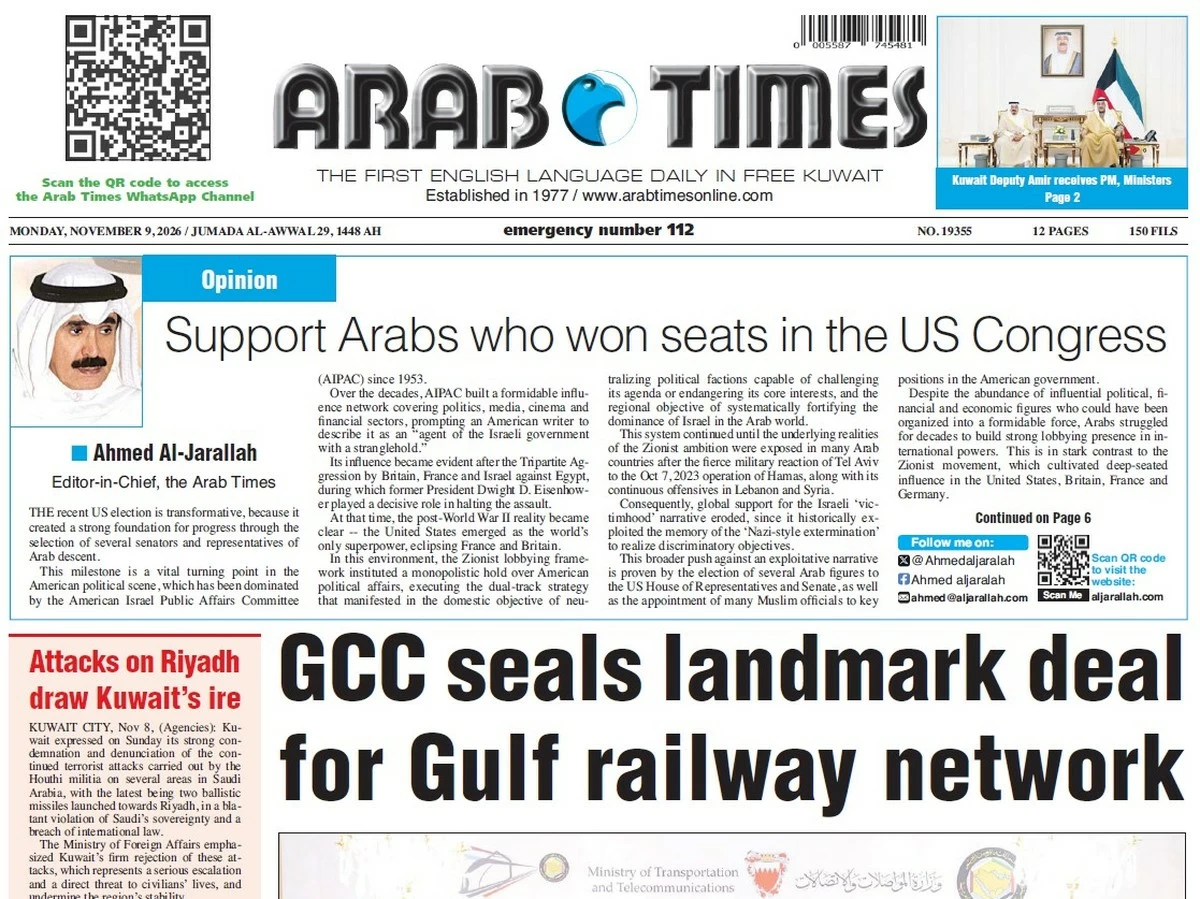
The recent US election is transformative because it created a strong foundation for progress through the selection of several senators and representatives of Arab descent. This milestone is a vital turning point in the American political scene, which has been dominated by the American Israel Public Affairs Committee (AIPAC) since 1953. Over the decades, AIPAC built a formidable influence network covering politics, media, cinema and financial sectors, prompting an American writer to describe it as an “agent of the Israeli government with a stranglehold.” Its influence became evident after the Tripartite Aggression by Britain, France and Israel against Egypt, during which former President Dwight D. Eisenhower played a decisive role in halting the assault. At that time, the post-World War II reality became clear -- the United States emerged as the world’s only superpower, eclipsing France and Britain. In this environment, the Zionist lobbying framework instituted a monopolistic hold over American political affairs, executing the dual-track strategy that manifested in the domestic objective of neutralizing political factions capable of challenging its agenda or endangering its core interests, and the regional objective of systematically fortifying the dominance of Israel in the Arab world.

This system continued until the underlying realities of the Zionist ambition were exposed in many Arab countries after the fierce military reaction of Tel Aviv to the Oct 7, 2023 operation of Hamas, along with its continuous offensives in Lebanon and Syria. Consequently, global support for the Israeli ‘victimhood’ narrative eroded, since it historically exploited the memory of the ‘Nazi-style extermination’ to realize discriminatory objectives. This broader push against an exploitative narrative is proven by the election of several Arab figures to the US House of Representatives and Senate, as well as the appointment of many Muslim officials to key positions in the American government. Despite the abundance of infl uential political, fi- nancial and economic figures who could have been organized into a formidable force, Arabs struggled for decades to build strong lobbying presence in international powers. This is in stark contrast to the Zionist movement, which cultivated deep-seated infl uence in the United States, Britain, France and Germany

Furthermore, individuals of Arab descent, who attained public office in the US Congress, French Parliament, British House of Commons or legislative bodies in Canada and Germany, did so through personal initiative and independent effort. They did not receive support from the Arab League or Arab governments. The historical trajectory of the region -- from 1967 to the present -- shows a painful truth: regional bodies dedicated to collective Arab action functioned as a ‘vocal phenomenon’, prioritizing empty rhetoric over substantive and reliable impact.

Till date, organizations like the Arab League limited their role to releasing repetitive statements of “concern.” Nonetheless, the current US electoral landscape offers a vital opportunity to seriously pursue the creation of a dedicated ‘Arab lobby’ in the United States and other global capitals. Leading Arab states or the transformed Arab League should push for this strategic initiative. The creation of an Arab ‘lobby’ within the international powers is an achievable goal, given the shared vision for the future of collective Arab action. The formation of such a lobbying group is now imperative, considering it will serve as a vital counterweight to Zionism, which caused widespread disruption in the Arab region in particular, and the entire world in general. The present realities of the Arab world are the undeniable proof of this necessity. Arab nations must stop acting as passive viewers of the unfolding developments even if they have significant potential and resources.