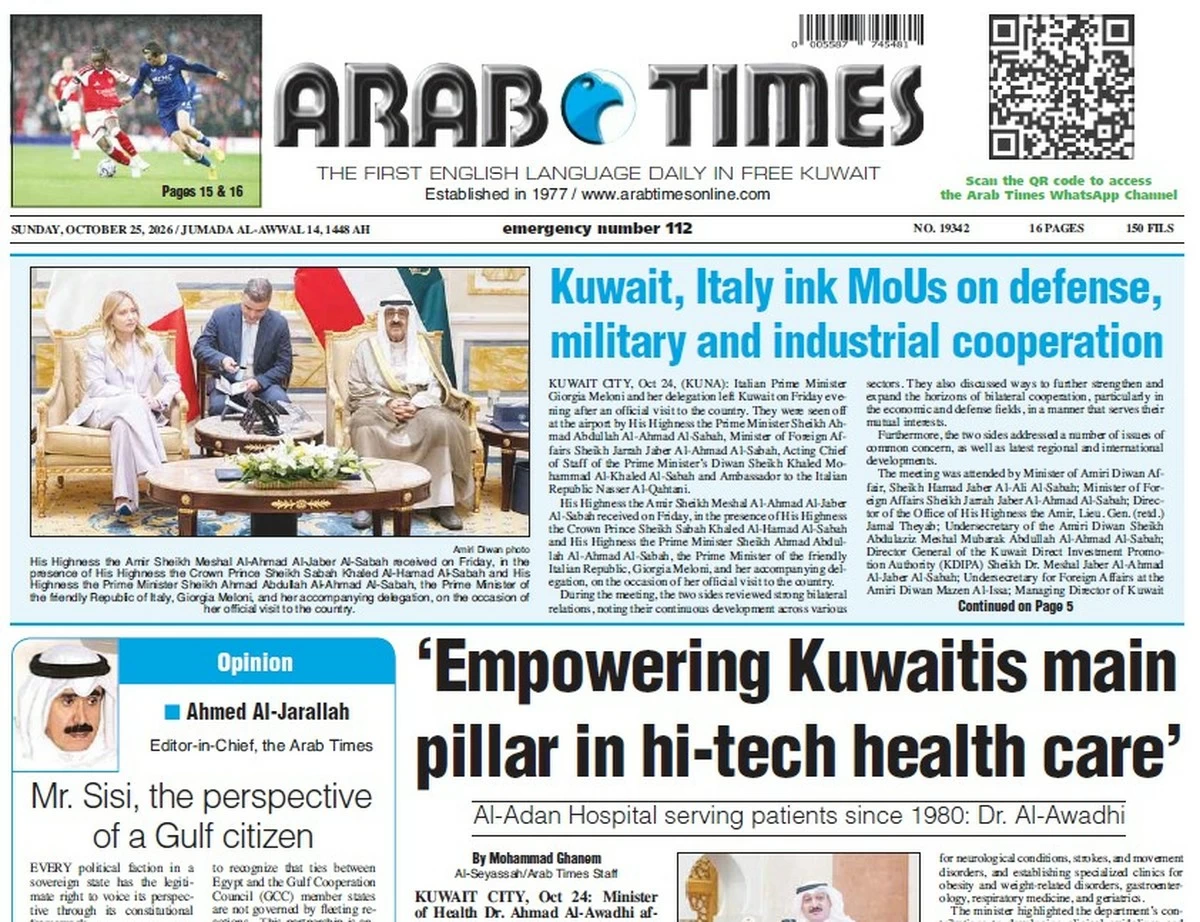



Every political faction in a sovereign state has the legitimate right to voice its perspective through its constitutional framework. In the same manner, certain political groups in Egypt have the right to convey to President Abdul Fattah El-Sisi their opposition to accepting assistance from the Gulf nations or even to express a preference for alignment with Iran. While these groups have their own stance, there are alternative viewpoints regarding the diplomatic ties between our nations that are equally deserving of consideration. If a certain segment opts to decline Gulf support, which is extended amidst the ongoing conflict driven by Iran and its regional proxies, it remains their sovereign choice.
Consequently, President El- Sisi should not be blamed for his position, as he acted strictly within the constitutional parameters of his nation. It is important to recognize that ties between Egypt and the Gulf Cooperation Council (GCC) member states are not governed by fleeting reactions. This partnership is anchored on the shared strategic imperatives regarding Egyptian and Gulf national security. This relationship remains exceptionally strong and deeply rooted. Our societies have grown closely connected through a rich history of cultural exchange— shaped by the Egyptians who relocated to the Gulf for employment and educational contributions, as well as Gulf students who pursued their academic endeavors in Egypt.
Reinforced by widespread familial bond and intermarriage, these enduring ties created an unbreakable alliance that withstands any challenge. The historical trajectory of relations with Egypt maintains a steady and reliable rhythm. Ties between Cairo and Gulf capitals have never suffered a complete breakdown. Even during the relocation of the Arab League headquarters to Tunis, the connection between the citizens of the Gulf and Egypt endured. Whether or not the Egyptian Parliament endorses support for the Gulf states in this imposed conflict, our nations will remain fully capable of defending themselves, exercising the collective resolve of Saudi Arabia and other Gulf countries against aggressors, thereby, prevailing in the end. Everyone must fully understand this truth, particularly those who resist the assistance of our countries.
Furthermore, the enduring kinship connecting our populations to the Egyptian people far transcends the transient political maneuvers of certain Egyptian groups. It is equally necessary to recognize the significant milestones that President Abdul Fattah El-Sisi has delivered for Egypt over the past 12 years, specifically the modernization of national infrastructure and strengthening diplomatic ties. Locally, he put about 17 trillion Egyptian pounds in investments, hence, raising the living standards of the Egyptians. These development efforts include extensive upgrades of the transportation networks and roadways and the construction of hundreds of thousands of residential units.
Looking ahead, the gross domestic product (GDP) growth of Egypt is on track to reach around 5.1 percent by the end of the 2025/2026 fiscal year. This expansion is a manifestation of the remarkable recovery of a country that previously endured years of widespread crises affecting every sector of society. This remarkable progress was made through the continuous support that the Gulf nations provide to Egypt. In response, Cairo is keen on solidifying its ties with these countries. The military salute of the Egyptian Armed Forces to Kuwait, Saudi Arabia, and other Gulf nations is a powerful symbol of how the leader of Egypt views the interconnected future of these seven states. Moreover, one must realize that modern warfare has totally changed, moving away from the conventional mobilization of massive troop concentrations. In an era of drones, guided missiles and advanced systems, engagements are directed from computer terminals before blue monitors by personnel stationed anywhere from California and Washington to Riyadh and Cairo. As a result, assistance can manifest as diplomatic or moral advocacy, or through the dispatch of a modest military contingent.
Any Arab who holds fast to the Quranic verse, “Indeed, God loves those who fight for His cause in a row, as though they are a structure joined firmly,” recognizes that the ongoing struggle will not remain contained within the boundaries of a single land. This truth ought to be fully evident to all Arab, Egyptian and Gulf citizens. Those in Parliament—whether they backed or opposed President El-Sisi’s request—can take comfort in knowing that the destiny of nations and the deep ties connecting brotherly states are never determined by transient crises or isolated choices made by those who lacked the complete picture at the time. The relationship between Egypt and the Gulf remains remarkably resilient. The revival and strength of Egypt are considered a resurgence for the GCC nations, transcending the interests of the Egyptian public alone. For decades, Egypt endured severe hardships, including four wars initiated during Gamal Abdel Nasser’s tenure that resulted in defeat.
Without the late President Anwar Sadat’s leadership in achieving victory over Israel and establishing peace, the nation would have easily fallen into ruin. Therefore, the Gulf’s dedication to supporting Egypt is an investment in its own long-term interests. Lastly, to President Abdul Fattah El-Sisi—who recently declared that he will step down by 2030—we offer our blessings. You serve your homeland faithfully, making Egypt fully equipped to overcome future challenges. Regarding those who decline to stand with the Gulf states, that is entirely their prerogative and it has no weight. The peoples of the Gulf have the capability to accomplish remarkable feats and may not need support from Egypt. President El-Sisi, the people of Egypt will not go hungry, but let us proceed with measured and steady steps. God is ever forbearing toward His servants.