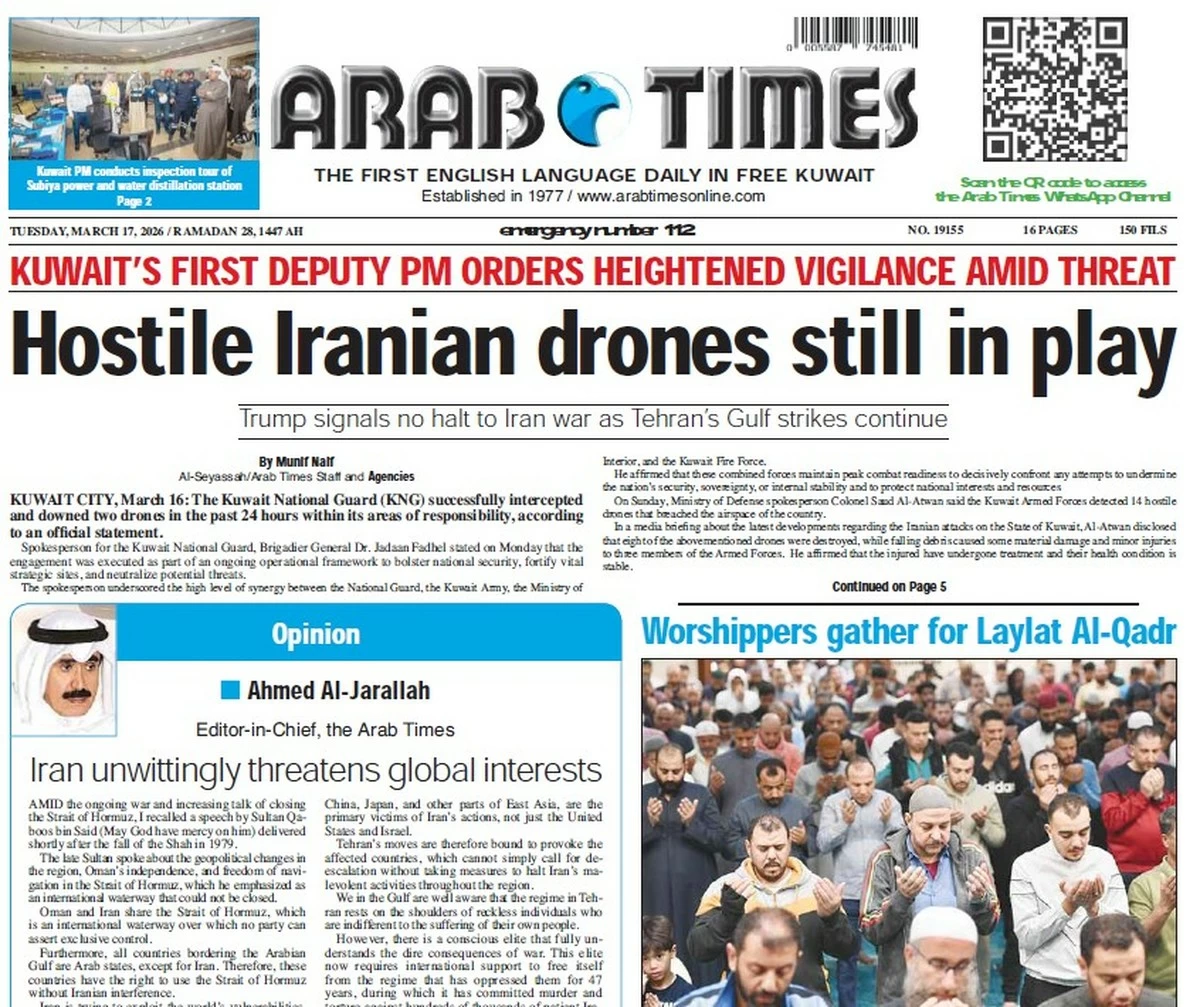




Amid the ongoing war and increasing talk of closing the Strait of Hormuz, I recalled a speech by Sultan Qaboos bin Said (May God have mercy on him) delivered shortly after the fall of the Shah in 1979. The late Sultan spoke about the geopolitical changes in the region, Oman’s independence, and freedom of navigation in the Strait of Hormuz, which he emphasized as an international waterway that could not be closed. Oman and Iran share the Strait of Hormuz, which is an international waterway over which no party can assert exclusive control.
Furthermore, all countries bordering the Arabian Gulf are Arab states, except for Iran. Therefore, these countries have the right to use the Strait of Hormuz without Iranian interference. Iran is trying to exploit the world’s vulnerabilities, but there is no doubt that the price it will pay, now and in the future, will be enormous. Approximately 20 percent of the world’s oil passes through the Strait of Hormuz daily, along with vital regional supply chains. It would be reckless for Tehran to attempt to close the strait unless it is willing to sacrifice the Iranian people, who have suffered poverty and famine since 1979. The Iranian people are capable of achieving miracles if granted freedom, free from the control of a regime still clinging to prehistoric illusions.
Meanwhile, the world will not allow this malevolent regime to exert pressure by threatening to close a vital waterway like the Strait of Hormuz. The international community is currently facing its worst economic crisis since World War II, and current conditions are on the verge of triggering a global recession. The world does not need further crises.
All countries must act to stop Iran’s aggression in this crucial waterway to prevent the closure of the Strait of Hormuz from becoming a reality. If Iran is allowed to control the Strait, it could potentially grant any country the right to close it at will. It is obvious that European countries, along with China, Japan, and other parts of East Asia, are the primary victims of Iran’s actions, not just the United States and Israel.
Tehran’s moves are therefore bound to provoke the affected countries, which cannot simply call for de-escalation without taking measures to halt Iran’s malevolent activities throughout the region. We in the Gulf are well aware that the regime in Tehran rests on the shoulders of reckless individuals who are indifferent to the suffering of their own people.
However, there is a conscious elite that fully understands the dire consequences of war. This elite now requires international support to free itself from the regime that has oppressed them for 47 years, during which it has committed murder and torture against hundreds of thousands of patient Iranian citizens.
This regime is unacceptable to its neighbors, particularly after it launched attacks on neighboring countries despite their repeated assurances that their territories would not be used for attacking Iran. I will not recount here the hostile acts the Iranian regime has carried out against the Gulf Cooperation Council countries from 1979 to the present.
We must recall what Tehran declared in 2011, when the then-commander of the Revolutionary Guard, Mohammad Ali Jafari, threatened to close the Strait of Hormuz, saying, “Stopping navigation in the Strait of Hormuz would be easier than drinking a glass of water.” Since then, the world should have developed a strategy to prevent Iran from taking such actions. It is not too late, however. Holding the Iranian regime accountable has become a necessity, and its removal would benefit both the region and the world.