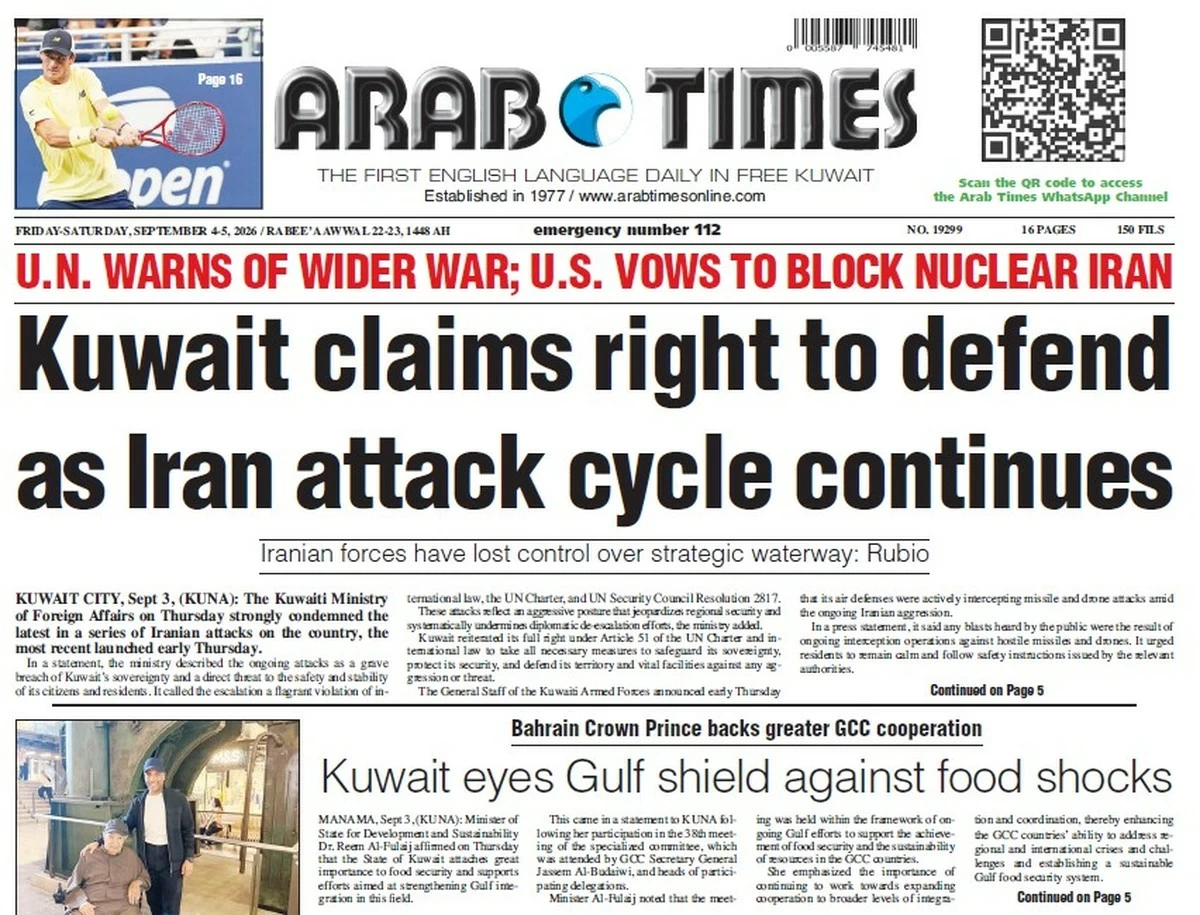



When the sirens wailed in Kuwait the night before last, I recalled Iranian President Masoud Pezeshkian’s apology to the Arabian Gulf states. I also remembered how the Revolutionary Guard retracted that apology within a few hours. This attitude reflects the current state of Iran, and indeed has reflected it for a long time.
Since 1979, this large country has become a multiheaded entity. Iran has not prioritized good-neighborly relations due to its arrogance and expansionist tendencies based on a centuries-old ideology. The Iranian expansionist strategy relies on religious and ideological influence over other countries’ populations. It appears that the Iranian mind is oblivious to the developments the world has witnessed since the Middle Ages. The sectarian Iranian mind, ruled by a group of madmen, thinks they own the world and can do whatever they please.
The ongoing Iranian bombardment of the Gulf states is part of the terrorist regime’s plan, which it has pursued for 47 years, up to the last war. Iran’s objective is not to bomb the United States, which it calls the “Great Satan”, nor Israel, which it calls the “Little Satan.”
The Iranian regime is working to achieve strategic integration between the two parties. While Israel strives to achieve its vision of a “Greater Israel,” Iran seeks complete control over the region to revive its ugly dream of the alleged “glories of the Persian Empire,” which vanished some 1,350 years ago. Because Iran is governed by multiple heads, each faction works according to its own interests. This indicates a lack of internal consensus. This was observed in the Islamabad negotiations, where the Iranian delegation included more than seventy people, each spying on the others and each with their own opinion.
This also applies to current indirect negotiations and the delay in responses to American messages, which can take several days, as the true decision-maker is absent. This situation is so dangerous that chaos could erupt in the region at any moment, especially amid Iran’s continued threats to close the Bab el-Mandeb Strait and the Strait of Hormuz. This would undoubtedly exacerbate the international economic crisis and increase global inflation.
The continuation of this precarious situation is pushing countries to seek solutions to avoid further losses Frankly, the Arabian Gulf states are not the only ones affected. According to strategic assessments, the Gulf states are among the least affected, as Europe and other regions are expected to be more severely impacted by fluctuations in oil and gas prices, as well as raw materials that contribute to global food security. The world must realize that Iran is pursuing a systematic policy of starvation.
According to the Food and Agriculture Organization of the United Nations (FAO), the current unrest threatens approximately 363 million people with acute hunger, including 45 million at risk of immediate famine. This means that Iran’s terrorist practices do not threaten just one country, but the entire world. Everyone must confront the Iranian threat of causing millions of people to face starvation and exerting further pressure to disrupt the global economy. The world must recognize the fact that engaging with Iran through diplomatic frameworks is like the Arabic proverb: “When a thief is asked to take an oath, he replies, ‘Relief has come!’”
The world must confront the rogue Iranian regime, which never ceases to threaten nations. The world must punish the Iranian regime so that Iran returns to democratic, civilian governance and so that the region, as well as the entire world, can dispose of this terrorism. Finally, may God bless the efforts of the Kuwaiti armed forces that dealt with the recent attack on Kuwait International Airport. I wish a speedy recovery to the wounded and pray that God have mercy on the civilian martyr who fell in the aggression.