


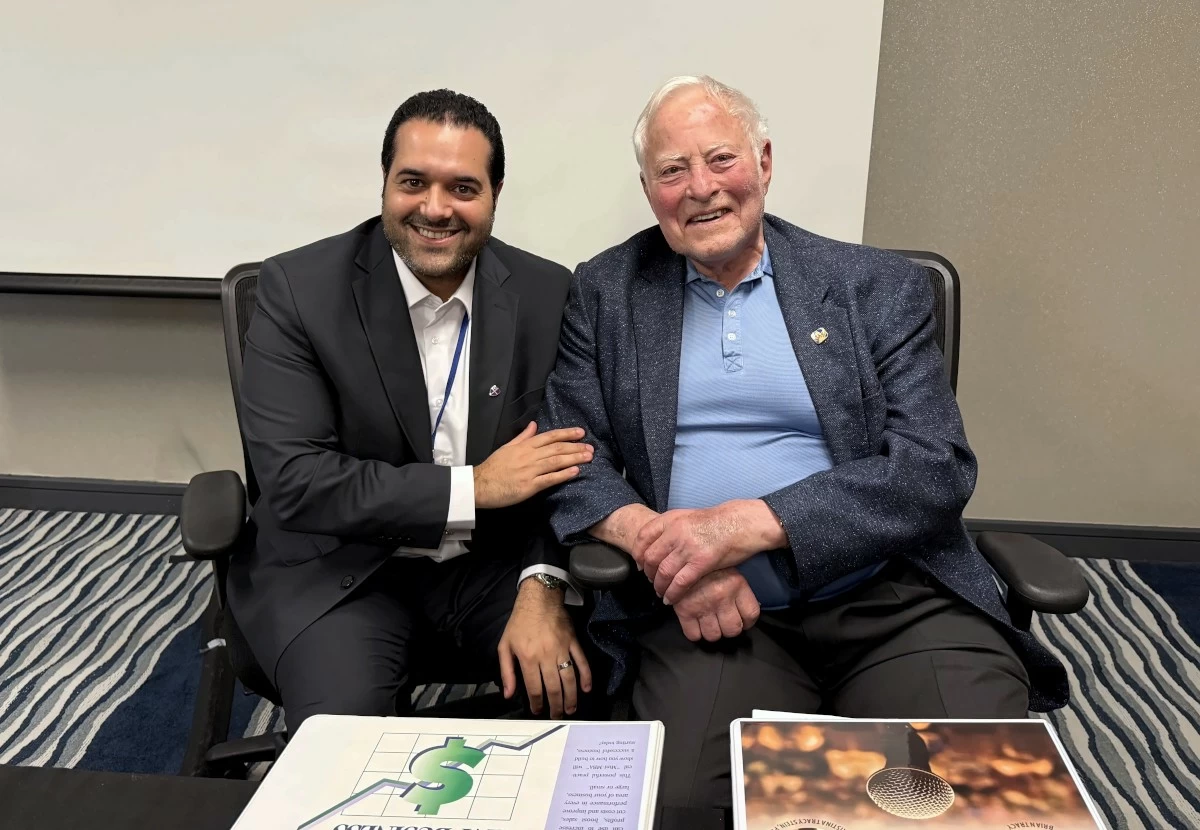
During a visit to Brian Tracy’s home in San Diego, I noticed a copy of the Qur’an in his study. I asked him about it. He explained that he found its storytelling inspiring and drew lessons and wisdom from sacred books.
I have been thinking about that conversation since Andrew Phillips, Managing Director of Brian Tracy Solutions, told us that Brian had passed away peacefully, surrounded by his family. It captured something I admired about him: a continuing curiosity about people, ideas and the stories through which we understand our lives.
Before meeting Brian, I had spent considerable time with his books and programmes, including courses through Brian Tracy University. Attending his Speaking Academy in San Diego in 2025 brought those lessons into a more personal setting. I came to know his wife, Barbara, and his daughter, Dr. Christina, and had the opportunity to spend time with him beyond the classroom. Those encounters are now memories I treasure.
People knew Brian for his teaching on achievement, productivity, leadership, selling and time management. The lesson that stayed with me most was the importance he gave to peace of mind. It belonged at the centre of a successful life, alongside the goals we worked so hard to achieve.
For someone working in law, training and business, that lesson matters. There is always another deadline, another difficult decision, another ambition. It is easy to postpone contentment until everything has been resolved. Brian encouraged me to think about the life I was creating while pursuing those goals. What would achievement mean if I could never feel at peace with myself?
His teaching often began with simple words: “I like myself.” “I can do it.” “I am responsible.” “I am unstoppable”. He encouraged people to repeat constructive messages until they became familiar habits. I understood their value through the choices they encouraged: approaching a challenge with confidence, recognising my own responsibility, and being more deliberate about how I responded to others.
Taking responsibility was especially important. Circumstances can be unfair, and much lies beyond our control. Yet we still have decisions to make about our preparation, our conduct and our next step. That was how I came to understand his message. It brought my attention back to what I could actually do.
He was equally practical about goals. Decide what matters. Write it down. Give it your attention and make time for it. His lessons made me ask whether a busy day had produced something useful, and whether my time had brought value to someone else. They also encouraged me to be more thoughtful about the conversations and relationships to which I gave my energy. As he said wisely “time is an opportunity to contribute”.
What made these ideas memorable was his gift for storytelling. He could explain a principle through a story so clearly that you would recognise it later in your own experience. You remembered the story, and with it, something you could use. The conversation about the Qur’an felt entirely consistent with that gift and his interest in wisdom wherever he encountered it.
My heartfelt condolences go to Barbara, Dr Christina, Catherine, Michael and David, and to Andrew Phillips, my dear friend Medhet Zaki, and the teams who worked with him.
Those of us who learned from Brian have a responsibility now: to put those lessons into practice and share them carefully with others. I hope to honour him through teaching that remains useful to people in their work and their lives.
I will miss our conversations, Brian. Thank you for the knowledge, the encouragement and the kindness. May God have mercy on you. What you taught us will continue to help others.
Dr Fawaz Khaled Alkhateeb