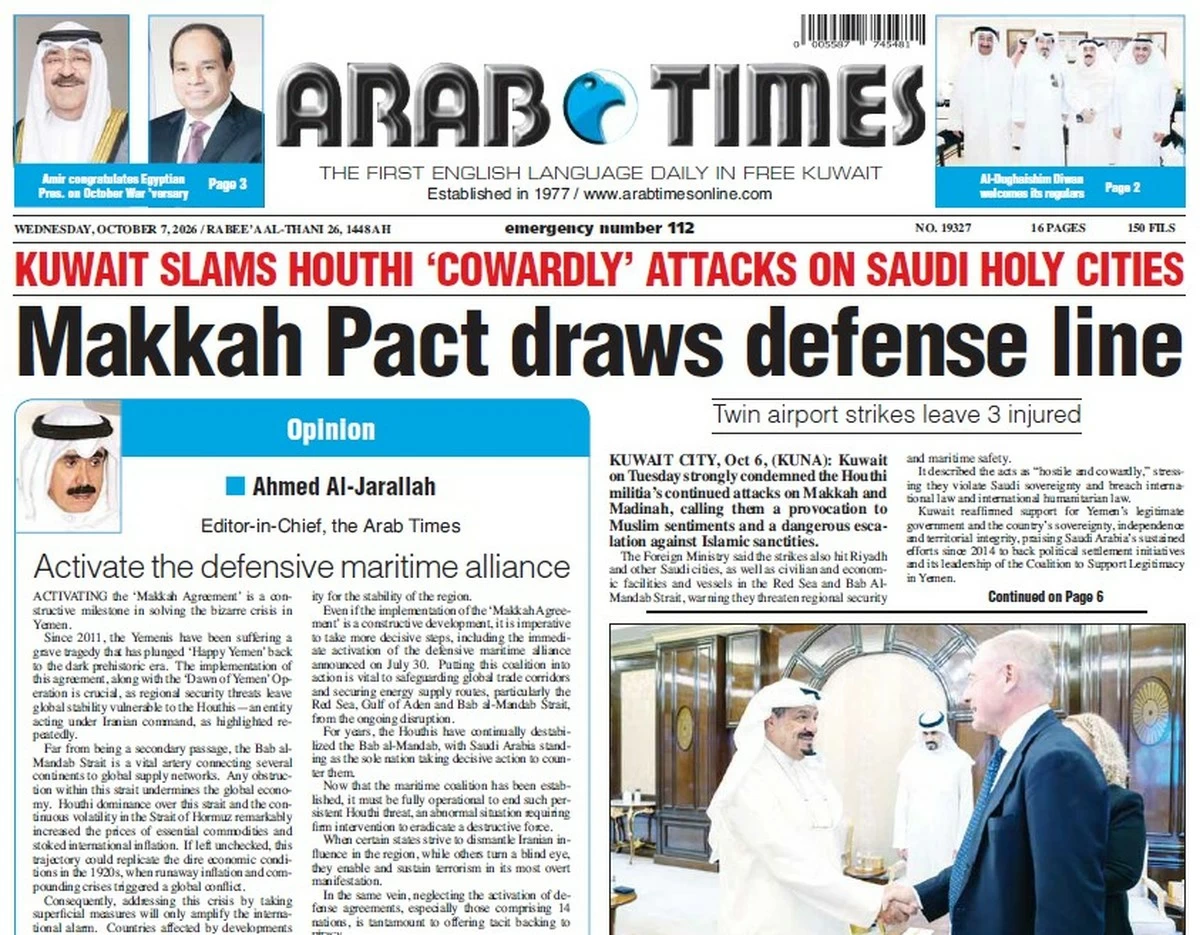





Activating the ‘Makkah Agreement’ is a constructive milestone in solving the bizarre crisis in Yemen. Since 2011, the Yemenis have been suffering a grave tragedy that has plunged ‘Happy Yemen’ back to the dark prehistoric era. The implementation of this agreement, along with the ‘Dawn of Yemen’ Operation, is crucial, as regional security threats leave global stability vulnerable to the Houthis—an entity acting under Iranian command, as highlighted repeatedly.
Far from being a secondary passage, the Bab al- Mandab Strait is a vital artery connecting several continents to global supply networks. Any obstruction within this strait undermines the global economy. Houthi dominance over this strait and the continuous volatility in the Strait of Hormuz have remarkably increased the prices of essential commodities and stoked international inflation.
If left unchecked, this trajectory could replicate the dire economic conditions in the 1920s, when runaway inflation and compounding crises triggered a global conflict. Consequently, addressing this crisis by taking superficial measures will only amplify the international alarm. Countries affected by developments in Bab al-Mandab and the Yemeni theater must intervene to stop the actions of the Houthis and their Iranian sponsors. Diplomatic rhetoric and formal denunciations are inadequate, as words alone cannot restore lost lives, reclaim occupied land or alleviate starvation. Saudi Arabia continues to serve as an unyielding bulwark against Iranian aggression.
Along with its partners in other Gulf Cooperation Council (GCC) states, the Kingdom has shouldered a huge burden in countering the Houthis since 2015. Yet, it is unreasonable to expect Saudi Arabia to single-handedly resist a campaign that jeopardizes the economic, military, social and religious fields in the region. Meanwhile, nations benefiting from the vital maritime passages limited their response to declarations, behaving as though they do not bear any responsibility for the stability of the region. Even if the implementation of the ‘Makkah Agreement’ is a constructive development, it is imperative to take more decisive steps, including the immediate activation of the defensive maritime alliance announced on July 30. Putting this coalition into action is vital to safeguarding global trade corridors and securing energy supply routes, particularly the Red Sea, Gulf of Aden and Bab al-Mandab Strait, from the ongoing disruption.
For years, the Houthis have continually destabilized the Bab al-Mandab, with Saudi Arabia standing as the sole nation taking decisive action to counter them. Now that the maritime coalition has been established, it must be fully operational to end such persistent Houthi threat, an abnormal situation requiring firm intervention to eradicate a destructive force. When certain states strive to dismantle Iranian influence in the region, while others turn a blind eye, they enable and sustain terrorism in its most overt manifestation. In the same vein, neglecting the activation of defense agreements, especially those comprising 14 nations, is tantamount to offering tacit backing to piracy.
This dynamic mirrors the instability that overtook Somalia after 1991, when pirate networks dominated the Somali coastline, Gulf of Aden and Indian Ocean. Today, similar maritime threats are emerging due to the failure to manage the Houthi crisis. If global leaders are genuinely committed to safeguarding international shipping lanes, they must face this reality. If their policies legitimize maritime piracy, they are acting against their own interests and those of their citizens—a path where no party prevails.