



22/07/2026

Share:
22/07/2026
Share:

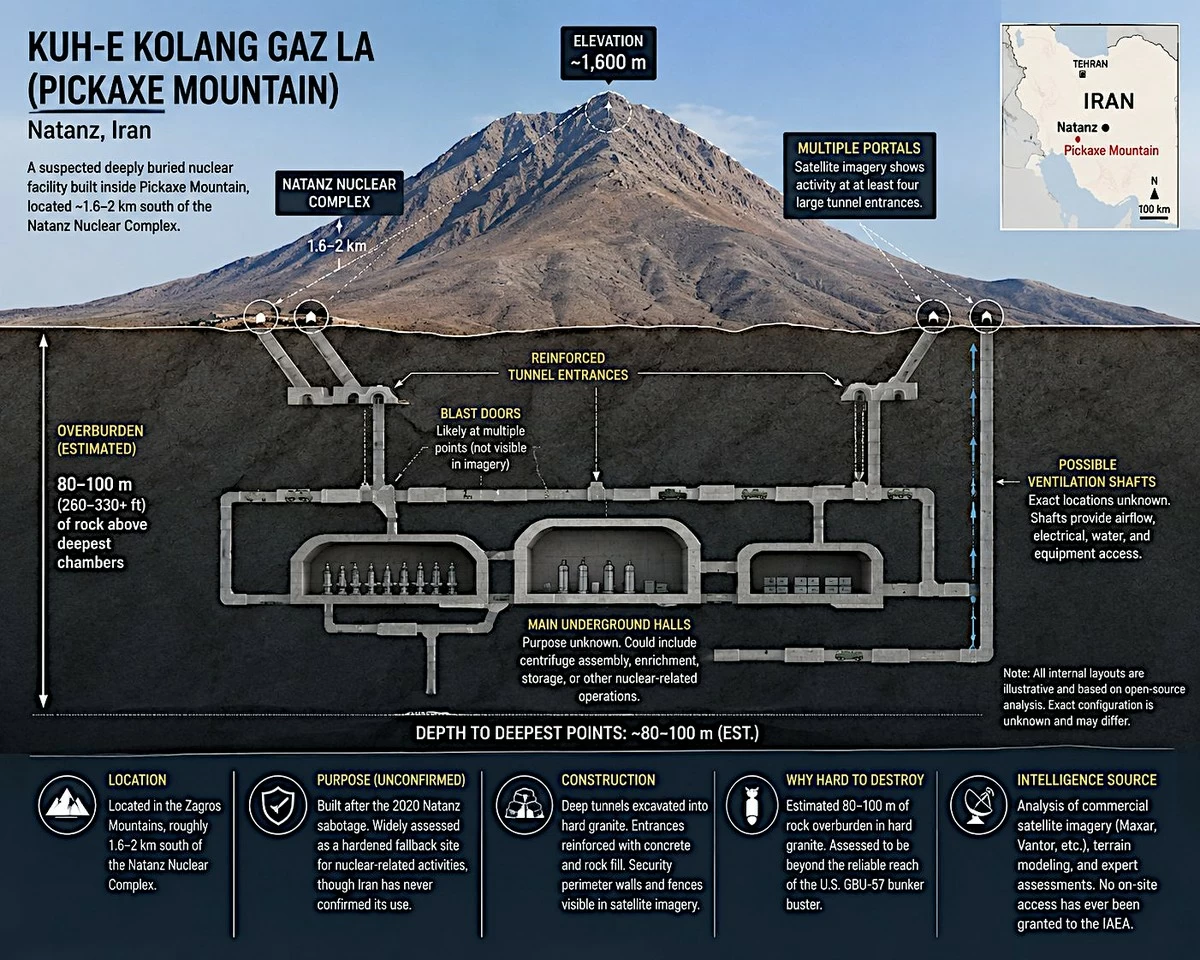

WASHINGTON/TEHRAN, Jul 22: US President Donald Trump has renewed threats to target Iran’s heavily fortified Pickaxe Mountain nuclear facility, a suspected underground site believed by Israel to contain parts of Tehran’s enriched uranium stockpile and advanced centrifuge technology.
“We’ll be hitting that area very probably pretty soon. And there’s not a thing they can do about it,” Trump said on Tuesday, referring to the underground facility.
Iran responded by warning that any US attack on its nuclear sites would be considered an expansion of the ongoing conflict and could trigger further regional escalation, state media reported.
What Is Pickaxe Mountain?Pickaxe Mountain, also known as Kuh-e Kolang Gaz La, is a deeply buried and highly protected facility located near Iran’s Natanz uranium enrichment complex in central Iran.
The site is believed to be located at least 100 metres (328 feet) underground, beneath a mountain that provides natural protection against air attacks. Its depth and fortifications make it one of the most difficult potential targets for US or Israeli forces.
According to nuclear security analysts, construction of the facility began in 2020 after Iran informed the International Atomic Energy Agency (IAEA) that the site would be used for centrifuge assembly.
However, the facility remains largely secretive, with no publicly available detailed blueprints. Experts have relied mainly on satellite imagery, which indicates the presence of tunnel networks, security zones and reinforced entrances designed to withstand attacks.
Suspected Nuclear RoleThe exact purpose of Pickaxe Mountain remains unclear.
The facility is not believed to be fully operational, but analysts say construction activity has increased following previous US and Israeli strikes on Iran’s nuclear infrastructure.
Experts have suggested several possible explanations for the expanded activity, including:
- Production or storage of advanced centrifuges
- Relocation of operations from damaged nuclear facilities
- Development of a concealed uranium enrichment capability
The Center for Strategic and International Studies (CSIS) has said the site could represent an effort by Iran to preserve parts of its nuclear programme following attacks on other facilities.
Concerns Over Enriched Uranium StockpileIsraeli intelligence officials believe Iran moved some of its highly enriched uranium stockpile and advanced centrifuges to Pickaxe Mountain after previous strikes on nuclear facilities, according to reports.
During a 12-day conflict, Israel targeted Iran’s nuclear sites at Natanz, Isfahan and Fordow, while the United States later carried out additional strikes using powerful bunker-penetrating weapons.
Trump previously claimed those attacks had “obliterated” Iran’s nuclear capabilities, but later assessments by US and international intelligence agencies suggested parts of Iran’s nuclear programme survived.
The US and Israel have since focused on Iran’s estimated stockpile of nearly 1,000 pounds of highly enriched uranium, seeking either its removal or destruction.
Trump Questions Intelligence ReportsWhen asked whether Iran had moved advanced centrifuges to Pickaxe Mountain, Trump said the US did not have confirmed evidence.
“We don’t have it on record,” he said.
Iran has denied allegations of secret nuclear activities at the site, with Iranian officials insisting that the country’s nuclear programme is designed only for peaceful energy purposes.
Tehran says it plans to expand nuclear power generation to meet domestic electricity needs and increase oil exports.
Regional Tensions RiseAny strike on Pickaxe Mountain could mark a major escalation in the confrontation between Washington and Tehran due to the facility’s suspected role in Iran’s nuclear programme.
The threat comes as tensions continue to rise across the Middle East, with both sides exchanging military strikes and diplomatic efforts remaining uncertain.