



28/04/2026

Share:
28/04/2026
Share:

BEIJING, Apr 28: China is accelerating large-scale efforts to combat desertification, transforming vast stretches of barren land into stabilized ecosystems and expanding its environmental technologies abroad, according to officials and field reports.
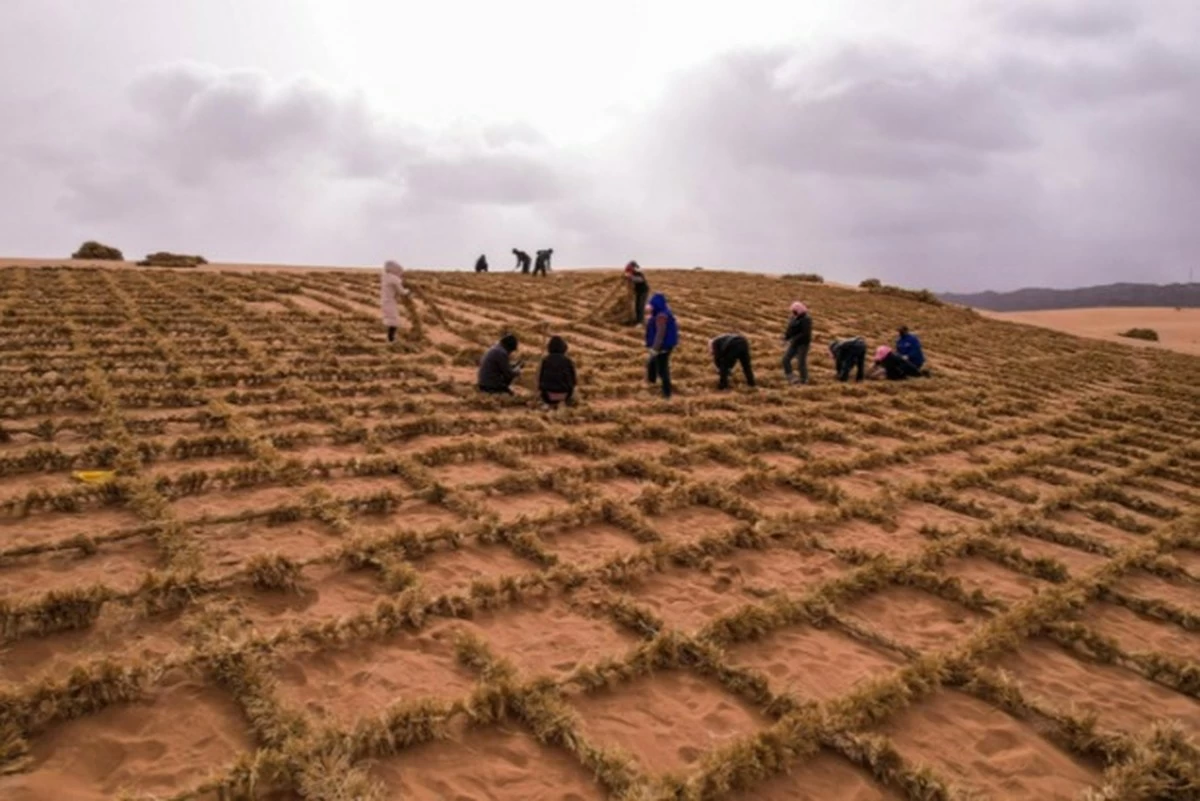
On the southeastern edge of the Tengger Desert, workers in Ningxia Hui Autonomous Region are reinforcing sand dunes using a newly developed grass grid barrier system. Forestry engineer Tang Ximing said the updated technique, which uses straw rope laid in a checkerboard pattern, is faster to install, less labor-intensive, and lasts up to five to six years.
The method builds on a technique first developed in the 1950s in Zhongwei to protect the Baotou–Lanzhou Railway from shifting dunes. Over decades, continuous ecological efforts have helped Ningxia become the first provincial-level region in China to reverse desertification in parts of its territory.

China’s broader anti-desertification drive is anchored by the massive Three-North Shelterbelt Forest Program, launched in 1978. Covering northern, northwestern, and northeastern regions—often referred to as the “three-north” area—the initiative is the world’s largest afforestation project. Officials say about 53% of treatable degraded land has now been effectively managed, contributing significantly to global greening trends.
Beyond ecological restoration, the effort is also reshaping local economies. In Inner Mongolia Autonomous Region, agricultural waste from windbreak trees is being converted into biomass pellets with high energy value, creating new income streams and jobs for rural communities.
Similar developments are emerging across desert-border regions. In Ningxia, solar energy projects and desert tourism are turning previously barren dunes into revenue-generating assets, while in Gansu Province, farmers are cultivating desert-adapted crops such as Cistanche and desert onions, supported by more than 100 sand-control enterprises.
China is also expanding its expertise internationally under the United Nations Convention to Combat Desertification framework. Through training programs in Yinchuan, specialists from across Asia, Africa, and Latin America are being trained in desert control techniques, with nearly 100 professionals trained annually.
In Central Asia, Chinese-developed quinoa varieties are being tested on saline-alkali soils in Kazakhstan’s Almaty region, with research showing improved soil fertility and reduced water usage. Cooperation is also expanding to countries such as Uzbekistan and Egypt under broader Belt and Road ecological initiatives.
China has further contributed expertise to international projects, including Mongolia’s “One Billion Trees” initiative and Saudi Arabia’s photovoltaic-based desert stabilization model. Similar techniques have also been applied to Africa’s Great Green Wall project.
Officials involved in international cooperation emphasize that desertification control is increasingly a shared global challenge. “We have only one Earth,” said Feng Zhanwen, noting that China’s technologies are being shared as part of global climate and land restoration efforts.
As desert regions worldwide face growing environmental stress, China’s model—combining engineering, agriculture, renewable energy, and international collaboration—is being positioned as a reference point for large-scale ecological restoration.