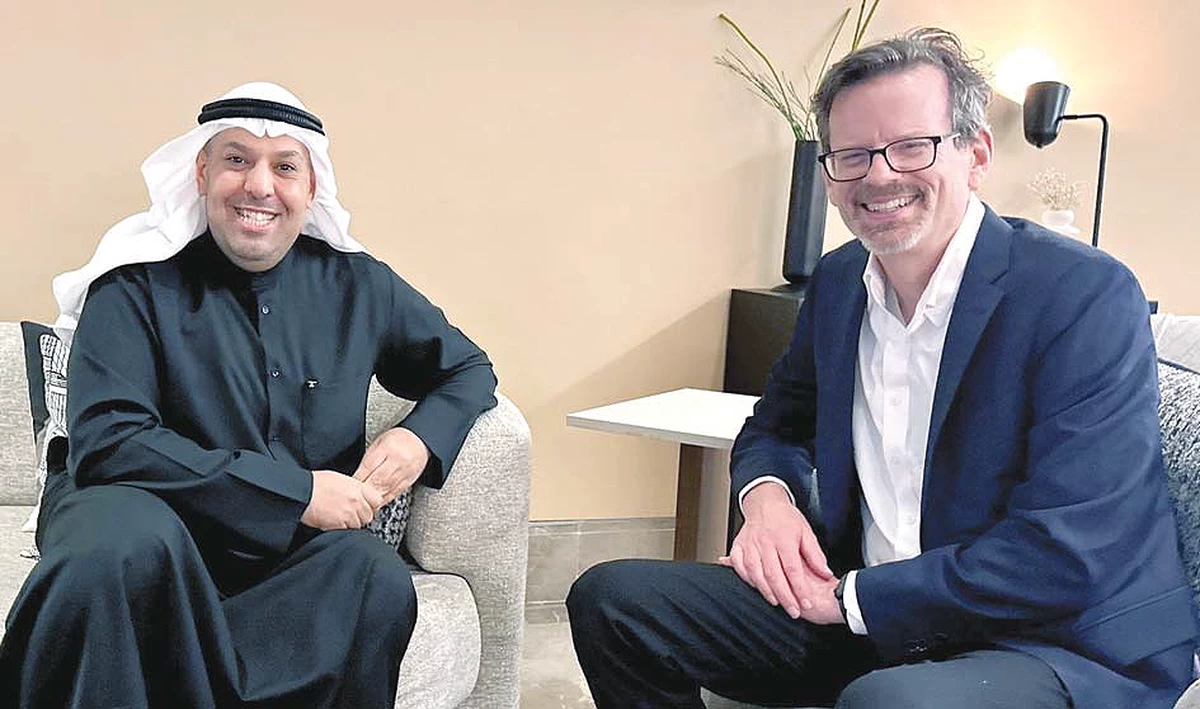
Reconnaissance Research founder and CEO Abdulaziz Al-Anjeri with Dr. Michael Herb, Professor of Political Science at Georgia State University.
Reconnaissance Research founder and CEO Abdulaziz Al-Anjeri conducted an interview with Dr. Michael Herb, Professor of Political Science at Georgia State University, on the sidelines of Dr. Herb’s visit to Kuwait to take part in a series of closed discussions and specialized seminars organized by the Center. This interview is published exclusively in Al-Seyassah and The Arab Times. The interview is part of a series of special conversations presented by Reconnaissance Research, aimed at offering readers an accessible academic lens on ongoing transformations and their realistic limits. The discussion covered structural shifts in Gulf political economies, the requirements for attracting foreign investment, how Gulf political systems are adapting to new economic and regional pressures, and the role of younger educated generations in shaping the future of governance.
Who is Dr. Michael Herb?
His research focuses on the Gulf monarchies. He wrote on the political development of monarchical regimes, the resource curse and Gulf politics. He received his Ph.D. from UCLA in 1997 and joined the political science department at Georgia State University in 1998. His undergraduate degree is from the University of Washington. He is the author of The Wages of Oil (Cornell, 2014). He served as chair of the Department of Political Science at Georgia State University from 2017 to 2023, and as Director of the Middle East Institute from 2009 to 2013
What is the most important structural change currently taking place across Gulf political economies?
Dr. Herb: The Gulf economies remain quite dependent on hydrocarbons. While some countries, notably the UAE, have made some progress toward diversification, overall, we mostly see a continuation of existing trends rather than a break with the past. Structural change is slow, and not all of it is moving toward diversification away from oil. On the positive side, the Gulf has continued to develop its tourism industry. The region continues to grow as a travel hub with Dubai’s airport now the second busiest in the world after Atlanta. And the region has expanded as a logistics hub with multiple port developments. Overall, however, the economies of the Gulf states, with the partial exception of the UAE, remain quite dependent on oil. The current decline in oil prices has forced some GCC countries to increase their borrowing. A true end to dependence on oil remains a very distant prospect.
The Gulf governments have continued with their efforts -- such as Saudi Arabia’s Nitaqat -- to segment local labor markets, reserving specific occupations for nationals and establishing quotas for nationals in private sector firms. Yet these efforts, while yielding some successes in some countries, have not prevented the share of non-nationals in the Gulf populations from returning to pre-Covid percentages across the Gulf. The Gulf private sectors remain dominated by non-national employees, and many nationals who work in the private sector have their pay supplemented by support from the state budget -- so their presence in the private sector is not in way an indication of diversification away from reliance on oil. And nationals continue to work predominantly in the public sector, with the share of non-nationals in the public sector varying sharply from one Gulf state to another, depending on its level of oil wealth, with citizens forming a much higher percentage of total public sector employees in Oman than in Qatar. Some recent changes do feel very much like they are new and deep, and at the top of the list of these changes, I would place the efforts by Saudi Arabia to attract tourists. This is a sharp break from the past, but in the long run tourism can only be one piece of an overall strategy to diversify away from oil in Saudi Arabia. We also see some progress toward diversification in manufacturing in the UAE and Saudi Arabia, especially, where parts of the manufacturing sector are not connected to hydrocarbons. Ras Al Khaimah has had notable success in nurturing world-class ceramics and pharmaceutical companies that do business around the world. It benefits from the advanced infrastructure of the UAE but, like Dubai, cannot rely on oil wealth and is thus more focused on diversification than other regional governments.
What do foreign investors need from GCC countries to assess whether economic visions will succeed in the long term?
Dr. Herb: Investors need strong institutions that provide a guarantee of property rights, political stability, the provision of high quality infrastructure, the ability to hire a trained workforce, a lack of bureaucratic obstacles to entry into marketplaces, the removal of monopolies and nepotism and the availability of land, and much else. At the moment the Gulf countries have institutions that deliver on many of these criteria, albeit with a varying level of success. International rankings tend to place the UAE and Qatar among the world’s leading investment climates, while Kuwait is generally ranked slightly lower within the GCC. This reflects Kuwait’s distinctive institutional setting, where reform often proceeds through a trial-and-error process rather than through a consistently calculated, long-term strategy.
That said, recent advances in digital governance and investment regulation indicate meaningful movement, and even by Gulf standards Kuwait is not facing drastic failure, but rather the need to accelerate an already emerging reform trajectory. Infrastructure across the Gulf is world-class and this directly contributes to the rise in logistics, tourism, and other industries. The GCC states as a whole have shown a great deal of political stability over the past decades and that does not appear likely to change in the short or medium term. Moreover, there appears to be an appreciation in the GCC states for the need to lift some layers of bureaucracy and make it easier, for example, to start new businesses. Saudi Arabia has in particular made efforts to lift the bureaucratic burden while Kuwait again still remains behind the rest of the Gulf. This reflects structural challenges, including limited coordination between numerous government entities, overlapping competencies, and a public sector that has grown faster than its capacity to deliver efficient services. As a result, reform has tended to be incremental and uneven compared with neighboring states
How are Gulf political systems adapting to new economic and regional pressures today?
Dr. Herb: There is a great deal of continuity in the basic political institutions of the Gulf. While there have been leadership changes in the Gulf countries in recent years, bringing to power younger leaders in many capital in the region, the basic institutions of rule remain those that were put in place when Gulf citizens built modern bureaucratic states in the middle of the twentieth century. The strategies adopted by rulers have of course changed. The Gulf countries have a vastly larger international presence today than they did in the past decades ago. When I was in Qatar thirty years ago I called an American and told him I was in Qatar -- he responded “where are you?”. That would not happen today. It is not just that the Gulf states are known, but also that they are serious players in international politics. The continuing decline in the fortunes of the Iranian regime poses a threat of instability for the GCC countries, but also sidelines a nearby regional actor who -- especially in the past -- was viewed as a threat.
How should observers understand differences among GCC states?
Dr. Herb: The GCC states are independent sovereign countries that make their own foreign policies. Their wealth and geographic position gives them the means and the incentive to pursue policies that affect other countries in the region. Sometimes, in the pursuit of what they see as their specific interests, the GCC states wind up at odds with each other. I think it is fair to wonder if activist foreign policies -- especially if not carried out in concert with other GCC states -- are really worth the treasure they cost and the risks they incur. Mediation seems to pay the best returns. These efforts help to resolve conflicts in the neighborhood and maintain good ties between GCC states and regional and world powers. Finally, the GCC states need to move toward economic diversification and tensions among themselves threaten serious harm to these efforts. The obvious path toward development among the GCC states is trade amongst each other: one can see this, for example, in the Hafeet Rail link being built between Oman and the UAE. This is often how we see economic growth proceed in other parts of the world -- it spreads from one country to another in a region. That cannot happen if the Gulf countries are blockading each other.
What role do younger educated generations play in shaping the future of governance in the Gulf?
Dr. Herb: They are the future. The challenge is to make room for them in governance, and then make sure that they do not block the next generation.