



12/03/2026

Share:
12/03/2026
Share:
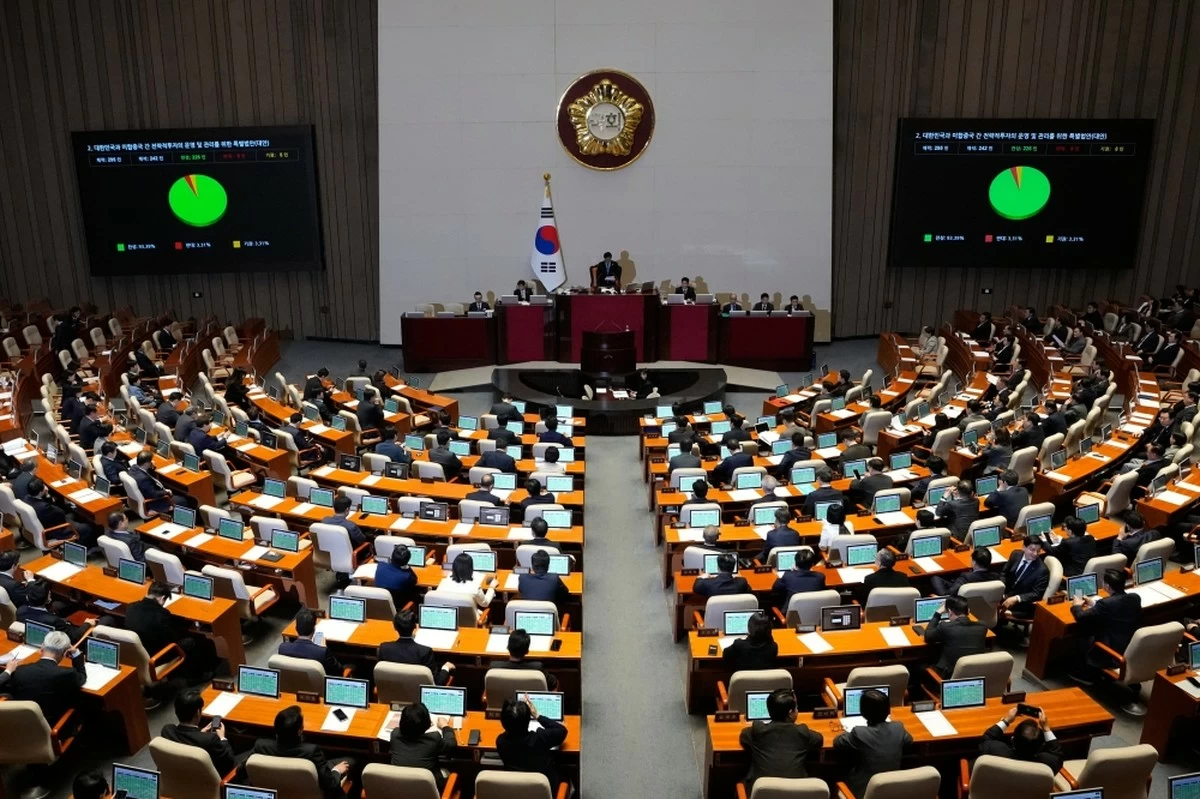
The National Assembly passes a law to implement hundreds of billions of dollars in US investments at the National Assembly in Seoul, South Korea on March 12. (AP)

SEOUL, South Korea, March 12, (AP): South Korean lawmakers on Thursday passed a law to implement a pledge of $350 billion in US investments Seoul made last year to avoid the Trump administration’s highest tariffs.
Government officials had urged lawmakers to quickly pass the contested bill, submitted in November, as uncertainty mounts for the country’s trade-dependent economy, already rattled by President Donald Trump’s protectionist swing and now fearing the fallout from his war on Iran.
The bill’s passage came hours after the Trump administration increased pressure on trade partners by opening a new investigation into manufacturing in foreign countries, including China and US allies South Korea and Japan, which could result in new import taxes if US officials see their practices as unfair.
Trump and his team have made clear they’re seeking to use new tariffs to recoup lost revenue after the US Supreme Court invalidated his sweeping tariffs issued with emergency powers.
China expressed opposition to the move and called for negotiations to resolve any differences. "China opposes any form of unilateral tariff measures,” Foreign Ministry spokesperson Guo Jiakun said in Beijing. "Tariff wars and trade wars serve no one’s interests.”
The South Korean law, which passed 226 to 8, calls for establishing a public corporation to manage the promised US investments, including reviewing and selecting projects based on input from South Korean and US trade authorities.
Some lawmakers spoke against the bill ahead of the vote, expressing frustration over Trump’s new trade investigations and the potential impact of the war in the Middle East, which has exposed the vulnerability of South Korea’s export-dependent economy and reliance on imported fuel.
"We cannot be the money machine Trump wants us to be,” said Son Sol, a member of the minor opposition Progressive Party. She said the bill does not give the legislature sufficient power to review and reject investments that could go against South Korean business or public interests.
Following months of tense negotiations, South Korea finalized an agreement with the United States in November to invest $200 billion in US semiconductor and other high-tech industries and another $150 billion in shipbuilding in exchange for Washington lowering reciprocal tariffs on Seoul from 25% to 15%.