



20/01/2026

Share:
20/01/2026
Share:

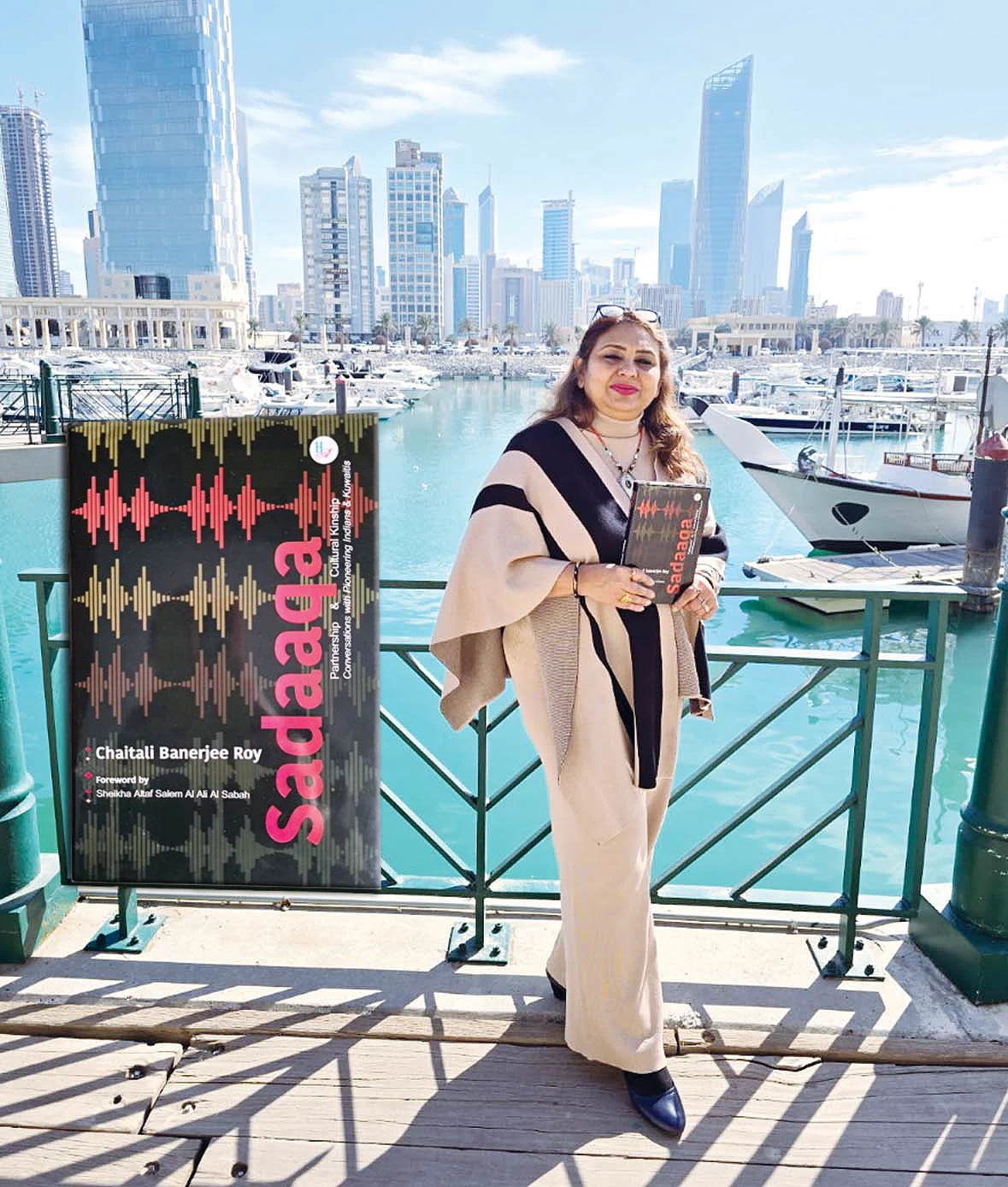
On the surface, few nations seem more distinct than Kuwait and India—one an affluent desert nation with a small population, the other a teeming subcontinent of staggering diversity. One would expect their worlds to intersect but not necessarily to intimately intertwine. Yet, as the compelling conversations in Sadaaqa, Partnership & Cultural Kinship reveal, outside the Arabian Gulf region, Kuwait shares its deepest historical, economic, and human bonds with India. Author Chaitali Banerjee Roy chronicles this fascinating paradox through personal interviews with pioneering Indians and Kuwaitis, highlighting the multifaceted threads of a remarkable relationship.
Tradition
In her foreword to the book, Sheikha Altaf Salem Al Ali Al Sabah notes that the ancient tradition of trade between the two countries became the vehicle for commercial exchange as well as the diffusion of knowledge. “With goods traded along the Arabian Gulf and the subcontinent, so too were traits, customs, and ideas. The most important of these were language, cuisine, social customs, and artistic styles.”
Fast forward to present day Kuwait, with nearly a million Indians living here and forming the country’s largest expatriate community. Obviously, Indian expatriates are an integral part of Kuwait’s social, cultural, and economic fabric. Yet surprisingly, there is very little documentation of this far-reaching relationship. As a cultural journalist, author, podcaster, and broadcaster with over three decades of experience in radio, print, and digital media spanning both Kuwait and India, it’s not surprising that Chaitali Banerjee Roy recognized the merit of researching this captivating and consequential subject.
Roy arrived in Kuwait in 2001 and soon began contributing articles to the Arab Times newspaper and presenting and editing interviews for Kuwait Radio. In the preface of Sadaaqa she discloses that already within her first few weeks in Kuwait she began noticing many shared traits between the Kuwaiti and Indian cultures, especially the strong emphasis on family ties and hospitality. Describing her deepening sense of kinship she writes, “I realised I was not immersed in an entirely foreign culture; instead, Kuwait felt like an extension of India in many ways. The civilisational ties were hard to miss.”
However, it wasn’t until the publication of her first book, Women of Kuwait: Turning Tides, in 2016, that she began to contemplate documenting the affinity of the two cultures as embodied by both Kuwaiti and Indian families and individuals. In January 2022, along with her technical director, Anees Backer, she began her radio series titled Sadaaqa, which translates as friendship in Arabic, and forms the backbone of the book.
According to Roy, what ensued were tales of “the inspiring journeys of pioneering Indian families, including the Jashanmals, Oberois, Kohlis, Bhasins, Mathews, and others, who built their businesses from the ground up through sheer hard work and determination. In doing so, they not only created livelihoods but also became significant contributors to Kuwait’s economic growth, standing shoulder to shoulder with the locals. These are accounts of grit and resilience, forged during a time when life in this desert nation was far from easy. This book is also about second and third-generation Indians who spend their entire lifetimes in Kuwait…”
Roy’s thoughtful interviews are well-researched. They provide the back-stories to familiar names of Indian families in Kuwait of which we may only have superficial knowledge.
Jashanmal’s, for example, is a well-known department store in Kuwait, and the first such commercial outlet of its kind in the country. A branch opened in Kuwait in 1934, following its founding in Basra, Iraq in 1919 by Rao Sahib Jashanmal. It is Rao Sahib’s grandson, Tony Jashanmal, who successfully rebuilt and expanded the business after the Iraqi occupation. Today Jashanmal’s remains a prominent retailer and distributor of international brands of luxury goods in Kuwait. Born in the old American Mission Hospital in Kuwait, Tony Jashanmal is an example of a prominent third-generation Kuwait-based Indian entrepreneur.
Businesses
Like the Jashanmals, many other Indian merchants suffered devastating losses during the Iraqi occupation and had to painstakingly rebuild their businesses from the ground up. Roy tells stories of Indian businessmen imbued with the trust and support of their Kuwaiti partners, adapting to change and capably facing the challenges of restarting businesses in post-liberation Kuwait. Strong work ethics passed down from father to son to grandson have resulted in successful businesses run by Indians and Kuwaitis spanning several generations, which are still ongoing.
While entrepreneurship forged these relationships, in most cases the bonds became cultural and social as well as economic. Several Indian businessmen in Roy’s book described the ties of personal kinship between themselves and their Kuwaiti sponsor as like that of father and son. Tolerance was a key factor in these strong bonds. Both Indians and Kuwaitis featured in the book recall the joy of participating in each other’s religious holidays and festivals.
In addition to Indians who migrated to Kuwait, Roy recognizes distinguished Kuwaitis with deep ties to India. From Kuwait’s love affair with Bollywood to marathon Indian shopping trips; from food, art, history, yoga, and tourism to the intimate fabric of families united through marriage, these personal stories form a rich tapestry. They show that long-time Kuwait-India relations are marked by trust, familiarity, and mutual respect.
Integration
Ahmed Al Sarraf, an outspoken newspaper columnist and successful businessman, has strong relations with India and with Indians in Kuwait. Speaking about cross-cultural relationships in an interview with Roy, he states that, “the strength of any society lies in its ability to bring people of different cultures together. The beauty of India, for instance, rests in its diversity…” He concluded that, the “spirit of achievement and integration flourishes best in environments where people are encouraged to feel part of the larger society.”
Besides Roy’s in-depth knowledge of her subject, her interviewing style and warm personality have no doubt contributed to the success of Sadaaqa. With an obviously genuine interest in her subjects she has a gentle way of putting them at ease, so no matter how long you’ve known her, the interview feels like having a chat with an old friend.
With the use of first-hand sources, Roy’s book goes beyond surface-level observations to illustrate deeply-woven real experiences. While the economic and political landscapes of both nations have inevitably evolved, Roy’s work ensures that the profound human legacy--forged


