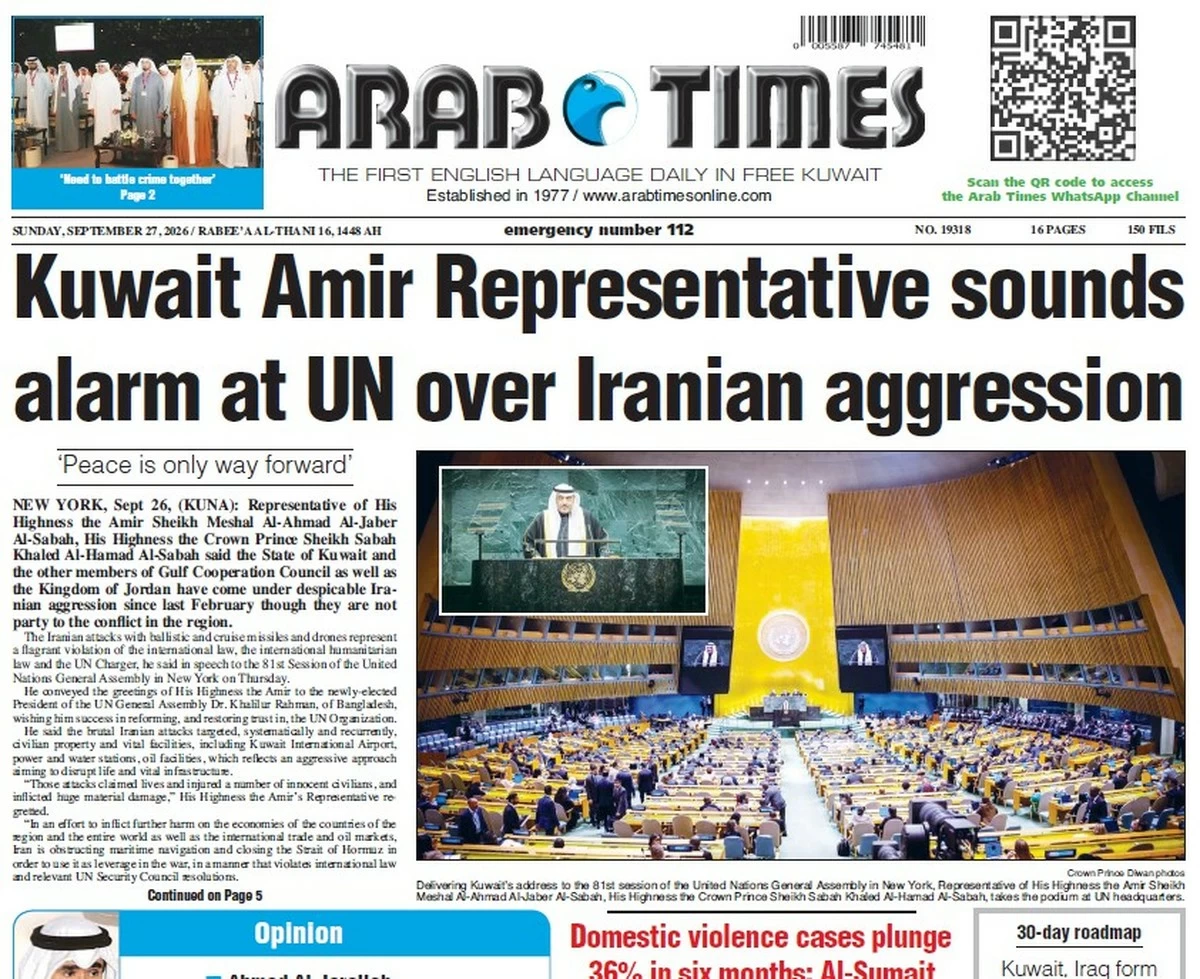
KUWAIT CITY, June 20: The piece published in both Arab Times & Al Seyassah on June 18, 2026, by Editor in Chief Ahmed Al Jarallah, under the title “The cunning Al-Mughira Ibn Shu’ba and the Bahraini people’s plot against him” contains delusional accusations against Mustafa Kemal Atatürk, the founder of the Turkish Republic. The legacy of Atatürk stands firmly on its own historical merits. He is a universally respected statesman whose 100th birthday in 1981 was designated by the United Nations and UNESCO as the Atatürk Centennial worldwide, officially recognizing him as a pioneer in fostering peace, international understanding, and human rights. Any objective reader of history is well-acquainted with his profound contributions to his nation and international peace and diplomacy.
Characterizing Atatürk as a ruler defined by animosity toward Islam contradicts the factual reality of his reforms. Far from marginalizing faith, his administration structured and supported it. In 1924, Atatürk established the Presidency of Religious Affairs (Diyanet). Rather than forcing Islam into the shadows, the state took on the responsibility of funding mosques, paying the salaries of imams, and ensuring that religious services were accessible across the nation. Atatürk did not close mosques. He dismantled institutions that he viewed as obstacles to the intellectual and social liberation of the Turkish people. He envisioned a society that looked forward to scientific advancement rather than backward toward fatalism. Atatürk himself addressed this directly in his famous 1923 Balıkesir speech, stating: “Our religion is the most reasonable and natural religion ...
For a religion to be natural, it must agree with reason, science, knowledge, and logic.” He did not see Islam as inherently backward; he saw the stagnation of religious thought as the enemy.
Atatürk commissioned and funded the first comprehensive Turkish translation and commentary of the Holy Qur’an, alongside translations of the Hadiths. He wanted an enlightened populace that could read their holy text in their native tongue, comprehend their worship intellectually, and practice their faith out of genuine conviction rather than blind obedience. Atatürk’s reforms did not destroy Islam; they modernized its place within a contemporary society. He left behind a republic where citizens could be fiercely patriotic, intellectually free, scientifically advanced, and securely grounded in their faith – all at the same time. Objective documentation of Atatürk’s life, his visionary reforms, and the global accolades he received are extensively preserved in historical archives.
Presenting a historical narrative so detached from these documented realities misleads the public. It is also necessary to note certain factual inaccuracies. Mehmet I (Çelebi Mehmet) is widely regarded as the second founder of the Ottoman State, rather than Murat IV. Murad IV’s reign represented a deliberate moment of state re-consolidation, through which the Ottoman polity regained internal coherence and a stabilizing presence in its surrounding environment. A departure from clichés and the mumpsimus of rigid in favor of sound scholarship may prove instructive. On the other hand, a brief review of the archives has revealed that, in an article published some six years ago, the author advanced views that stand in direct contradiction to those expressed in the present piece. In this regard, the author is invited to adopt a more consistent approach, rather than relying on arguments that appear detached from factual and historical foundations and conveyed in a confrontational tone. In the spirit of journalistic objectivity and accurate reporting, I kindly request the publication of this letter to ensure your readers are presented with a balanced and factually accurate perspective.
Yours sincerely, Tuba Nur Sönmez Ambassador of the Republic of Türkiye