



13/01/2026

Share:
13/01/2026
Share:

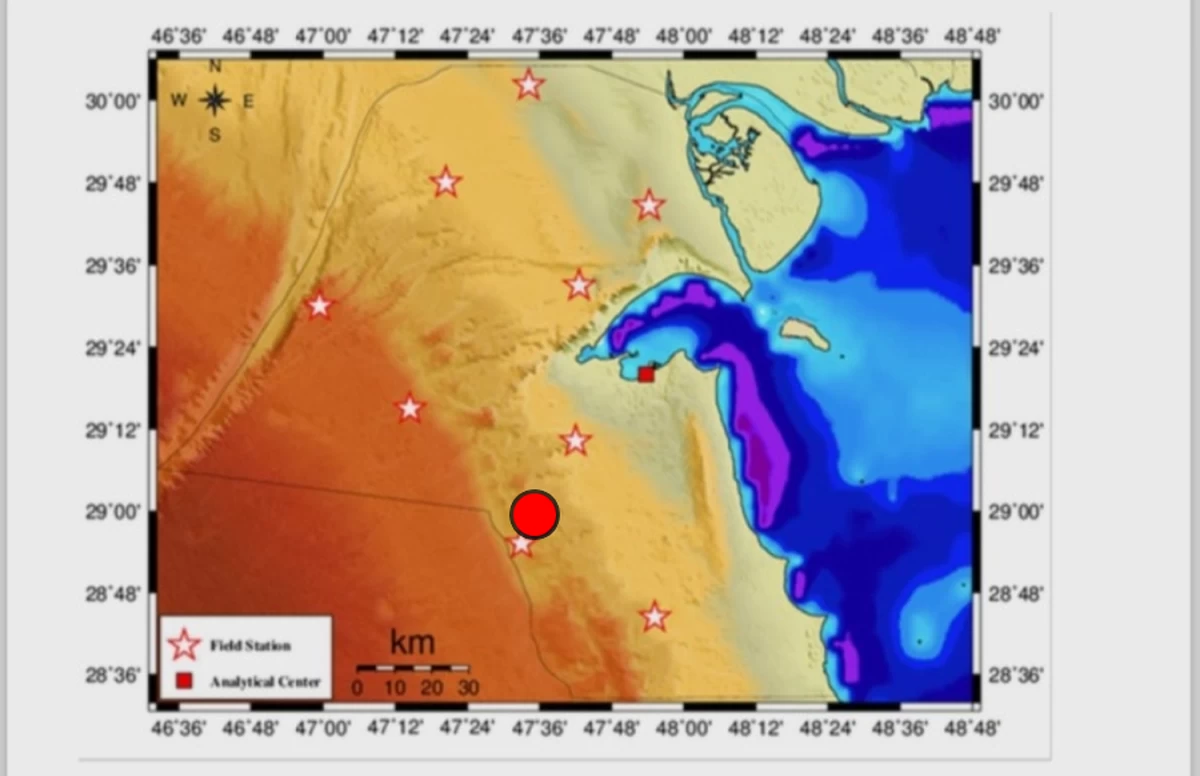
KUWAIT CITY, Jan 13: Director of the Kuwait Institute for Scientific Research (KISR), Dr. Faisal Al-Humaidan, says the Kuwait National Seismic Network has recorded more than 1,400 local earthquakes, ranging from weak to moderate in magnitude, since its establishment in 1997, reports Al-Seyassah daily. In an interview with the Daily, he indicated that the network also monitors regional and global earthquakes around the clock. Dr. Al-Humaidan revealed that the network includes nine field stations in various regions of Kuwait, as well as a central seismic data analysis center at the institute’s headquarters in Shuwaikh. In response to a question about KISR’s recent achievements, Dr. Al-Humaidan explained that in 2024 and 2025, KISR successfully solidified its position as a leading national research institution by implementing a wide range of scientific and applied projects in the fields of environment, energy, water, food security, and innovation. It achieved a significant milestone by ranking second in the Gulf region and fourth regionally among 322 research centers, according to the SCIMAGO 2024 ranking.
This ranking, which was based on research output, innovation, and community service indicators, reflects the development of KISR’s research performance. Regarding environmental and marine projects, Dr. Al-Humaidan explained that KISR completed several high-quality initiatives, including a project to adapt to and build resilience against cross-border sandstorms between Kuwait and Iraq, the development of advanced air quality management systems to support decision makers, and the establishment of a remote sensing unit to monitor environmental changes. KISR carried out environmental compensation projects, such as restoring vegetation cover, monitoring the Sabah Al-Ahmad Reserve, and preparing a long-term plan for the marine reserve in Sulaibikhat Bay.
In the marine sector, KISR began implementing five research projects aboard the research vessel “Al- Mustakshif” (The Explorer), funded by the Kuwait Foundation for the Advancement of Sciences (KFAS), to support marine food security and study the Kuwaiti marine environment. In energy and renewable energy, Dr. Al-Humaidan highlighted KISR’s contribution to developing the Energy Efficiency Code in cooperation with the Ministry of Electricity and Water. As a consultant, KISR inaugurated two solar power plants at the factories of the Kuwait Oil Tanker Company (KOTC) in Shuaiba and Umm Al-Aish, and developed a smart home energy management system using artificial intelligence, achieving up to 26 percent energy savings.
The institute also completed a study on offshore wind energy in Kuwait Bay, showing production potential ranging from 350 to 550 megawatts. Dr. Al-Humaidan emphasized KISR’s focus on the water sector, including solar-powered desalination projects, studies on desalinating highly turbid water using wastewater, and research on reusing treated wastewater and extracting minerals. He stated that these efforts aim to enhance water security through sustainable solutions that account for climate change, population growth, and rising water demand. Regarding KISR’s methodology for setting priorities, Dr. Al-Humaidan explained that KISR prioritizes its research projects as per an institutional framework in line with national plans and the New Kuwait 2035 vision.
This process includes consultations with government agencies and the private sector, as well as analysis of future risks and challenges. KISR follows its Tenth Strategic Plan, which focuses on maximizing the economic, environmental, and social impact of research outputs. Concerning earthquake monitoring and geological studies, Dr. Al- Humaidan stated that the institute established the Kuwait National Seismic Network in 1997, which consists of nine field stations and a main analysis center in Shuwaikh. The “Seismic Wheel” network was also created to enhance building protection. Since its establishment, the network has recorded over 1,400 local earthquakes ranging from weak to moderate, in addition to continuously monitoring regional and global seismic activity.
Dr. Al-Humaidan also highlighted the institute’s contributions to food security through research in aquaculture, vertical farming, and the marine environment. He noted KISR’s role in establishing the Kuwait Central Laboratory for Food Control and developing food risk assessment systems, supporting regulatory bodies and protecting consumer health. Regarding the application of research outputs in decision-making, Dr. Al-Humaidan stated that during 2024-2025 period, the institute completed 175 research projects, 112 of which were contracted by national entities, representing 64 percent of the total projects. The institute established the “Kazma” company to commercialize research outputs and has already begun producing drinking water using desalination technology from coastal wells. Addressing financial challenges, Dr. Al-Humaidan noted that the current budget is insufficient to meet the needs of research activities, which has affected the implementation of some strategic objectives, adding that delays in approvals have compounded these challenges, despite efforts to reallocate funds.
When asked about the readiness for artificial intelligence, Al-Humaidan stated that the institute developed the “Icarus” high-performance computing system for big data processing and AI model development. He also highlighted the integration of smart technologies into research projects and the ongoing development of human capacity. Dr. Al-Humaidan clarified that there are currently no plans to change KISR’s organizational structure. The focus is still on continuous review of research programs to ensure alignment with rapid scientific and technological advancements and the development priorities of the State of Kuwait.
In response to a question about filling vacancies, he revealed that KISR institute conducted three recruitment campaigns last year, targeting priority research, administrative, and technical positions. Dr. Al-Humaidan emphasized that KISR views regulatory bodies as partners in improving performance and enhancing transparency, rather than merely external evaluators. He revealed that the institute signed approximately 17 cooperation agreements and memoranda of understanding with local, regional, and international entities in 2025. Dr. Al-Humaidan concluded by underlining that scientific research is a national imperative, noting that developed countries allocate up to three to four percent of their GDP to research and development.