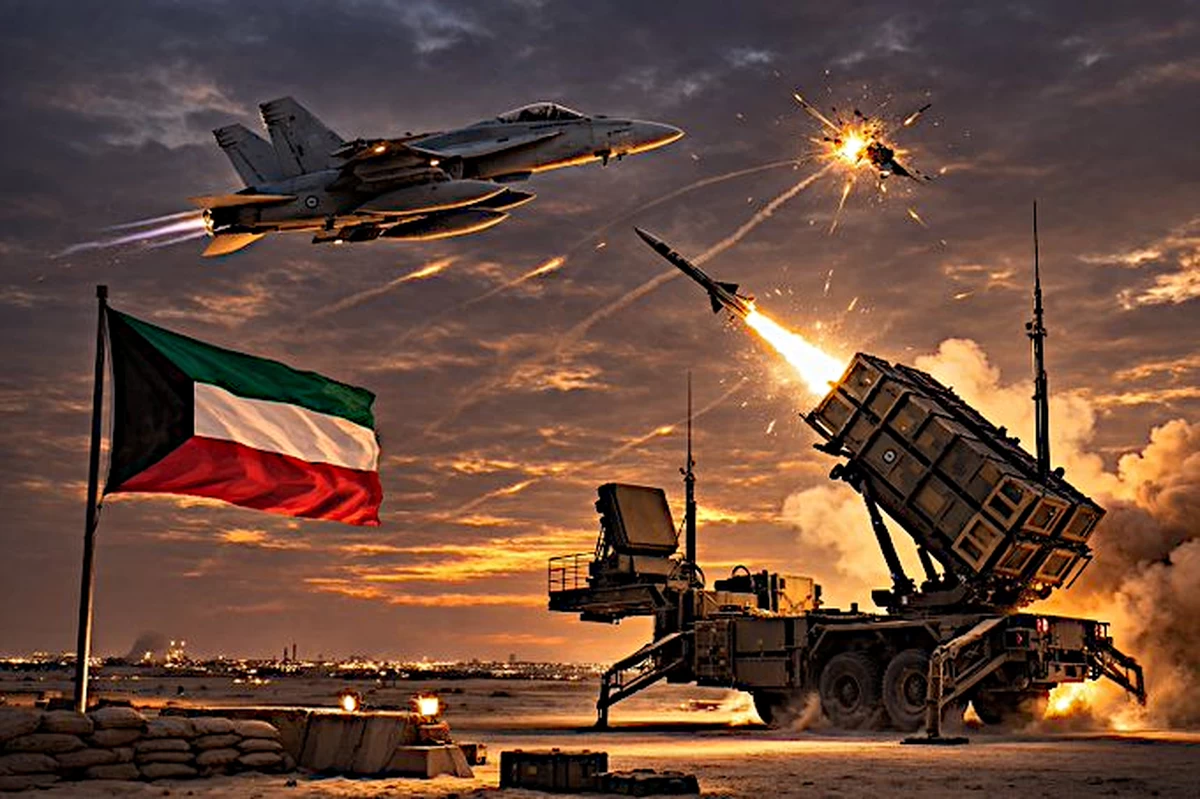
KUWAIT CITY, July 18: Kuwait’s air defenses intercepted a new wave of Iranian ballistic missiles and hostile drones early Saturday as attacks targeted military, security and vital civilian facilities, including oil, electricity and water installations, causing fires, damage and injuries. Ministry of Defense spokesman Colonel Saud Al-Atwan said the Kuwait Armed Forces detected the incoming threats within Kuwaiti airspace during the early hours of Saturday and successfully intercepted them. He confirmed that Iranian attacks targeted a number of strategic facilities, including those belonging to the oil, electricity and water sectors, resulting in fires and extensive material damage. The concerned authorities immediately launched firefighting and emergency response operations, during which several firefighters and oil sector workers were injured while carrying out their duties. The injured were transported for treatment and remain under medical care. Colonel Al-Atwan said fragments from the intercepted missiles and drones fell in several locations, including residential areas, causing property damage but no reported fatalities.
He stressed that the Kuwait Armed Forces remain fully prepared and continue to perform their duties with the highest level of efficiency, working in coordination with relevant government agencies to protect the country’s sovereignty, security and stability.
Earlier Attacks Colonel Al-Atwan had earlier announced that Kuwaiti air defenses intercepted ballistic missiles and hostile drones within national airspace at dawn Friday. He said drones targeted several Kuwait Army facilities and camps, resulting in injuries to members of the Kuwait Land Forces who were on duty. The injured personnel received medical treatment and their conditions were reported as stable. Defense Minister Sheikh Abdullah Al-Ali visited the injured soldiers and was briefed by medical teams on their conditions and the care being provided. Chief of the General Staff Lieutenant General Khaled Al-Shuraiaan and Deputy Chief of Staff Major General Sabah Al-Jaber also visited the wounded personnel.
Kuwait Condemns “Systematic” Attacks The Ministry of Foreign Affairs strongly condemned the renewed Iranian attacks, particularly the targeting of another power and water desalination facility. The ministry said the repeated strikes against vital infrastructure demonstrate a “systematic and aggressive approach” targeting civilian facilities and endangering lives. It described the attacks as a blatant violation of international law, the United Nations Charter and Security Council Resolution No. 2817. Kuwait held Iran fully responsible for the aggression and its consequences, demanding an immediate halt to the attacks. The ministry reaffirmed Kuwait’s right to take all necessary measures to protect its security, territory and vital facilities in accordance with Article 51 of the UN Charter and international law. It warned that the continued aggression represents a dangerous escalation threatening regional security and undermining efforts toward peaceful solutions.
Oil Facilities Hit, Firefighting Operations Launched The Kuwait Petroleum Corporation (KPC) confirmed that one of its vital oil facilities was repeatedly targeted Saturday morning, causing major material losses and injuries. KPC said the injured received medical treatment and the affected site was evacuated, adding that it was coordinating with all relevant authorities to address the aftermath of the attack. The Kuwait Fire Force (KFF) said several firefighters and one civilian employee were injured while battling fires caused by the attacks. KFF teams responded to two separate fire incidents in South Kuwait, with five firefighting teams, supported by oil sector firefighting units, handling the first operation, while three teams responded to the second. KFF spokesman Brigadier General Mohammad Al-Gharib said the fires were brought under control after coordinated efforts involving the Kuwait Armed Forces and Kuwait National Guard firefighting teams.
Power, Water Teams Begin Restoration Work Minister of Electricity, Water and Renewable Energy Dr. Subaih Al-Mukhaizeem inspected affected electricity and water desalination facilities Saturday, reviewing damage assessments and ongoing repair efforts. The minister was briefed on emergency operations carried out in coordination with the Kuwait Fire Force and security agencies, including a six-hour firefighting operation. He praised the efforts of firefighters, engineers and technical teams, stressing that repair work would continue until affected units return to service under the highest safety standards. The ministry said it is operating at full capacity and utilizing all available technical resources to maintain electricity and water supplies and reduce the impact of the attacks.
Health System on Alert Minister of Health Dr. Ahmad Al- Awadhi chaired an emergency meeting at the Ministry’s Crisis Center to assess the readiness of Kuwait’s healthcare system. The meeting reviewed preparedness reports covering hospitals, primary healthcare centers, emergency departments, ambulance services, intensive care units, medical warehouses and strategic reserves of medicines and supplies. Al-Awadhi emphasized the importance of continuous monitoring, proactive preparedness and coordination among all ministry sectors to ensure rapid response.
Kuwait Airways Reschedules Flights Kuwait Airways announced the rescheduling of most flights following the temporary suspension of operations at Kuwait International Airport due to the attacks. The airline urged passengers to check their flight status and said updates would be sent through text messages. Passengers requiring assistance may contact customer service at 171 from Kuwait or +965 2434 5555 ext. 171 from abroad, or reach the airline via WhatsApp at +965 180 2050. The airline reaffirmed its commitment to passenger safety.
Philippine Embassy Issues Advisory The Philippine Embassy in Kuwait urged Filipino nationals to remain vigilant and maintain situational awareness amid ongoing developments. The Embassy advised Filipinos to follow instructions from Kuwaiti authorities, monitor official news sources and verified social media accounts, and avoid relying on unconfirmed reports. It recommended minimizing nonessential travel and outdoor activities, keeping communication devices charged, and avoiding the spread of fake news and speculation. The Embassy said it continues to closely monitor developments and will issue further advisories when necessary. Filipinos needing assistance may contact: * +965 9403 9063 * +965 6040 3858 * +965 6558 5355 For emergencies, they may call Kuwait’s emergency number 112.
Regional Condemnation The United Arab Emirates strongly condemned the renewed Iranian attacks targeting Kuwait, Bahrain and Jordan, describing them as violations of sovereignty and threats to regional security. The UAE Ministry of Foreign Affairs expressed full solidarity with the affected countries and support for measures aimed at protecting their security and stability. GCC Secretary General Jassem Al-Budaiwi also condemned Iran’s continued attacks, describing them as violations of international law and the UN Charter. He affirmed the GCC’s support for all measures taken by affected countries to safeguard their sovereignty and protect citizens and residents. The Arab League likewise condemned the attacks targeting Kuwait, Qatar, Bahrain, Jordan and Iraq’s Kurdistan region, calling them unacceptable violations of sovereignty and international law. Secretary General Nabil Fahmy expressed solidarity with the affected states and urged Iran to immediately stop actions that fuel instability and threaten regional security.
Tehran freezes deal In latest development, the United States and Iran exchanged strikes aimed at infrastructure and military targets on Saturday as an Iranian negotiator said Tehran had suspended its commitments under the interim deal with the U.S. - snapping another fragile thread as the war shows no end in sight. The battle over the Strait of Hormuz intensified in a conflict increasingly focused on control of the essential waterway that previously carried a fifth of the world’s crude oil. The widening strikes threatened civilians and services to them, including desalination plants for drinking water, while the global economy again was on alert.
The U.S. Central Command said early Saturday that its seventh straight night of strikes hit “surveillance sites, military logistics infrastructure, underground weapons storage, and maritime capabilities.” The U.S. has violated its commitments under the deal that was signed about a month ago and now Iran is “no longer implementing them,” Kazem Gharibabadi, Iran’s deputy foreign minister, told state TV. There was no new word on mediation efforts. The most significant damage from Iranian strikes on Saturday occurred in Kuwait, where a water desalination plant and an oil facility were hit, according to the Kuwait authorities and the Kuwait Petroleum Corporation.
Both declined to provide locations. Meanwhile, Iraq said it shot down attack drones over the city of Irbil. Jordan’s state-run Petra news agency said the kingdom’s air defense systems had downed Iranian missiles, while air sirens sounded multiple times in Bahrain throughout the day and in Saudi Arabia in the morning, according to their governments. U.S. airstrikes hit an electricity and desalination plant in Iran’s southern Hormozgan province, Iranian state TV reported. IRNA said the Bonji desalination plant was destroyed, cutting off water supplies to about 10,000 people, and that a desalination plant on strategic Qeshm Island inside the strait was damaged.
Overnight strikes damaged two tunnels and a bridge, disrupting one of the main highways toward Bandar Abbas, Iran’s main port that sits near the narrowest part of the strait, according to Iran’s state-run news agency. IRNA said three bridges were hit Saturday, including one on a route to Bandar Abbas. Iran acknowledged “attacks on power infrastructure” during the U.S. airstrikes for the first time Friday when its Energy Ministry issued a call for people to use less power in southern provinces “experiencing extreme heat.” It did not specify what was hit. The Islamic Revolutionary Guard Corps stepped up its warning that countries hosting U.S. forces should be “prepared to receive a corresponding response,” according to Iran’s state TV. Iranian authorities said at least 50 people have been killed and more than 500 wounded in U.S. strikes in the past three weeks, including eight killed in a strike on a bridge Friday. U.S. officials acknowledged 13 additional U.S. service members - 10 Army soldiers and three Navy sailors - had been injured since Monday, but offered no details. Since the war began, 14 U.S. service members have been killed and 427 wounded. Iran effectively closed the strait to shipping traffic after the war started with U.S. and Israeli strikes on Feb. 28. That sent the price of oil soaring and has given Tehran significant leverage in negotiations. Iran has said the strait must be under its sole control and that vessels should pay fees to Tehran, even though the world for decades has considered it an international waterway. It fired on ships on recent days. Crossings through the strait fell to a three-week low, according to an international shipping tracker. Trump has resumed threats to target power stations and bridges to try to compel Iran to loosen its hold. The U.S. in the past week reimposed a naval blockade on Iranian ports to halt its shipments of crude oil. A growing amount of the region’s energy is being shipped through pipelines, but not nearly enough to offset the decline in shipping. Before the war began, the U.S. had been in talks with Iran over its nuclear program. Trump now faces political pressure to end the war and avoid the kind of prolonged Middle East conflict he had campaigned against.
By Munif Naif and Mohammad Ghanem Al-Seyassah/Arab Times Staff and Agencies