


17/06/2026

Share:
17/06/2026
Share:
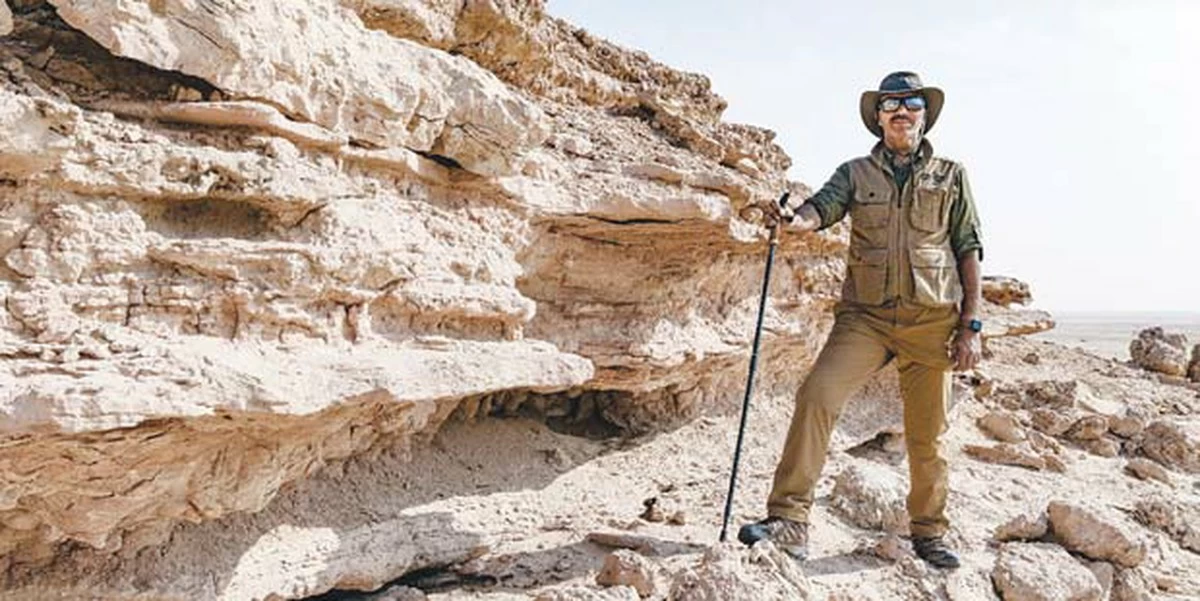
Kuwait Geosciences Society Chairman Dr. Mubarak Al-Hajeri at Subiya, where evidence of ancient waterways and coastal changes offers insight into the country’s environmental evolution

KUWAIT CITY, June 17: Chairman of the Kuwait Geosciences Society Dr. Mubarak Al-Hajeri said on Wednesday that Kuwait’s geographical environment underwent profound climatic transformations throughout its recent geological history, changing from a humid landscape featuring river channels into an arid desert. On the occasion of the World Day to Combat Desertification and Drought, Dr. Al-Hajeri told KUNA that thousands of years ago Kuwait’s environment was closer to a semi-humid land characterized by seasonal lakes and summer rainfall, while the sea extended further inland along its coasts. He noted that Kuwait’s present day summer temperatures, which approach 50 degrees Celsius, and its dust-laden northerly winds were not a feature of the region thousands of years ago during the Holocene epoch. Successive climatic cycles gradually altered the climate, leading to the conditions currently prevailing across the Arabian Peninsula.
Al-Hajeri noted that Kuwait now lies within a continental desert climate zone marked by a long, hot and dry summer, with temperatures reaching 50.7 degrees Celsius as recorded in August 2012, and a short, mild winter accompanied by irregular rainfall, while dust activity has increased. He stressed that Kuwait’s climate stabilized into its current desert pattern by the first millennium BC, noting that climatic cycles play an important role in shaping patterns of human life and activity. He referred to a report issued by the society on Kuwait’s climate, which showed that the Subiya area was once the outlet of four rivers and witnessed human settlements and activities near those water sources. Kuwait at that time formed part of a submerged coastal plain, with geological studies indicating that the last retreat of sea levels around 4,000 years ago extended between four and six kilometers inland from the current shoreline.
Al-Hajeri said the sea retreated from the coasts of Subiya in six main stages, the first occurring more than 43,000 years ago and the last around 4,000 years ago, according to a study conducted by Dr. Taibah Al-Asfour as part of her doctoral dissertation at Durham University in England in 1975. Each stage of retreat left behind a limestone coastal rock layer composed of shell and mollusk fragments. He also pointed to a recent study by King Abdullah University of Science and Technology in Saudi Arabia indicating that a vast lake existed in the Empty Quarter around 6,000 years ago before rainfall declined and the lake dried up. The Empty Quarter subsequently became a barrier that traps northerly winds and windborne dust.(KUNA)