


22/01/2026

Share:
22/01/2026
Share:
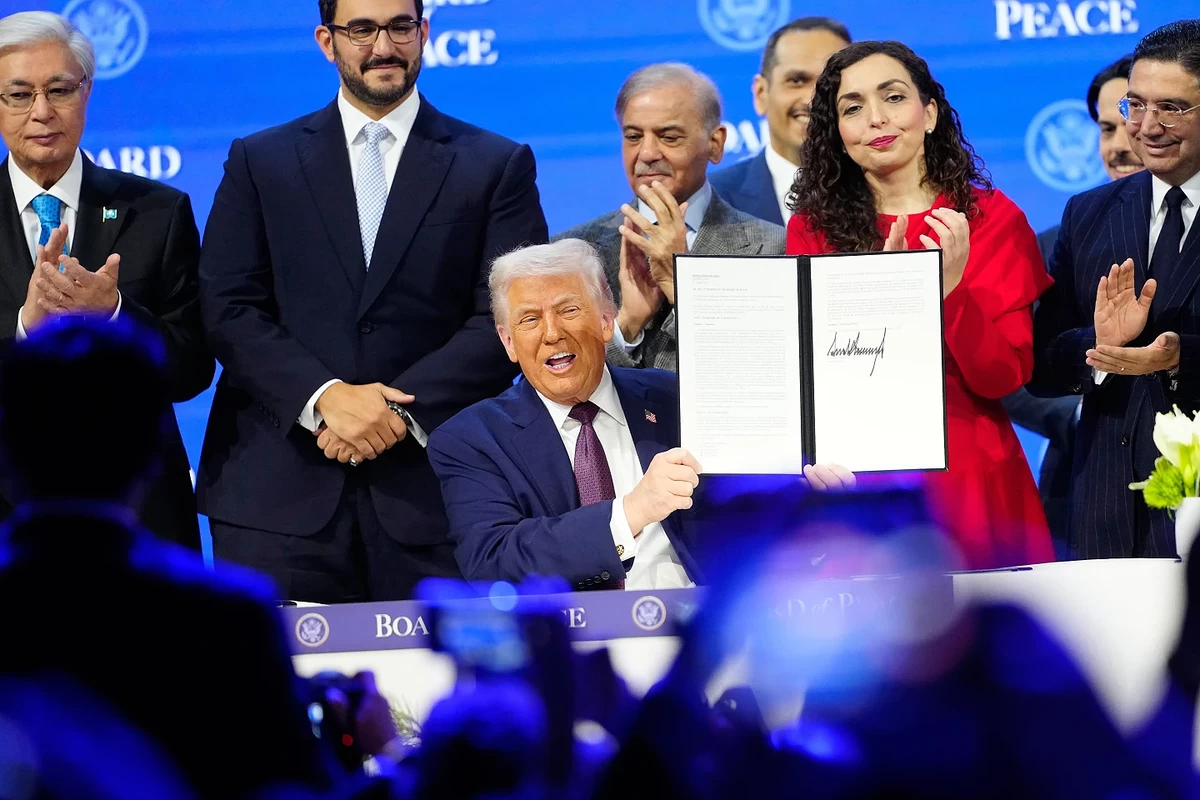
US President Donald Trump holds up a signed Board of Peace charter during the Annual Meeting of the World Economic Forum in Davos, Switzerland, Thursday, Jan. 22, 2026.

KUWAIT CITY, Jan 22, (Agencies): The Ministry of Foreign Affairs expressed Kuwait’s welcome of the invitation extended to His Highness the Amir Sheikh Meshal Al-Ahmad Al-Jaber Al-Sabah by President Donald Trump, President of the friendly United States of America to join the Board of Peace for Gaza. The Ministry of Foreign Affairs announced, in a statement on Wednesday, that Kuwait will join the Board of Peace, with the accession documents to be signed in accordance with the constitutional and legal procedures in Kuwait.
According to the statement, Kuwait commended the peace efforts led by President Trump, affirming its support for the implementation of the Board’s mandate as a transitional body under the comprehensive plan to end the conflict in Gaza, which was adopted by the United Nations Security Council under Resolution No. 2803. This plan aims to consolidate a permanent ceasefire, support reconstruction in Gaza, advance toward a just and lasting peace, and fulfill the Palestinian people’s right to self-determination and the establishment of their independent state in accordance with international law, in order to achieve security and stability for the region and its peoples.
On Thursday, US President Donald Trump signed the Board of Peace charter under the Gaza peace plan, formalizing a framework to support stability and end the war in Gaza Strip. The charter was signed during an official ceremony on the sidelines of the World Economic Forum in Davos, attended by state and government leaders from countries that have formally agreed to join the council.
Trump explained that the Board of Peace will operate in coordination with the United Nations, describing it as one of the most consequential bodies ever created. He said the Gaza plan was unanimously adopted by the UN Security Council and that the current phase focuses on maintaining the ceasefire and ensuring the flow of humanitarian aid. “We are committed to ensuring Gaza is demilitarized, properly governed, and rebuilt in a way that guarantees a better future for its people,” he added. Trump described the signing as a “first step toward a brighter future for the Middle East and a safer future for the world,” saying it offers a real chance to end decades of suffering, halt generations of hatred and bloodshed, and forge a lasting, comprehensive peace. The signing ceremony was attended by prominent leaders joining the Board of Peace charter, including Argentine President, the Prime Minister of Armenia, the Turkish and Saudi foreign ministers, Jordan’s Deputy Prime Minister, presidents of Pakistan and Indonesia, and Morocco’s foreign minister, along with other leaders. In a speech at the World Economic Forum, Trump sought to create momentum for a project to map out a future of the war-torn Gaza Strip that has been overshadowed this week, first by his threats to seize Greenland, then by a dramatic retreat from that push. “This isn’t the United States, this is for the world,” he said, adding, “I think we can spread it out to other things as we succeed in Gaza.”
The event featured Ali Shaath, the head of a new, future technocratic government in Gaza, announcing that the Rafah border crossing will open in both directions next week. That’s after Israel said in early December it would open the crossing, which runs between Gaza and Egypt, but has yet to do so. Shaath, an engineer and former Palestinian Authority official from Gaza, is overseeing the Palestinian committee set to govern the territory under U.S. supervision. The new peace board was initially envisioned as a small group of world leaders overseeing the ceasefire, but it has morphed into something far more ambitious - and skepticism about its membership and mandate has led some countries usually closest to Washington to take a pass. Trump tried not to let those not participating ruin his unveiling party, saying 59 countries had signed onto the board - even though heads of state, top diplomats and other officials from only 19 countries plus the U.S. actually attended.
He told the group, ranging from Azerbaijan to Paraguay to Hungary, “You’re the most powerful people in the world.” Trump has spoken about the board replacing some U.N. functions and perhaps even making that entire body obsolete one day. But he was more conciliatory in his remarks on the sidelines of the forum in the Swiss alps. “We’ll do it in conjunction with the United Nations,” Trump said, even as he denigrated the U.N. for doing what he said wasn’t enough to calm some conflicts around the globe. Secretary of State Marco Rubio said that some countries’ leaders have indicated they plan to join but still require approval from their parliaments, and the Trump administration says it has also gotten queries about membership from countries that hadn’t been invited to participate yet.
Big questions remain, however, about what the eventual board will look like. Russian President Vladimir Putin said his country is still consulting with Moscow’s “strategic partners” before deciding to commit. The Russian president on Thursday is due to host Palestinian President Mahmoud Abbas for talks in Moscow. Others are asking why Putin and other authoritarian leaders had even been invited to join. Britain’s foreign secretary, Yvette Cooper, said her country wasn’t signing on “because this is about a legal treaty that raises much broader issues.” “And we do also have concerns about President Putin being part of something which is talking about peace, when we have still not seen any signs from Putin that there will be a commitment to peace in Ukraine,” she told the BBC. Norway and Sweden have indicated they won’t participate, after France also said no. French officials stressed that while they support the Gaza peace plan, they were concerned the board could seek to replace the U.N. as the main venue for resolving conflicts.
Canada, Ukraine, China and the executive arm of the European Union also haven’t committed. Trump calling off the steep tariffs he threatened over Greenland could ease some allies’ reluctance, but the issue is still far from settled. The Kremlin said Thursday that Putin plans to discuss his proposal to send $1 billion to the Board of Peace and use it for humanitarian purposes during his talks with Abbas. But it noted that the use of those assets will require the U.S. action to unblock them. The idea for the Board of Peace was first laid out in Trump’s 20-point Gaza ceasefire plan and even was endorsed by the U.N. Security Council.
Israeli Prime Minister Benjamin Netanyahu announced he’s agreed to join, after his office has earlier criticized the makeup of the board’s committee tasked with overseeing Gaza. Months into the ceasefire, Gaza’s more than 2 million Palestinians continue to suffer the humanitarian crisis unleashed by more than two years of war. And violence in Gaza, while not at the same level as before the October ceasefire and hostage deal was agreed on, continues. Key to the truce continuing to hold is the disarming of Hamas, something that the militant group that has controlled the Palestinian territory since 2007 has refused to do and that Israel sees as non-negotiable. Trump on Thursday repeated his frequently mentioned warnings that the group will have to do so or face dire consequences. He also said the war in Gaza “is really coming to an end” while conceding, “We have little fires that we’ll put out. But they’re little,” and they had been “giant, giant, massive fires.” Trump’s push for peace also comes after he threatened military action this month against Iran as it carried out a violent crackdown against some of the largest street protests in years, killing thousands of people.
Trump, for the time being, has signaled he won’t carry out any new strikes on Iran after he said he received assurances that the Islamic government would not carry out the planned hangings of more than 800 protesters. But Trump also made the case that his tough approach to Tehran - including strikes on Iran’s nuclear facilities in June last year - was critical to the Israel-Hamas ceasefire deal coalescing.
Iran was Hamas’ most important patron, providing the group hundreds of millions of dollars in military aid, weapons, training and financial support over the years. Trump also spoke with Ukrainian President Volodymyr Zelenskyy, who arrived in Davos. Trump, who continues to struggle to get Zelenskyy and Putin to agree to terms to end their nearly 4-year-old war, has repeatedly expressed frustration with both sides. “I believe they’re at a point now where they can come together and get a deal done,” Trump said Wednesday. “And if they don’t, they’re stupid - that goes for both of them.”