


08/03/2026

Share:
08/03/2026
Share:

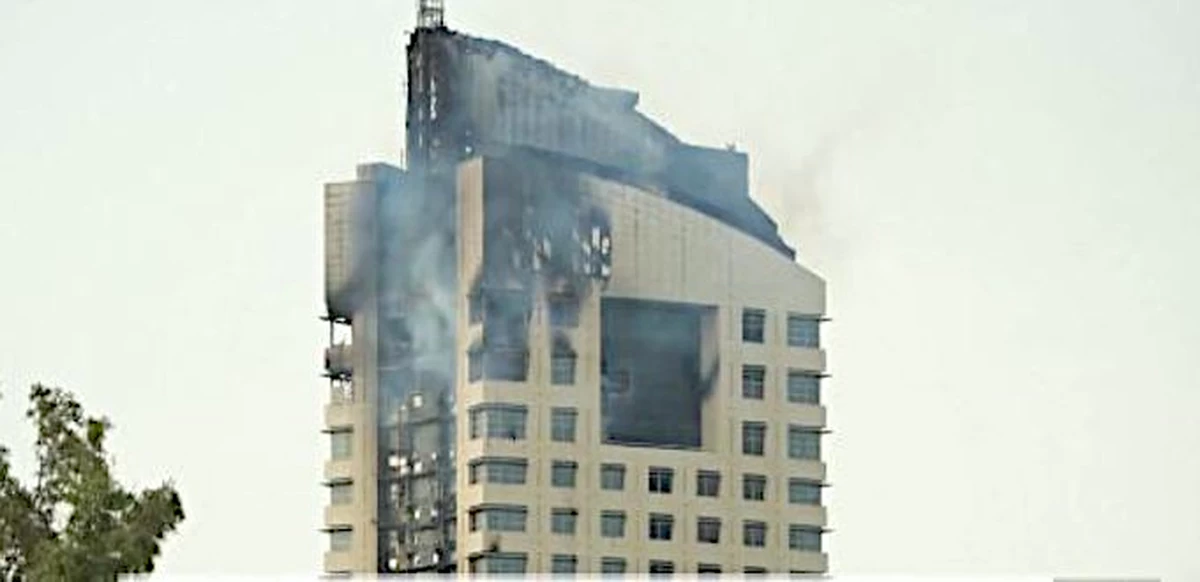
Aftermath of the attack on the PIFSS building
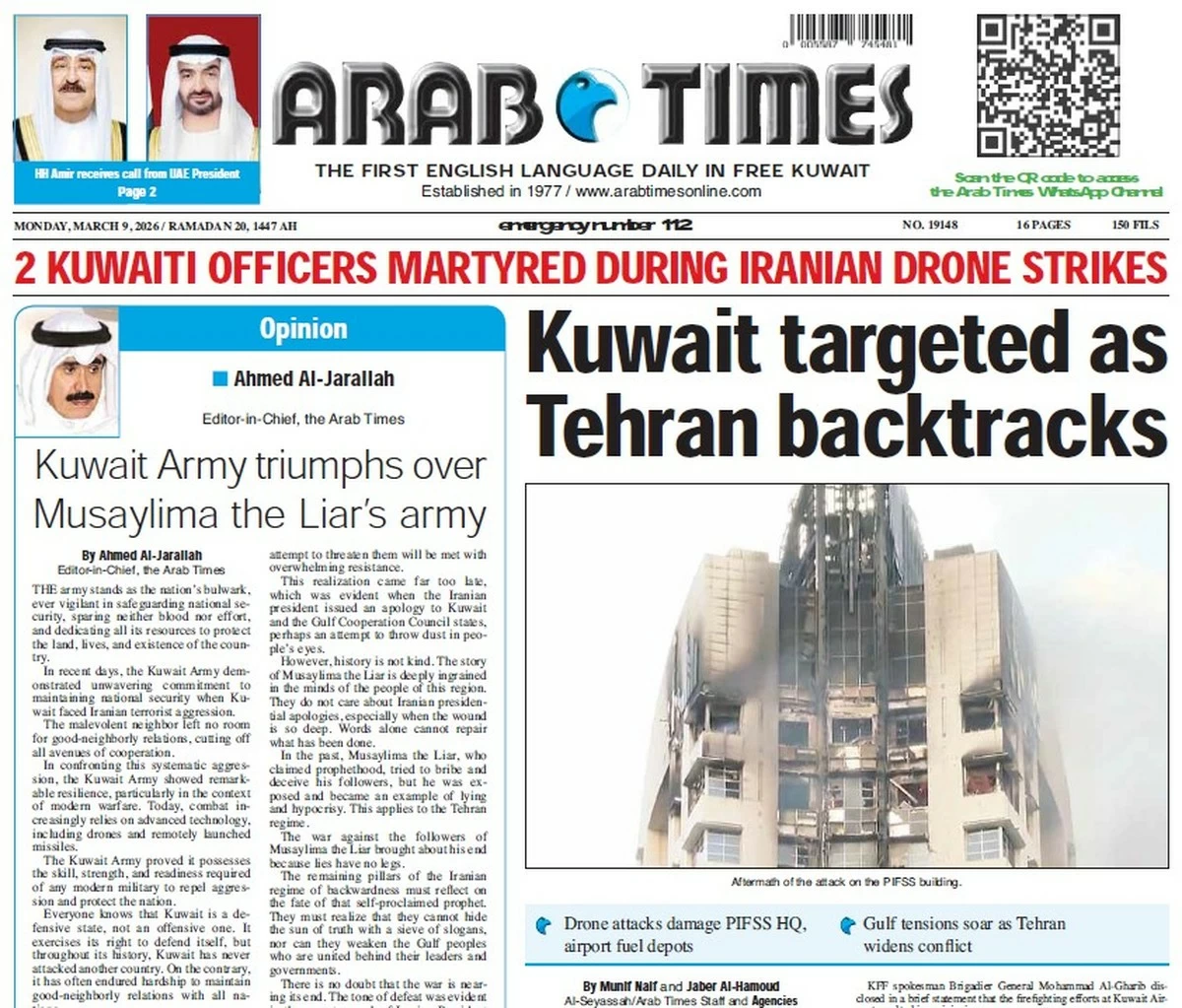
KUWAIT CITY, March 8: Things quickly deteriorated and the optimism that briefly prevailed in the region following the statement of Iranian President Masoud Pezeshkian evaporated. The statement of Pezeshkian, which included an apology to neighboring countries -- the Gulf Cooperation Council (GCC) member states -- and a decision purportedly issued by the Transitional Leadership Council not to attack them again, was followed by one of the worst waves of Iranian attacks on the Gulf states, including Kuwait, suggesting that the leadership in Tehran is on the path of no return and has decided to burn all bridges and destroy all ties and connections. The attacks launched by Tehran after Pezeshkian’s statement, which instilled a false sense of optimism, included targeting the main building of the Public Institution for Social Security (PIFSS) and two fuel depots at Kuwait International Airport.
In view of this, PIFSS announced that its main building had been targeted, resulting in material damage. This prompted the institution to apologize for not receiving visitors at its headquarters. Acting Director of the institution Khaled Al-Mudhaf stated that the institution is capable of continuing its operations from secure alternative locations, emphasizing that all data are preserved and backed up, and that most services are available through electronic systems. He indicated that there is no work at the main building of the institution until further notice, while the branches continue to operate according to the approved plan at 30 percent capacity.
Meanwhile, the Kuwait Fire Force (KFF) confirmed that its teams controlled the fire at the fuel tanks of Kuwait International Airport, while other teams dealt with the fire at the headquarters of PIFSS. KFF spokesman Brigadier General Mohammad Al-Gharib disclosed in a brief statement that the firefighting efforts at Kuwait Airport resulted in no injuries. Also, the Directorate General of Civil Aviation (DGCA) announced that a drone targeted two fuel tanks at the airport belonging to the Kuwait Aviation Fueling Company (KAFCO), resulting in a huge fire at the site. Official spokesman of DGCA Abdullah Al-Rajhi cited initial reports stating that the damage was only material and there were no casualties.
Furthermore, official spokesman of the Ministry of Defense Colonel Saud Al-Atwan affirmed that the Armed Forces dealt with a wave of hostile drones that violated the airspace of the country early Sunday morning. He said the Armed Forces destroyed 12 ballistic missiles and successfully dealt with 23 drones over the past 48 hours, indicating that “the operation resulted in minor material damage without any casualties among the Armed Forces personnel.” Director of the Public Relations and Security Media General Department at the Ministry of Interior and its official spokesperson Brigadier General Nasser Bouslaib confirmed that security and military agencies coordinated their efforts. He added “starting at midnight on Friday, the field teams for disposing of explosives, formed by the Kuwaiti Army, Ministry of Interior and National Guard dealt with 64 field reports about falling shrapnel and foreign objects, bringing the total number to 229 reports since the beginning of the Iranian aggression. All of these were dealt with quickly and efficiently.”
In related news, Lieutenant Colonel Staff Abdullah Emad Al- Sharrah and Major Fahad Abdulaziz Al-Majmad were martyred at dawn Sunday while performing their national duty as part of their assigned security tasks, following the heinous Iranian aggression on the countryIn its condolence statement, the Ministry of Interior quoted the Quranic verse, “And never think of those who have been killed in the cause of Allah as dead. Rather, they are alive with their Lord, receiving provision.” The ministry revealed that the two martyrs were members of the General Directorate of Land Border Security and were martyred while performing their national duties within the framework of their assigned security responsibilities. The ministry expressed its deepest sorrow and grief over this loss, affirming that its security personnel continue to perform their duty with utmost courage and dedication in protecting the homeland and preserving its security and stability. It prayed to Almighty Allah to have mercy on the two martyrs, grant them eternal peace in Paradise, and give their families patience and solace.
In a related development, the Ministry of Defense and Kuwait Fire Force (KFF) mourned with deep sorrow the two martyrs of duty from the Ministry of Interior—may Allah have mercy on them. It implored Almighty Allah to have mercy on them, grant them eternal peace in Paradise, and give their families patience and solace. Elsewhere, Bahrain accused Iran of striking a desalination plant on Sunday, raising fears that civilian infrastructure may become fair game in the war, as Iran’s president vowed to expand the country’s attacks on American targets across the region in the face of intense U.S. and Israeli airstrikes. A late-night Israeli strike on an oil facility engulfed parts of Iran’s capital, Tehran, in smoke on Sunday, while Israel renewed attacks in Lebanon. President Donald Trump and Israeli Prime Minister Benjamin Netanyahu vowed to press ahead with the nine-day-old campaign, which has rippled across the region and appears to have no end in sight. Iranian President Masoud Pezeshkian threatened Sunday to step up attacks on American targets across the Middle East. He appeared to backtrack from conciliatory comments toward his Gulf neighbors on Saturday. Those comments, in which he apologized for attacks on their soil, were quickly contradicted by Iranian hard-liners. The Gulf nations of Bahrain, Kuwait and the United Arab Emirates, reported additional Iranian missiles launched toward them on Sunday, including several that hit new categories of civilian infrastructure. The United Arab Emirates said that Iran launched more than 100 missiles and drones in new barrages. Only four drones fell at unnamed locations, the country’s defense ministry said.
Bahrain accused Iran of indiscriminately attacking civilian targets and damaging one of its desalination plants, though its electricity and water authority said supplies remained online. The island nation, home to the U.S. Navy’s Fifth Fleet, has been among the countries targeted by Iranian drones and missiles. Attacks have hit hotels, ports and residential towers and killed at least one person. The desalination plant strike came after Iran said a U.S. airstrike damaged an Iranian desalination plant. Abbas Araghchi, the country’s foreign minister, said the strike on Qeshm Island in the Strait of Hormuz had cut into the water supply for 30 villages. He warned that in doing so “the U.S. set this precedent, not Iran.” Neither U.S. Central Command and Israel’s military had immediate comment on the plant. Desalination plants supply water to millions of residents in the region, raising new fears of risks in multiple parched desert nations.
Iran also said on Sunday that overnight strikes from Israel hit four oil storage tankers and a petroleum transfer terminal, killing four people. Witnesses in Tehran said the smoke was so thick from a fire that engulfed the north Tehran oil depot that it felt as if the sun had not risen. The Iranian Red Crescent Society said on Sunday that about 10,000 civilian structures across the country had been damaged, including homes, schools and medical facilities. It warned Tehran residents to take precautions against toxic air pollution and the risk of acid rain after Israeli strikes set fires at oil depots in the area. Iran maintains sufficient fuel, Veys Karami, Managing Director of the National Iranian Oil Products Distribution Company, told Iran’s state-run news agency. Israel’s military said on Saturday that the targeted oil depots were being used by Iran’s military.
By Munif Naif and Jaber Al-Hamoud Al-Seyassah/Arab Times Staff and Agencies