

28/10/2026

Share:
28/10/2026
Share:

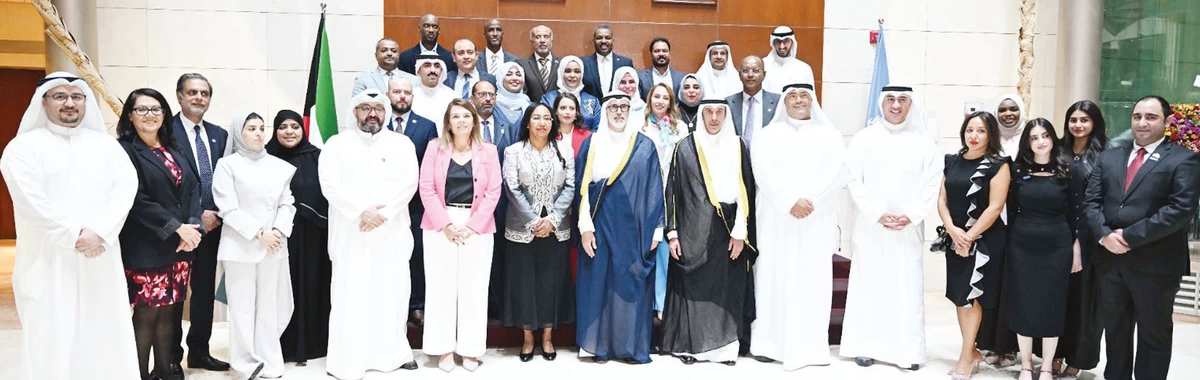
KUWAIT CITY, Oct 28: Foreign Affairs Minister Sheikh Jarrah Jaber Al- Ahmad Al-Sabah stated that diplomacy is the pillar of maintaining peace, preventing confl icts, bridging different perspectives and building trust among nations, even under the most complex circumstances. Speaking on the occasion of United Nations Day -- observed annually on Oct 24, Sheikh Jarrah Jaber said this year’s theme, “The Power of Diplomacy,” carries special significance due to the overlapping crises, ongoing conflicts and escalating geopolitical tensions. He explained that the effectiveness of diplomacy depends on adherence to the United Nations Charter and international law, along with efforts to strengthen a multilateral system that provides the framework for resolving disputes and safeguarding the rights and interests of countries. He asserted that diplomacy is not just about the management of relations between states, as it is an essential instrument for preserving peace, preventing conflicts, and promoting international dialogue and cooperation.
He said since its establishment in 1945, the United Nations has been playing a crucial role in maintaining international peace and security, promoting sustainable development, protecting human rights, and strengthening dialogue and cooperation among nations. He added that the United Nations remains the cornerstone of collective international action up to this day. He indicated that, for Kuwait, the “power of diplomacy” is not just a theoretical concept, but a fundamental tenet of its national identity and foreign policy. He pointed out that since joining the United Nations in 1963, Kuwait has consistently maintained that global security and stability depend on an international order, which respects the sovereignty and territorial integrity of states and upholds the principle of non-interference in their internal affairs. He stated that Kuwait follows a balanced foreign policy based on dialogue and mediation, greatly contributing to the resolution of regional and international crises and containing tensions for decades. He stressed that these efforts have sometimes been conducted publicly and, at other times, behind the scenes.
He cited the partnership between Kuwait and the United Nations, highlighting the position adopted by the international organization, particularly the Security Council, after the 1990 Iraqi invasion of Kuwait. He pointed out that the international community’s commitment to the principles of justice played a crucial role in Kuwait’s liberation and the restoration of its sovereignty in 1991, marking one of the most notable success stories of the United Nations. Regarding cooperation between Kuwait and the United Nations, he revealed that the partnership, which spans more than six decades, has produced important humanitarian and developmental initiatives aimed at supporting communities affected by conflicts and disasters. He emphasized that humanitarian diplomacy is deeply rooted in the national identity of Kuwait, citing the establishment of the Kuwait Fund for Arab Economic Development in 1961 as a prominent example. He added that, under the leadership of HH the Amir Sheikh Meshal Al-Ahmad Al-Jaber Al-Sabah and HH the Crown Prince Sheikh Sabah Al- Khaled Al-Ssabah, Kuwait will remain an active and reliable partner of the United Nations, continuing to support international multilateralism and humanitarian efforts aimed at achieving peace and stability.
On the other hand, Ghada Al-Taher, Representative of the United Nations Secretary General and Resident Coordinator in Kuwait, affirmed that diplomacy is a strategic choice and a vital tool for preventing confl icts, containing crises and building peace. She underscored the importance of dialogue, international cooperation and respect for international law, particularly in light of mounting global challenges. She stated that 81 years after the founding of the United Nations, the world continues to need stronger multilateral cooperation and a greater emphasis on dialogue. She added that true strength lies in preventing conflicts and protecting civilians, indicating that women, children and the elderly bear the heaviest burden of such conflicts. She commended Kuwait’s contributions to multilateral action, as well as its support for mediation and humanitarian diplomacy. She pointed out that Kuwaiti development aid has reached more than 100 countries over the past six decades. She also called to mind the legacy of HH the late Amir Sheikh Sabah Al-Ahmad, whom the United Nations honored with the designation “Humanitarian Leader” in recognition of his contributions. She congratulated Kuwait on its reelection to the Human Rights Council, expressing the United Nations’ anticipation of continuous joint efforts to promote human rights, advance decent work, and protect all segments of society.
By Fares Ghaleb Al-Seyassah/Arab Times Staff