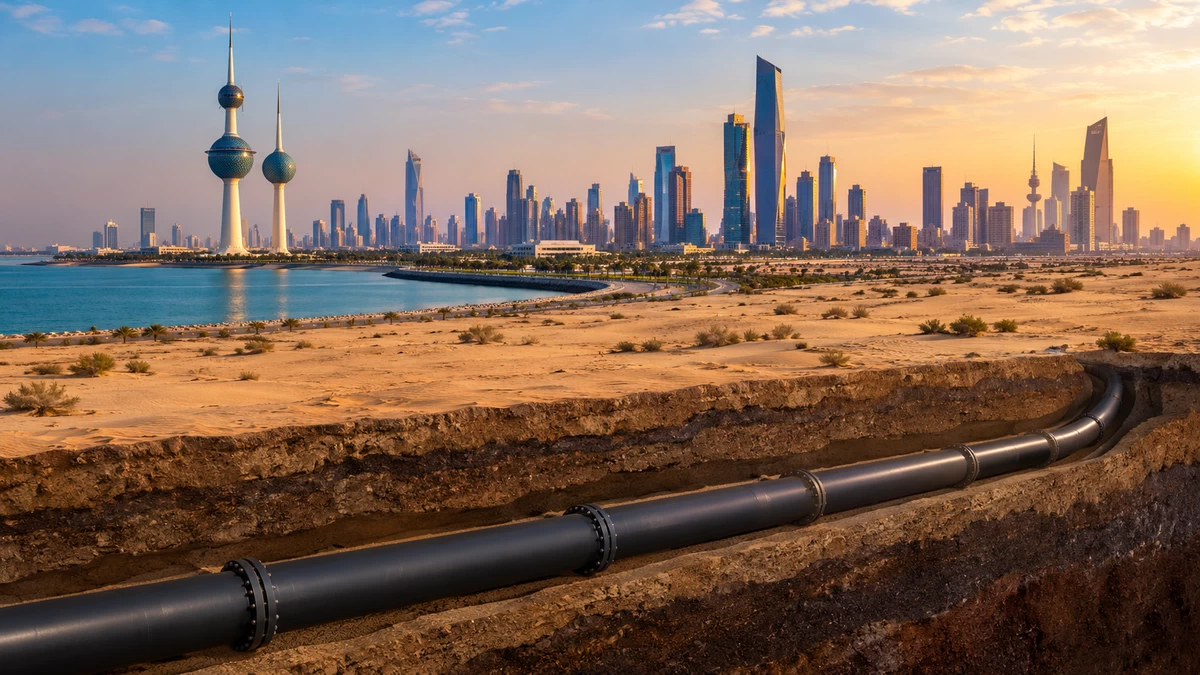
KUWAIT CITY, Sept 14: Recent attacks on oil pipelines in the region, particularly the crude oil lines in Saudi Arabia, reshaped the priorities of the Gulf Cooperation Council (GCC) countries, transforming the security of supply lines into an existential issue that transcends narrow commercial calculations. As Kuwait seriously considers laying oil pipelines in Saudi territory and neighboring countries to bypass critical maritime chokepoints, the newspaper raised a crucial question regarding the engineering and security trade-offs between laying pipelines aboveground versus burying them underground.
A high-ranking oil official emphasized that the choice between buried and aboveground pipelines depends on carefully balancing long-term security, immediate economic costs, and geographical realities. He pointed out that each option has advantages and disadvantages that affect sovereign decision-making regarding the protection of national wealth and the assurance of uninterrupted flow to global markets.
On the advantages of underground pipelines, he indicated that they offer superior military and cybersecurity compared to exposed aboveground pipelines or traditional maritime transport through straits, as they are difficult to target with drones or guided missiles. He said burying the pipelines provides comprehensive engineering protection against harsh climatic conditions, such as extreme temperature fluctuations and sandstorms.
“These pipelines ensure a continuous and stable flow of oil, unaffected by escalating geopolitical tensions in the Strait of Hormuz or the Bab al-Mandab Strait, thereby, providing Kuwait with high, consistent reliability in the eyes of its international customers in the long term,” he elaborated. On aboveground pipelines, he cited the highly complex geographical and political challenges, requiring transit through the territories of neighboring countries—such as Saudi Arabia or the Sultanate of Oman—to reach the Arabian Sea or the Red Sea.
“This renders the project entirely dependent on regional political agreements and considerations of shared sovereignty, in addition to the immense cost of constructing a massive pipeline network spanning hundreds of kilometers, a process that would take many years to complete,” he added. Regarding the cost of constructing onshore pipelines, the officials said the option to build pipelines bypassing the Straits of Hormuz and Bab al-Mandab is a complex financial equation. “It requires carefully balancing the massive capital expenditure for infrastructure against the need to protect Kuwait’s annual oil revenues and market share.
The total cost is affected by the route, which must traverse neighboring territories to reach open waters like the Red Sea or the Arabian Sea. Preliminary estimates indicate that laying a buried pipeline costs about $3 million to $5 million per kilometer, whereas an aboveground pipeline costs around $1.5 million to $2.5 million per kilometer. However, the long-term costs associated with maintenance, as well as security and military protection for aboveground lines, could erode these initial savings, given a route spanning around 1,200 kilometers to reach the Arabian Sea,” he explained.
He stated that decision-makers face a strategic investment choice requiring massive capital outlays ranging from $3.6 billion to more than $6 billion, depending on the terrain and the required level of engineering fortification. He pointed out that establishing a cross-border, underground, and structurally fortified onshore pipeline network remains the inevitable and most sustainable option to ensure the continuous and safe flow of crude oil, bypassing the volatility of maritime straits and threats to shipping. He added that constructing this system— up to 1,200 kilometers—is a genuine safeguard in spite of the high cost. “It is a new energy-geopolitics paradigm, as it secures Kuwait’s global market share and preserves its long-standing reliability among international partners amidst escalating regional tensions,” he concluded.
By Najeh Bilal Al-Seyassah/Arab Times Staff