


25/09/2026

Share:
25/09/2026
Share:

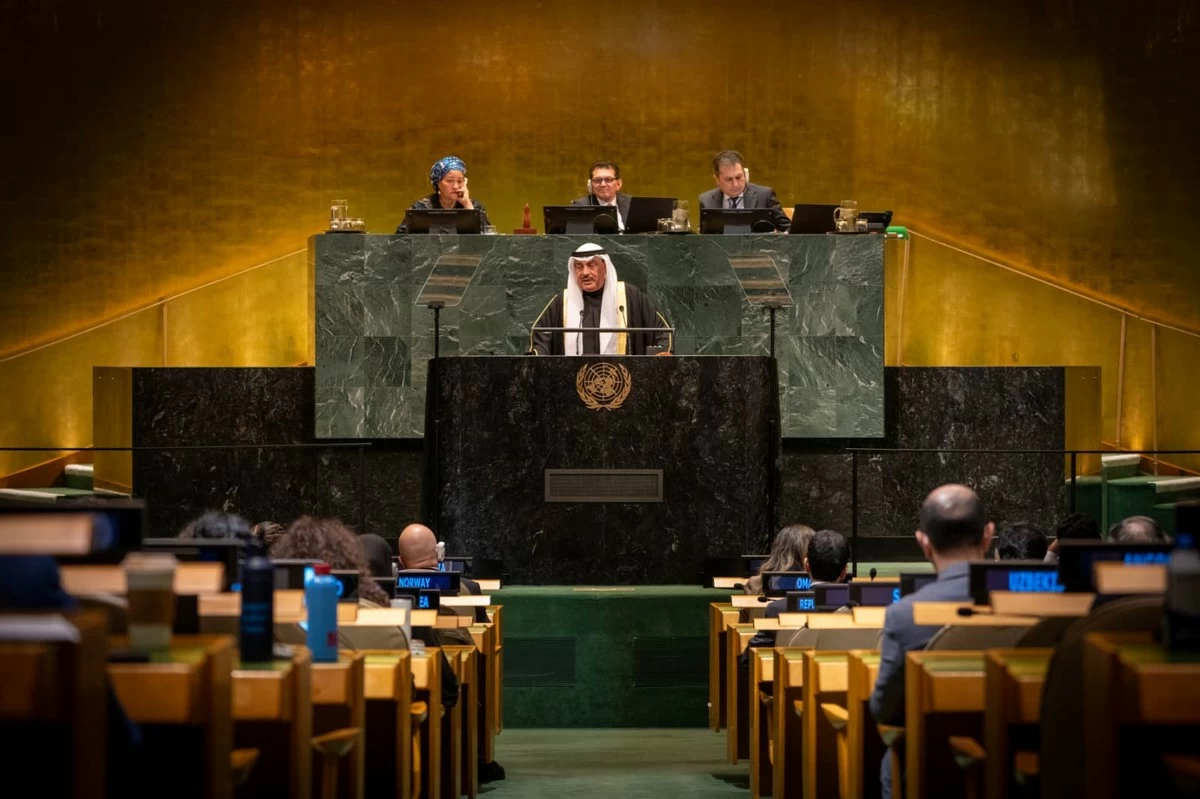
NEW YORK, Sept 25: Kuwait Crown Prince Sheikh Sabah Khaled Al-Hamad Al-Sabah said Thursday that Kuwait, the Gulf Cooperation Council states and Jordan have been subjected to Iranian attacks since February despite not being parties to the conflict, describing the strikes as violations of international law, international humanitarian law and the UN Charter.
Sheikh Sabah Khaled, representing His Highness the Emir Sheikh Mishal Al-Ahmad Al-Jaber Al-Sabah at the 81st session of the UN General Assembly, said the attacks involved ballistic and cruise missiles and drones and repeatedly targeted civilian infrastructure and vital facilities.
He specifically cited Kuwait International Airport, power and water stations and oil installations, saying the attacks had caused deaths, injuries and significant material and economic damage.
The Crown Prince also accused Iran of obstructing maritime navigation and closing the Strait of Hormuz, saying the waterway was being used as a bargaining tool in the war and that such actions violated international law and relevant UN Security Council resolutions.
Kuwait welcomed the support of countries that stood by it and backed Security Council Resolution 2817 and other international resolutions condemning the Iranian attacks. Sheikh Sabah Khaled said those resolutions affirmed the right of states to self-defense under Article 51 of the UN Charter and stressed the importance of ensuring freedom of navigation without restrictions or conditions.
He stressed that Kuwait supports diplomatic efforts aimed at de-escalation and a peaceful settlement of the conflict, commending mediation efforts by Qatar and Pakistan.
Kuwait, he said, believes any sustainable regional understanding must be based on good-neighborly relations, respect for the sovereignty of states, non-interference in internal affairs and a rejection of the use or threat of force. He also called for an end to support for proxies and militias and said regional security concerns, including Iran's nuclear program, ballistic missiles and drones, must be addressed.
The Crown Prince said Kuwait also attaches importance to guaranteeing the freedom and safety of navigation through the Strait of Hormuz and Bab el-Mandeb in accordance with international law and the 1982 UN Convention on the Law of the Sea.
Kuwait backs Iraq, demands maritime border progressTurning to Iraq, Sheikh Sabah Khaled reaffirmed Kuwait's support for its neighbor, describing a stable, secure and prosperous Iraq as a common interest for Kuwait and the region.
Kuwait welcomed steps by Iraqi Prime Minister Ali al-Zaidi to consolidate weapons under state control and strengthen Iraq's relations with neighboring countries.
He said Kuwait wants to expand bilateral relations and resolve outstanding issues, particularly the completion of maritime border demarcation beyond marker 162 in accordance with international law and the UN Convention on the Law of the Sea.
Kuwait also called on Iraq to cooperate with the UN Secretary-General's High-Level Representative on Security Council Resolution 2792 concerning Kuwaiti prisoners of war and missing persons, nationals of third countries and Kuwaiti property, including the national archives.
Kuwait calls for Palestinian rightsOn Palestine, the Crown Prince reiterated Kuwait's condemnation of what he described as ongoing violations by Israeli occupation forces against the Palestinian people.
He called for implementation of the comprehensive peace plan and subsequent phases adopted by the Security Council in Resolution 2803, including the withdrawal of Israeli forces from Gaza, the delivery of humanitarian aid and the return of the Palestinian Authority to the Strip.
Kuwait reaffirmed its position that a just and lasting peace requires an end to the Israeli occupation of Arab territories and the establishment of an independent Palestinian state within the June 4, 1967 borders, with East Jerusalem as its capital.
Kuwait condemns Houthi attacksOn Yemen, Sheikh Sabah Khaled expressed concern over the military escalation involving the Houthi group and attacks affecting navigation in Bab el-Mandeb.
Kuwait reaffirmed support for UN-led efforts to reach a comprehensive and sustainable political settlement in Yemen and stressed the importance of preserving the country's unity, sovereignty and territorial integrity.
He also condemned Houthi attacks on Saudi Arabia, including strikes targeting civilian and economic sites, and said Saudi Arabia's security is an integral part of the security of Kuwait and the GCC states.
Kuwait stresses dialogue and international lawThe Crown Prince said Kuwait's foreign policy is based on moderation, balance and commitment to the UN Charter and international law, stressing that dialogue and peaceful settlement of disputes are essential to maintaining international peace and security.
He highlighted Kuwait's humanitarian and development role through the Kuwait Fund for Arab Economic Development, which he said has financed development projects in 107 countries since 1961.
At home, he said Kuwait is moving forward with Kuwait Vision 2035 through development projects, economic diversification, digital transformation, the empowerment of women and youth, legislative development, governance and transparency.
Concluding his address, Sheikh Sabah Khaled said Kuwait's experience of occupation and regional wars had reinforced its belief in the importance of justice, international law and dialogue.
He said Kuwait believes that “just peace is the path to stability” and that respect for state sovereignty, the rights of peoples and international law are essential pillars of security and stability.
Kuwait, he said, will continue to support dialogue, cooperation and international partnerships while working to strengthen international peace and security.