


09/04/2026

Share:
09/04/2026
Share:

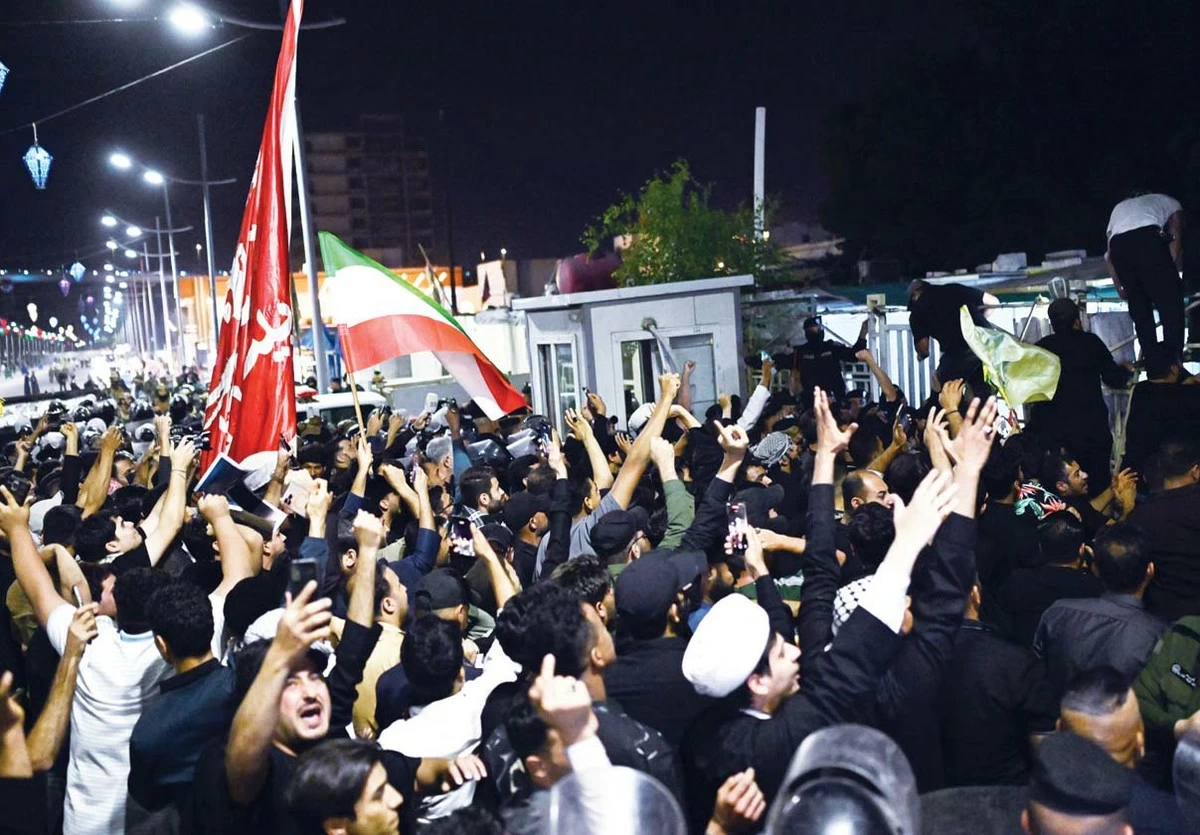
A group of Iraqi protesters storms the Kuwaiti Consulate and removes the Kuwaiti national flag from the building, in Basra, Iraq, Wednesday, April 8, 2026. (AP)
KUWAIT CITY, April 9: The attack on the Kuwaiti Consulate in Basra two days ago, including acts of vandalism and storming, sparked widespread resentment and anger among Kuwaiti citizens, as well as many Iraqis and politicians, who viewed it as a blatant violation of international conventions and norms.
According to an investigation conducted by the daily, the small group responsible for storming the consulate does not represent the Iraqi people as a whole. The Popular Mobilization Forces (PMF) act as an Iranian proxy. The report stressed the necessity of holding those involved accountable to prevent a recurrence of such deplorable acts and to curb the unchecked actions of certain factions and militias.
In this regard, the advisor to the Iraqi Prime Minister, Ayed Al-Hilali, condemned the storming of the Kuwaiti Consulate in Basra, describing the incident as deeply regrettable due to its negative implications, which are inconsistent with the longstanding historical relations and fraternal ties between Iraq and Kuwait.
He explained that the incident was impulsive and ill-considered, casting a shadow over the internal situation and raising legitimate concerns about the ability of certain parties to regulate public behavior within legal and diplomatic frameworks. The Iraqi-Kuwaiti relations have seen significant development in recent years, based on the principles of respecting sovereignty and promoting shared interests. This makes such individual actions a clear departure from the general approach adopted by both countries.
The incident cannot be seen as representing an official or public stance, but rather as an isolated event that does not reflect Iraq’s true orientation. Al-Hilali affirmed the Iraqi government’s full commitment to protecting diplomatic missions in accordance with international agreements, including the Vienna Convention on Consular Relations. He stressed the necessity of holding those involved accountable and taking legal action against them, thereby restoring the state’s prestige and sending a clear and reassuring message to the Kuwaiti side.
Al-Hilali affirmed that the incident represents a crucial test of the Iraqi state’s ability to enforce the rule of law and maintain balance in its foreign relations, ensuring that such actions are not repeated and preserving the fraternal ties between the two brotherly countries. Meanwhile, researcher and academic Dr. Ayed Al-Manna’a described the attack as an act of aggression that reflects the negligence of the relevant Iraqi authorities in protecting the Kuwaiti Consulate. He called for holding the perpetrators accountable, particularly since they recorded themselves storming the consulate, climbing onto its roof, and tearing down the Kuwaiti flag.
Dr. Al-Manna’a emphasized that these actions are completely unacceptable, especially considering Kuwait’s consistent support for Iraq through all its trials. Furthermore, Lawyer Hamdan Al- Namshan, legal advisor to the National Human Rights Bureau, stated that the attack on the Kuwaiti Consulate by a small group of Iraqis is unacceptable and that the Iraqi government must hold those responsible accountable. He emphasized that international law strictly prohibits violations of diplomatic missions.
Al-Namshan noted that the perpetrators do not represent the Iraqi people as a whole and highlighted that they are affiliated with another country. He affirmed that Kuwaiti-Iraqi relations will remain fraternal. In addition, former acting Director General of Immigration, Bader Al- Hammadi, expressed his astonishment at the attacks, asking, “Is this acceptable behavior from Iraqis toward their Kuwaiti brothers?” He recalled that during the term of Sheikh Sabah Al-Ahmad (may God have mercy on him), Kuwait provided Iraq with extensive aid, including the reconstruction of residential cities and power stations, as well as the construction of a sports stadium. Al-Hammadi stressed that the Popular Mobilization Forces (PMF) are behind the efforts to incite a segment of the Iraqi population against Kuwait, noting that this group, like Hezbollah, receives support from Iran.