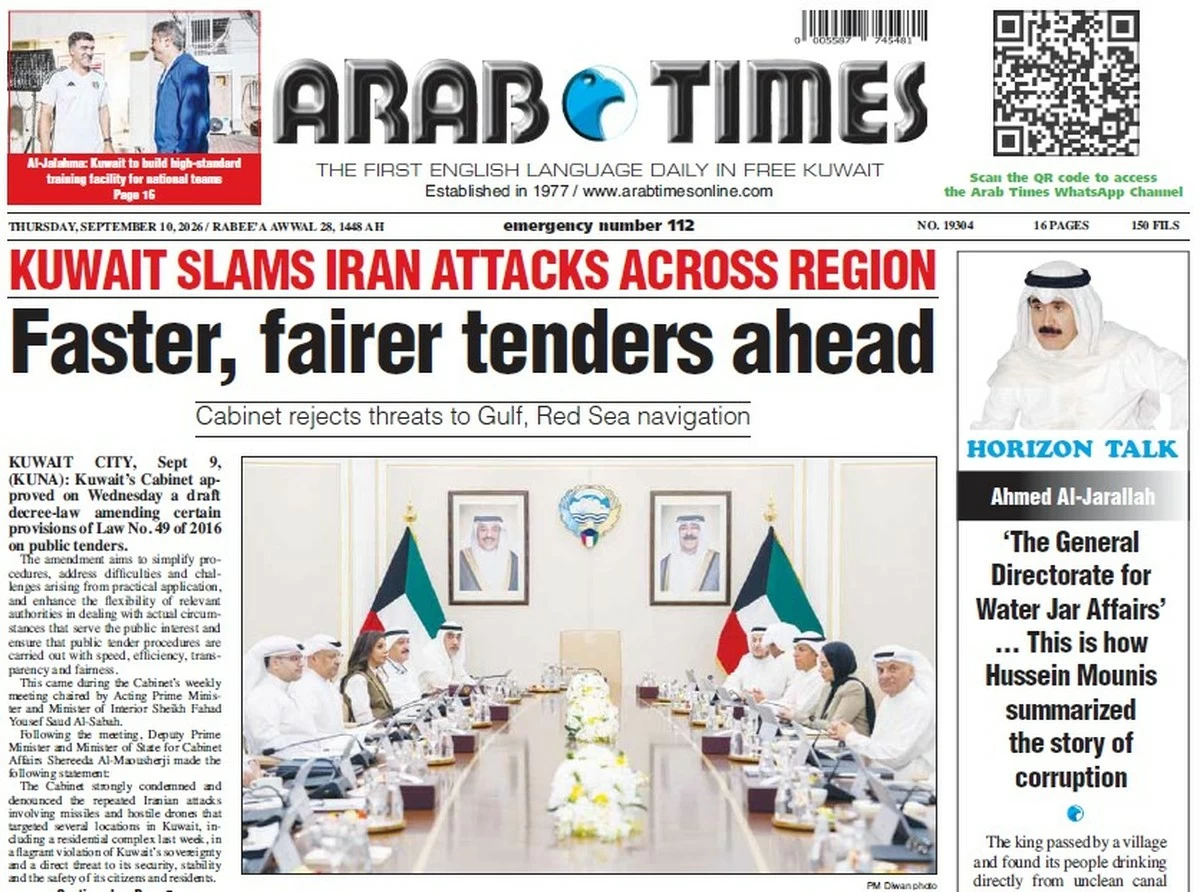



09/09/2026

Share:
09/09/2026
Share:

He considers this rapid rise, by about $11 within a short period, a reflection of the mounting pressure on the supply and demand system. He predicted that oil price will continue its meteoric rise, reaching $120 per barrel in the coming period, due to threats to strategic waterways, such as the Strait of Hormuz, and the resulting restrictions on logistical supply chains and global market supplies. He pointed out that in contrast to these dramatic shifts, the position of Kuwait emerged as a stabilizing factor and a wise analysis of the complex landscape.
He praised the confirmation of Oil Minister Tariq Al-Roumi that Kuwait remains committed to the collective decisions of the OPEC+ alliance, including its decision to maintain oil production for October at the current level of 2.67 million barrels per day. He emphasized that this step indicates the cautious and well-considered vision of Kuwait for addressing fluctuations and ensuring balance between supply and demand to prevent haphazard speculation in energy markets. He asserted that such commitment by all parties protects the global energy system, while prioritizing price stability over engaging in fierce competition for individual market shares, which could lead to an unplanned deficit that harms the interests of both the producers and consumers.
On stabilizing production, he said maintaining production at September level affirms that the oil alliance is following a flexible and rational approach to adapt to the decline in global demand. He asserted that maintaining the cohesion of the oil alliance is the strongest weapon for protecting the public budgets of the Gulf states, including Kuwait, which has recorded a budget deficit resulting from fluctuating revenues and increasing government spending. He pointed out that the oil policy of Kuwait is not based on quick profit calculations, but on a long-standing legacy of joint oil diplomacy, fully aware that any supply disruption could lead to global stagflation which harms everyone. He added that Kuwait prefers compromise solutions to ensure the continuation of global energy flows and protect the market from the geopolitical storms surrounding the region.