


25/07/2026

Share:
25/07/2026
Share:

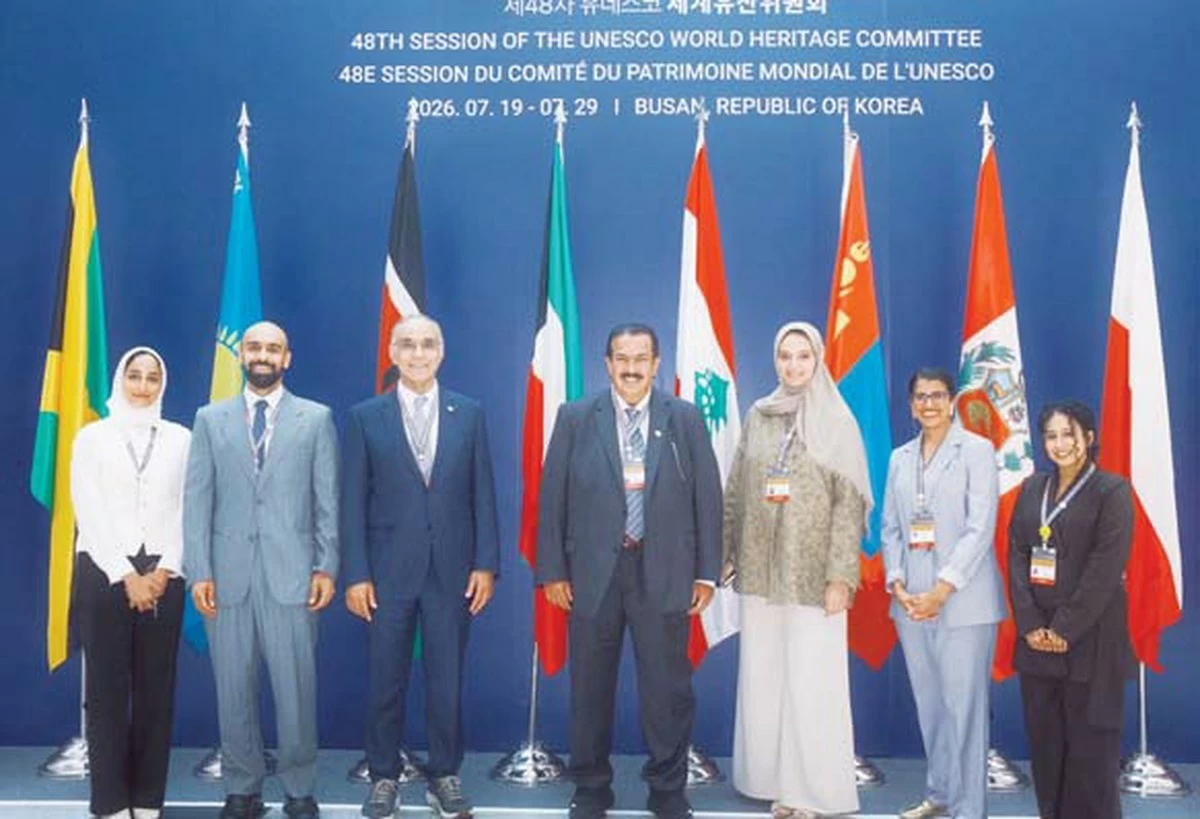
KUWAIT CITY, July 25, (Agencies): The National Council for Culture, Arts and Letters (NCCAL) affirmed the State of Kuwait’s continued commitment to supporting efforts of the United Nations Educational, Scientific and Cultural Organization (UNESCO) in protecting cultural and natural heritage by enhancing its presence in concerned international forums. This contributes to strengthening cultural cooperation and exchanging expertise with member states and relevant international organizations.
This came in a statement issued by the Council on the sidelines of Kuwait’s participation in the 48th session of the UNESCO World Heritage Committee, held in Busan, Republic of Korea until July 29. The Kuwaiti delegation is headed by the country’s Permanent Delegate to UNESCO, Ambassador Dr. Ali Al-Mudhaf, and includes the Secretary General of the Council, Dr. Mohammad Al-Jassar, along with a number of specialists in the fields of cultural and natural heritage.
The Council noted that the World Heritage Committee is one of UNESCO’s most prominent committees, responsible for implementing the 1972 Convention Concerning the Protection of the World Cultural and Natural Heritage. This includes reviewing nominations for new sites to be inscribed on the World Heritage List, assessing the state of conservation of inscribed sites, making decisions related to their protection and the preservation of their outstanding universal value, and discussing policies and programs aimed at strengthening international cooperation in the field of heritage preservation. He explained that Kuwait won membership on the committee, becoming one of 21 member states representing the Arab Group for a four-year term, following elections held at UNESCO headquarters in Paris in November 2025. Meanwhile, the Okefenokee Swamp in Georgia, an ornate 13th-century Buddhist temple in Thailand and tidal flats in western South Korea were among several sites added to the World Heritage List on Saturday at a U.N. committee meeting in South Korea.
The UNESCO meetings in Busan, which continue through next Wednesday, are reviewing dozens of other nominations, including the D-Day landing beaches in France, Mount Olympus in Greece and the ancient Japanese capitals of Asuka-Fujiwara. The Okefenokee Swamp is regarded as one of the world’s largest freshwater ecosystems, encompassing a vast network of wetlands that supports exceptional biodiversity and serves as the source of two major rivers. Its largely undisturbed peat beds preserve a 5,000-year record of environmental change, making the swamp both a globally significant natural habitat and a valuable source of information on long-term environmental change, according to a UNESCO description. While the World Heritage designation places the Okefenokee National Wildlife Refuge alongside iconic U.S. landmarks such as the Grand Canyon, some locals have opposed the listing, fearing it would increase U.N. involvement in managing the site. “We accept this inscription not as a finish line, but as a commitment to keep the Okefenokee wild, resilient, and thriving for generations to come,” said Kim Bednarek, executive director of the nonprofit Okefenokee Swamp Park that’s worked with the U.S. government on the refuge’s nomination package.
Wat Phra Mahathat Woramahawihan, a 13th-century Buddhist temple in southern Thailand known for its 78-meter (255-foot) stupa and distinctive architecture, was also inscribed on the World Heritage List, becoming Thailand’s ninth site. UNESCO has described the temple as an outstanding example of Theravada Buddhist architecture that remains a living place of worship, preserving religious traditions that draw large gatherings of devotees. The temple was first proposed to UNESCO in 2012, and has gone through more than a decade of preparation to meet the nomination requirements. While the World Heritage listing is expected to dramatically increase visitors to the temple, Kanop Ketchart, mayor of Nakhon Si Thammarat City, said officials are prepared to address potential infrastructure and capacity challenges.
A United Nations committee on Friday inscribed a major archaeological site in the West Bank and a group of castles in southern Lebanon on the World Heritage List, despite objections from Israel, which had urged the committee to reject the bids. The decision at a U.N. Educational, Scientific and Cultural Organization meeting in South Korea came days after Israel’s Foreign Ministry urged the committee to reject efforts to designate the small West Bank town of Sebastia and the Lebanese castles, calling the nominations a “weaponization of cultural heritage.”
At their meeting in Busan, members of the UNESCO committee decided to place Sebastia and five castles in Lebanon’s Mount Amel area on both the World Heritage List and the List of World Heritage in Danger after reviewing the nominations on an emergency basis, citing ongoing conflicts in the Middle East. Sebastia, a hilltop town about 10 kilometers (6 miles) northwest of Nablus in the Israeli-occupied West Bank, is identified by scholars as ancient Samaria, capital of the biblical Kingdom of Israel. The area’s archaeological remains span the Iron Age, Roman, Byzantine and Islamic periods. Christian and Islamic tradition holds that John the Baptist was buried there, according to a UNESCO website. Sebastia’s nomination, first submitted by the Palestinian delegation to UNESCO in 2012, argued that World Heritage status was needed to help preserve the site, saying it remains largely undeveloped under Israeli control and requires additional conservation despite attracting tourists.