


04/04/2026

Share:
04/04/2026
Share:
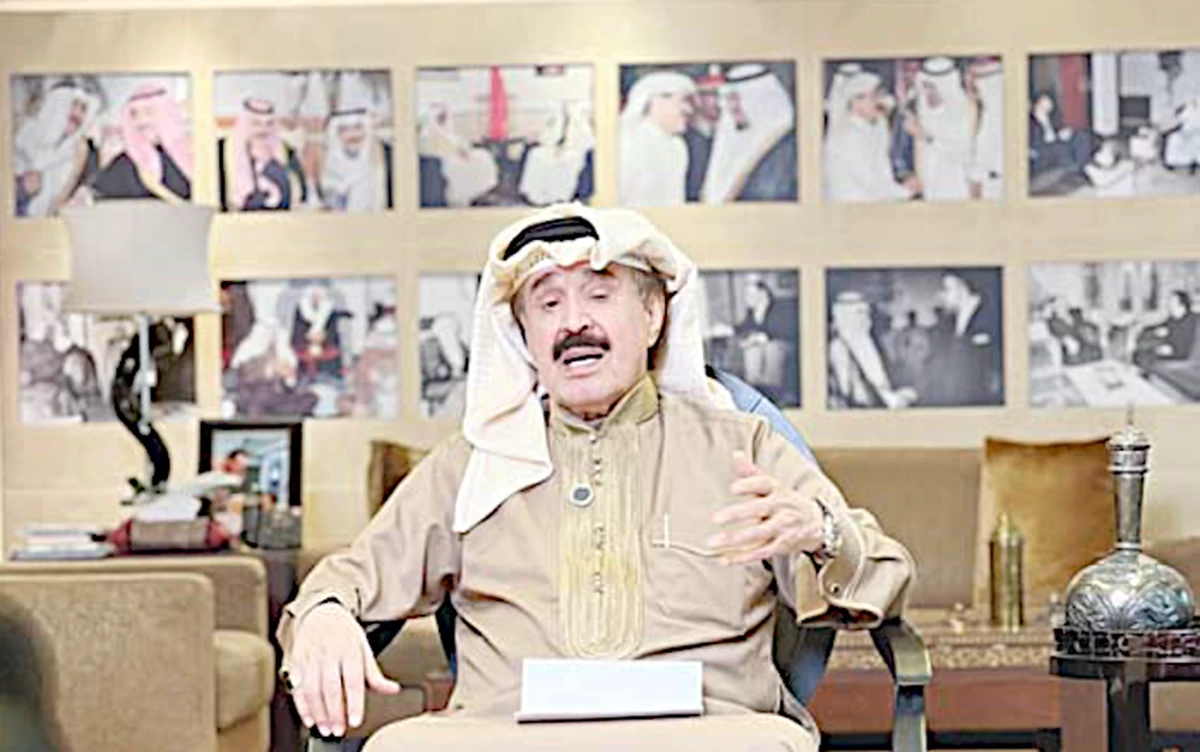
Dean of Kuwaiti journalism Al-Jarallah shares insights on local and regional developments during an exclusive interview with Kuwait TV.

KUWAIT CITY, April 4: The Iranian escalation in the Gulf is raising increasing questions about its motives and timing, even though the declared confrontation appears limited to Iran and both the United States and Israel. While the Gulf states continue to manage their daily affairs and maintain internal stability, a central question arises - Why is this escalation affecting the Gulf states? This question was the focus of a new episode of the talk show “High Tension,” presented by journalist Tony Khalifa on Al-Mashhad TV and a digital platform.
The show hosted the Dean of Kuwaiti journalism Ahmed Al-Jarallah, Editor-in-Chief of Arab Times and Al- Seyassah newspapers. Al-Jarallah began by stating that the Gulf Cooperation Council (GCC) states have never been unaware of the situation or the behavior of the Iranian regime. He explained that the regime has long pursued an ideological project aimed at exporting a model alien to the region and relies on fueling sectarian divisions as a tool of influence. This trajectory did not develop in isolation from the international context but benefited at times from a degree of leniency, particularly during the administration of former US President Barack Obama. The Obama administration gambled on the possibility of containing Tehran or reintegrating it into the international system, but the reality on the ground proved this approach misplaced. What followed was a gradual escalation, starting with Iran’s attempts to destabilize countries in the region through local proxies, which eventually progressed to direct confrontation and open threats.
Al-Jarallah went on to explain that some defenders of Iranian policy claim that the Gulf states invited foreign powers into the region. This assertion is inaccurate, as the international military presence in the Gulf was part of clear defensive arrangements and was not aimed at Iran. The Gulf states have repeatedly affirmed that they do not seek direct conflict with Iran. The idea that the Gulf states brought Israel into the situation is a gross oversimplification.
The real escalation began with Iranian rhetoric, as Tehran raised the stakes of its threats, highlighted its cross-border military capabilities, and promoted its controversial nuclear program while repeatedly obstructing international monitoring efforts. These Iranian policies prompted the international community to adopt a more stringent stance, not the other way around, holding the Gulf states responsible ignores the roots of the crisis and its true context.
Escalation
Placing full responsibility for the escalation on Iran, Al-Jarallah affirmed that the Gulf states did not invite anyone into the conflict. Regarding the ongoing debate about sympathizing with Iran, Al-Jarallah argued that the saying “the enemy of my enemy is my friend” does not reflect reality, especially when the entity in question is directly targeting the Arab and Muslim Gulf states. He explained that justifying sympathy for Iran on the basis that it opposes the United States and Israel overlooks a fundamental truth - the security of the Gulf states cannot be linked to the conflicts of other parties.
Sympathy does not change the facts, as Iran has, for over four decades, offered no justification for it. Instead, it has pursued hostile policies toward regional countries, including attempts at security breaches, support for espionage networks, and arms smuggling. Al-Jarallah cited a number of cases in Kuwait and Saudi Arabia where cells and activities linked to Iran were uncovered as part of attempts to destabilize the domestic front. He emphasized that these countries successfully contained the threats thanks to the readiness of their security services. Regarding the recent escalation, Al- Jarallah said the war, which has been ongoing for over a month, has not caused significant damage to the GCC countries, despite the intensity of the Iranian attacks. He stressed that defensive preparedness has helped intercept a large portion of missiles and drones before they reached their targets.
Al-Jarallah indicated that the Gulf states have been preparing for this phase for years by developing defense and early warning systems, which have enabled them to contain threats and minimize losses. He emphasized that the priority is protecting national security and strengthening internal stability, regardless of external considerations or alignments, stating that the events unfolding in the region require clear positions. Al-Jarallah affirmed his support for the actions of US President Donald Trump, noting that they do not harm the security or political trajectory of the Gulf states. He revealed that the countries of the region have come to understand the nature of these wars and their ultimate outcomes, adding,
“We are facing new Tatars, a rogue state that has destabilized the region, and it must be stopped. The continuation of this situation is no longer acceptable and that the current phase demands decisive action.” Stating that the regime in Iran is sectarian rather than political, Al-Jarallah asked, “Who governs Iran today? Who makes the political and military decisions there?”, alluding to the multiple centers of influence within the Iranian Revolutionary Guard. He noted that recent strikes targeted a large number of Iranian leaders, and that every day reports emerge of the assassination of prominent figures, all of whom were either running Iran or collaborating in its administration. Al-Jarallah said, “The one who runs the government in Iran today is a cunning devil, not a clearly defined political system. This reality reinforces the need to end this influence and put a stop to it.”
In response to a question about whether it is Israel or Iran that poses a greater threat to the Gulf and Arab states, Al-Jarallah affirmed that it is Iran, noting that this is well-known to all the Gulf states and their people. He acknowledged that even if some Arab countries hold differing views, reality shows otherwise. Al-Jarallah described Iran as a malevolent state with historical animosity toward the Gulf and the Arab world. He asserted that current events are an extension of this Iranian approach and that the regime governing Iran is not a normal political system. Commenting on Russian Foreign Minister Sergey Lavrov’s statement that the United States does not want the Gulf states to normalize relations with Iran, Al- Jarallah said, “I clearly state that I do not trust Iran, and any political discourse on this matter does not alter my convictions.” He called on all Gulf states to withdraw their ambassadors from Iran and expel Iranian ambassadors from their countries, emphasizing that this reflects his personal opinion that more decisive steps must be taken in dealing with Tehran, unless other considerations apply.
Al-Jarallah indicated that some diplomatic measures had been partially taken, but stressed that a firmer, collective stance toward Iran was needed from the Gulf states. In his analysis of the regional landscape, Al-Jarallah expressed his sharp and direct opinions, emphasizing that he does not support normalization with either Iran or Israel. He offered his perspective on the regional balance of power, stating, “I will not normalize relations with Iran, nor will I normalize relations with Israel. I speak from over four decades of experience in journalism and media, during which I have observed developments on both the Israeli and Iranian paths and how things have unfolded.”
Al-Jarallah explained that peace among Arab states is the only way to counter Israel and halt its expansion. Any stability or settlement with Arab countries would limit Israel’s influence, especially given the significant demographic disparity, as the Arab population numbers in the hundreds of millions, compared to a few million in Israel, which reduces its ability to impose longterm hegemony.
Criticism
Al-Jarallah continued his sharp criticism of Iran and its claims about the limits of its regional influence by saying, “The Iranians talk about Israel’s expansion, but what are your limits?! Everyone knows about Tehran’s interference in several Arab countries. The Iranians have declared control over four Arab capitals and have instigated crises in Yemen, Lebanon, Syria, and Iraq. This expansion is the most dangerous threat to the region’s stability and its impact surpasses theoretical discussions about Israeli expansion.”
In response to a question about the sabotage cells apprehended in Kuwait and other Gulf countries, Al-Jarallah replied, “What was uncovered in some Gulf countries, including Kuwait and Bahrain, was not merely limited security activity, but part of a broader project to prepare the region for chaos and political infiltration. The goal of the Al-Abdali terrorist cell was to prepare Kuwait for unrest that could later allow the imposition of Iranian influence, as had occurred in other countries in the region. Bahrain faced similar cells aimed at spreading unrest and sabotage, serving the same Iranian agenda.
The intended mechanism wasn’t a direct Iranian occupation, but rather the creation of internal chaos, terrorism, bombings, and accumulated tensions, followed by the empowerment of pro- Iranian forces to seize control of key decision-making positions, similar to the model now in place in Lebanon. These terrorist cells were established to serve this objective, whether through stockpiling weapons, organizing, providing support, or waiting for the opportune moment to act.” Regarding his vision for the end of the war, Al-Jarallah said, “I don’t believe Iran is finished yet, but it has entered a phase of extreme exhaustion. Anger toward Iran is no longer solely external, as it has become internal as well. The Iranian structure itself is now susceptible to further disintegration.” When asked about the possibility of a ground war, Al-Jarallah replied, “This war might not require a ground invasion. We have seen other battlefields and witnessed the extent of the destruction that occurred without a full-scale ground invasion. I believe the Iranians will ultimately be forced to admit defeat.”
Regarding the stances of Arab states, particularly the Arab League, toward Iran’s continued aggression against the Gulf states, the Dean of Kuwaiti journalism said, “The Gulf’s anger toward some Arab states stems from their complete failure to address Iran’s blatant aggression against the Gulf countries. It’s not a matter of partial inaction but it is a complete failure.” Al-Jarallah sharply criticized the Arab League, describing it as a dead body for years. He criticized the Arab League’s decision- making mechanism, explaining that issuing a single resolution requires the unanimous agreement of 22 member states, making it incapable of taking decisive or effective positions.
The Arab League, which was founded in 1945 through the initiatives of Arab leaders, including King Abdulaziz and King Abdullah I, is no longer able to achieve its objectives. Al-Jarallah pointed to pivotal events, such as the Iraqi invasion of Kuwait, where half the Arab world sided with the invaders instead of supporting Kuwait. He said, “There is no doubt that the continuation of this situation has stripped the Arab League of its role and value, rendering it incapable of keeping pace with challenges. The Arab League has become a place inhabited by ghosts and beneficiaries.” When asked if he supports the Gulf states remaining within the Arab League, Al-Jarallah replied, “Clearly, I call for the Gulf states to withdraw from the Arab League. Membership in the Arab League is an unnecessary expense and may even involve corruption. I advocate for seeking more effective frameworks for cooperation, similar to other regional models.”
In response to a question about the Lebanese situation and the repercussions of the fierce Israeli war on it, Al- Jarallah said, “Frankly, I cannot provide a direct answer regarding the scenarios on the ground in Lebanon. The situation there is complex and open to multiple possibilities, but there is no doubt that the comparison between what happened to Kuwait and what is happening in Lebanon is inaccurate. Kuwait is a sovereign state, while Hezbollah is a state within a state.”
He explained that the liberation of Kuwait after the Iraqi invasion was not a matter of contention because it was based on a unified state and a cohesive people, which does not apply to the Lebanese situation, where internal divisions and multiple centers of power exist. The problem in Lebanon is not the multiplicity of sects itself, but rather the monopolization of decision-making by one party, namely Hezbollah, which has imposed its influence on the other components.
This situation has disrupted the political balance in Lebanon. When asked about the fate of Hezbollah, Al-Jarallah replied, “The end of Hezbollah is not solely a matter of external decision, but is primarily linked to the stance of the Lebanese people. Change, if it occurs, will come from within, despite the presence of influential external factors. Ultimately, everyone knows that the Lebanese landscape is fundamentally different from any other experience in the region. Dealing with the Lebanese situation requires a careful analysis of its political and sectarian complexities.” Al-Jarallah believes that “the continued influence of Hezbollah within the Lebanese state has created a state of lost sovereignty, which has opened the door wide to foreign interventions.”
Invade
He said, “If you are pleased with what Israel and Hezbollah are doing, that is your decision. Then let Israel invade and rule Lebanon. The institutions of the Lebanese state are no longer capable of enforcing their decisions.” Al-Jarallah highlighted that the Iranian ambassador in Beirut refused to leave Lebanon despite official instructions declaring him persona non grata, adding that this stance clearly reflects the weakness of the central authority.
“There is no doubt that the continuation of this situation could lead Lebanon into open-ended scenarios, including an Israeli invasion or broader foreign interventions. The absence of a unified decision within Lebanon remains the decisive factor in determining the course of the next phase,” Al-Jarallah emphasized. When asked about his view of the movements of the Iraqi Popular Mobilization Forces (PMF) factions on the Syrian border, Al-Jarallah said, “The PMF operates under Iranian command despite its affiliation with the Iraqi government. These factions receive funds from the government and claim independence, but in reality, they implement agendas that transcend the Iraqi state. The movements on the Syrian border represent a distribution of harm in more than one direction within the region. This pattern has included targeting, or attempted targeting, Gulf states. All of this occurs while Iranian influence continues to control the PMF”. Regarding Iran’s relationship with the Muslim Brotherhood, Al-Jarallah said, “The Muslim Brotherhood and Iran share a tendency to exploit crises. The Muslim Brotherhood seeks a source of power, clings to it, and uses it to expand. This approach has appeared in multiple arenas, and many Arab countries, including Egypt and some Gulf states, have suffered from it. There is no doubt that recent measures taken by some countries, especially in the Gulf, have helped reduce this influence and greatly restricted the relationship based on exploiting crises to gain power.”
By Suzanne Nasser Al-Seyassah/Arab Times Staff