



15/02/2026

Share:
15/02/2026
Share:

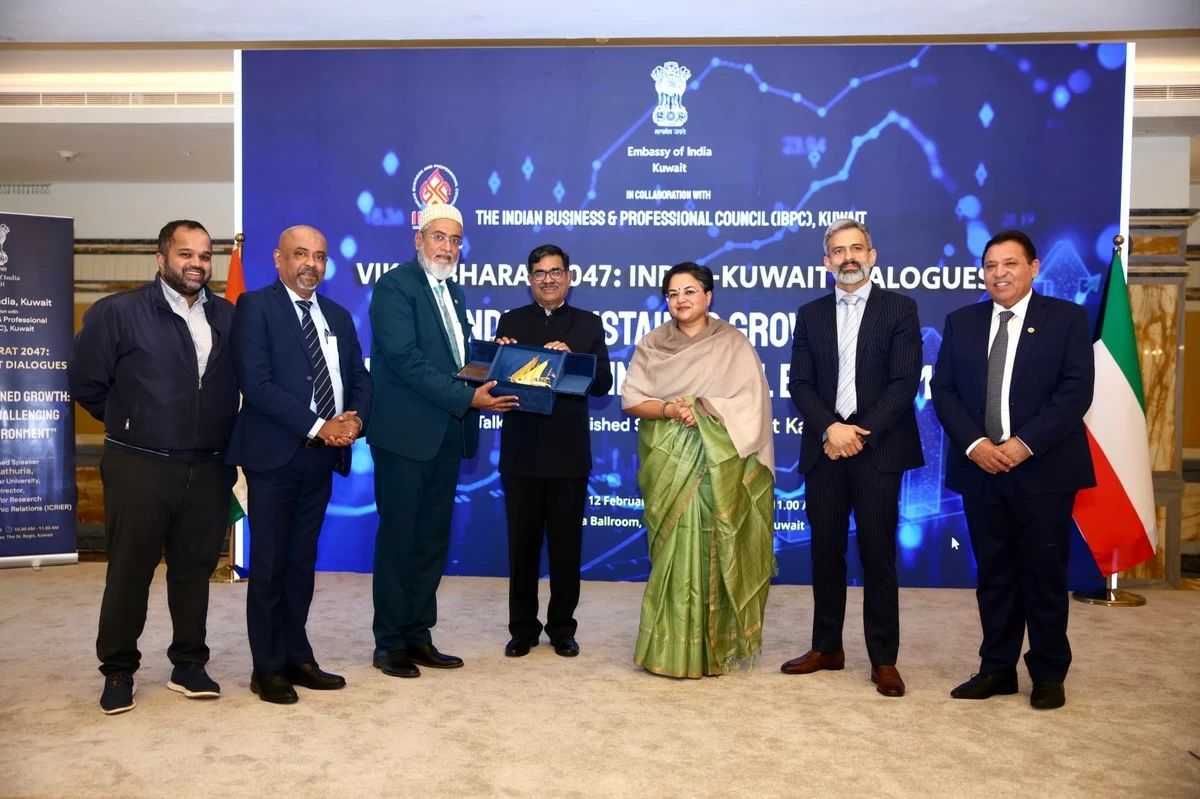
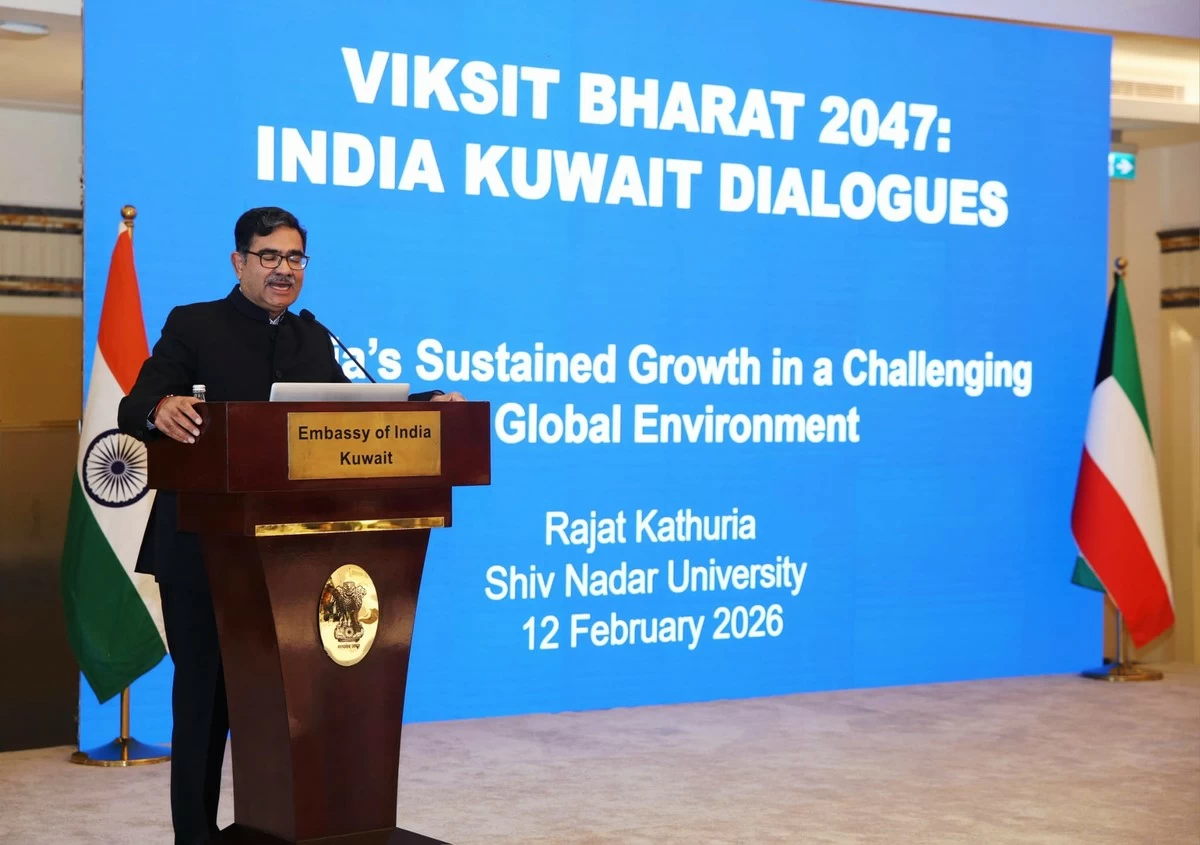
As global trade fractures, supply chains realign, and geopolitical tensions redraw economic partnerships, India is positioning itself not merely as a survivor but as an alternative growth engine for the world. It was against this backdrop that Dr. Rajesh Kathuria, Senior Visiting Professor at ICRIER, former Director and Chief Executive of the institution, and Dean of the School of Social Sciences and Humanities at Shiv Nadar University visited Kuwait to deliver a keynote lecture as part of the ‘Viksit Bharat 2047: India–Kuwait Dialogues’, organised by the Indian Embassy in collaboration with the Indian Business & Professional Council (IBPC).
The theme of his lecture focused on India’s resilience amid global disruptions, emerging trade realignments, and investment opportunities in one of the world’s fastest-growing major economies. Addressing policymakers, business leaders and members of the Indian diaspora, Dr. Kathuria examined how India has sustained 7–8% growth despite global slowdown, tariff wars and geopolitical uncertainty. With over 20 years in academia and 25 years in economic policy alongside assignments with the World Bank, ILO, UNCTAD and ADB, Dr Kathuria brought a blend of policy insight and global perspective to the discussion.
In an exclusive interview with Arab Times, he spoke about India’s services-driven growth model, the strategic advantage of its 1.4 billion-strong domestic market, the acceleration of trade partnerships with Europe and beyond, and the structural reforms needed to make India a competitive manufacturing hub. He also outlined concrete opportunities for Kuwaiti investors in infrastructure, capital markets, manufacturing and emerging sectors while cautioning against inward-looking economic policies. His message to Kuwait was direct and strategic: this is a moment of global realignment, and India offers not just growth, but partnership.
AT: India has been growing at approximately 7.8%, according to Prime Minister Modi’s statement in the first quarter of this year. Many major economies are growing more slowly than India is. Why has India grown faster than most countries during a global economic slowdown?
Dr. Kathuria: I think one must look at this in at least two ways. First, we are not only one of the largest economies in the world but will soon become the third largest. Our population is also very large. If you multiply our per capita income of roughly $2,500–$2,700 by 1.4 billion people, you get a very large number. Our economy is large relative to that of the rest of the world, but our per capita income remains relatively low. We are large, which is good, but this is only the start of a process. Our size must be seen in context. Therefore, growth of 7–7.5% or even 8% is essentially about meeting our needs and aspirations.
One explanation is the logic of arithmetic. We are still a relatively poor country, and emerging markets tend to grow rapidly. So that partly explains our growth. Secondly, we are growing rapidly because we have a very large domestic market—1.4 billion people. Approximately 50% of our growth is attributable to consumption. Some comes from investment, but consumption plays a major role. On the demand side, we have consumption, investment, and exports. On the production side, our services sector has been very robust. Services account for approximately 60% of our GDP. If that 60% grows at 9%, then 9 × 0.6 gives you 5.4%. So, 5.4% out of a 7–8% GDP growth rate is already contributed by services. That is what drives India’s growth. However, we need to do better if we want to become a truly large economy. The two reasons are: the arithmetic of being a large yet poor country, and the strong growth of the services sector.
AT: Your topic was global disruptions and challenges, and how India is managing to hold its own. If we speak of the war in Ukraine, rising prices have affected the world. How has India managed rising prices while maintaining economic growth?
Dr. Kathuria: One important point today is that the difference between nominal GDP and real GDP is historically low. The difference between nominal and real GDP essentially reflects inflation, as measured by the GDP deflator. It is growing at only about 0.5%, indicating very low inflation. We are at historically low inflation rates for several reasons. One reason is that industrial manufacturing no longer has strong pricing power. Oil prices, despite domestic taxes, are relatively low globally. We have been importing oil at historically low global prices, around $30–$40 per barrel at certain times. Prices remain high domestically due to taxes. But the import price of oil has not been increasing. The stability of oil prices is helping to keep inflation under control. If oil prices rise to $60 and we do not reduce taxes, inflation will rise.
Another factor is agricultural output. We had a strong agricultural year, and expectations are that output will remain strong. When agricultural output is strong, food prices remain stable, and expectations of price rises are lower. Low inflation is both good and concerning. It is good because food prices are under control and oil prices are stable. But low inflation can also reflect weak pricing power in the industry. Right now, although the economy is growing, industries lack strong pricing power.
One complicating factor is China’s huge excess capacity. Many countries are adopting a “China + 1” strategy, leading to excess capacity in China. Even if that excess capacity is not directly dumped into India, the expectation that it could be affects pricing decisions in India.
AT: India is currently the fastest-growing large economy in the world. Does this make India a natural competitor to China?
Dr. Kathuria: Yes. India offers today what China offered 15–20 years ago—a large domestic market that absorbs imports and exports to the world. Investment opportunities exist in labour-intensive sectors such as textiles, sports goods, and medical equipment, as well as sunrise sectors like cloud services, data services, mobile manufacturing, electronics components, and even semiconductor manufacturing. Traditional sectors such as chemicals also offer opportunities.
You can think of India as having two parts: Bharat and India. Bharat represents rural India, encompassing agriculture, food processing, fisheries, and the primary sector. India is a globally competitive economy that produces CEOs of global companies and competes in technology, FMCG, film, and other sectors.
AT: Regarding Kuwaiti investment in India, the government has increased spending on roads, railways, airports, and other infrastructure, sustaining strong growth even during difficult times. Do you see foreign companies or countries with economic strength, such as Kuwait, finding opportunities in India's infrastructure sector?
Dr Kathuria: I think the interest from Kuwait has to go beyond the traditional areas of oil and the diaspora. Those are important, but it has to expand further. In my less than two days here, I have observed that Kuwait has an appetite for investment but lacks adequate conduits. The kind of handholding and trust between India and Kuwait has not been deeply entrenched. To answer your question, yes, there are opportunities.
From what I understand, some Kuwaiti funds invest in India indirectly via U.S.-based funds. They do not directly invest in India. However, there are many opportunities for them to invest directly in India, even if they do not want to build manufacturing units like Samsung or other large corporations, as the Japanese did with Suzuki or as Nokia did. If they do not want to establish physical factories, they can invest in the stock market. There are infrastructure bonds and investment trusts that offer attractive returns. However, direct exposure to India still seems limited. Look at CDPQ, the Canadian pension fund, or Macquarie, the Australian pension fund. They are investing directly in India and have been receiving good returns. If a Canadian pension fund, subject to its investors' regulatory requirements, can invest in India, what is preventing Kuwait from doing so?
AT - India and Kuwait have a longstanding relationship, but the two countries need to strengthen economic trust to accelerate investment.
Dr Kathuria: Yes, we have not built that level of trust. I have not personally experienced it, but it is a rational and justifiable argument. What has been the dominant image of Indians in Kuwait? Primarily blue-collar workers. That shapes perceptions. It is similar to what used to happen in America. When I was there, Indians were often associated with petrol pumps or low-skilled jobs. Now it has changed 360 degrees. I believe part of the hesitation is stereotyping and perception. There needs to be greater direct engagement and better understanding between the two countries.
AT - This recent trade deal with the USA—things are a little grey, aren’t they? The recent issues with tariffs - Has it cast a shadow on India-US image as great friends?
Dr Kathuria: I think there has been a lot of positive fallout from the back-and-forth between Mr Trump and Mr Modi, and between the US and India. All things considered, I think Trump has actually done a big service for India.
AT: In what way?
Dr Kathuria: The good thing for India is that he made Europe think differently. Europe began to view India as a form of insurance. Earlier, Europe’s focus was always on standards. If you met their standards, then they would consider reducing duties. The real issue was standards. But the fact that India and Europe have now signed the agreement was a fallout of what happened between Trump, Europe, and India. We would have signed it eventually, but his actions accelerated the process.
That is the positive outcome. The second positive was that he effectively brought India and Europe together to negotiate more urgently. Imagine—what had dragged on for years suddenly moved forward within weeks. I think he has done India a great service by pushing India to sign these deals. Left to itself, India might not have signed them so quickly. That is what I mean when I say he has done a service.
AT : What have been the other fall outs?
Dr. Kathuria: In some ways, external pressures have encouraged India to sign trade agreements more quickly. Lower tariffs will enhance India's competitiveness. Historically, whenever Indian industry has faced competition, it has adapted and improved. India has signed agreements with Australia, is negotiating with Canada, and continues to engage with ASEAN countries, Japan, and others. While the WTO has weakened, India is pursuing bilateral and regional agreements to secure market access. Our current challenge is competitiveness—improving logistics, reducing bureaucratic hurdles, enhancing port and customs efficiency, and reducing corruption. The global environment actually favours India because many countries want an alternative to China. India is in a “sweet spot” where the world wants it to succeed.
AT: India aims to become a developed country by 2047, but challenges remain—unemployment, limited manufacturing jobs, low public spending on health and education, and rising inequality. What concrete steps are being taken?
Dr. Kathuria: Growth is essential. Without growth, the government will lack the resources for welfare programs and infrastructure. Growth enables public spending. The government is investing heavily in infrastructure to crowd in private investment. Better roads, ports, and connectivity reduce production costs and attract private investment. The budget includes plans for SME clusters in leather, textiles, sports goods, and medical devices. Welfare schemes such as MGNREGA and food distribution programs support millions. However, the fact that 800 million people receive food rations indicates that productive jobs are still insufficient. We should not glorify the “delivery economy.” It should be temporary, not a permanent solution. The focus must be on creating productive employment.
AT: Given the increasing use of economic sanctions and tariffs as political tools, should India focus more on self-reliance?
Dr. Kathuria: Self-sufficiency is a discredited doctrine for India. We tried that approach in the past. To become a developed country and raise per capita income to $8,000–$9,000, India must engage with the world. External engagement brings investment, technology, skills, and competition. We cannot produce everything ourselves. However, we must calibrate our engagement and prepare for risks. The recent India–EU engagement reflects a commitment to a rules-based order. India should insure itself against uncertainty but not turn inward. No country can develop in isolation.