


27/01/2026

Share:
27/01/2026
Share:

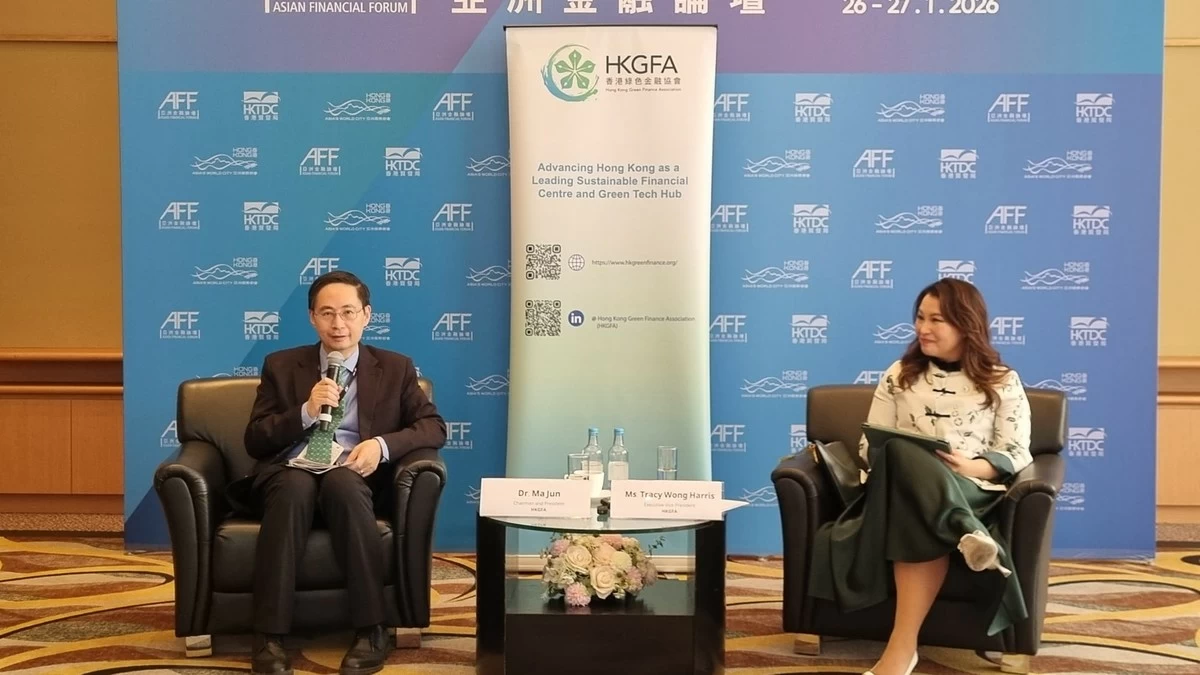
HONG KONG, Jan 27: The Hong Kong Green Finance Association (HKGFA) held a press briefing, where Chairman Dr. Ma Jun and Executive Vice President Tracy Wong Harris outlined the organization's achievements, China's pivotal role in green financing for the Global South, and Hong Kong's dominance as Asia's sustainable finance hub.
Global Landscape: Shrinking Aid Creates Private Sector ImperativeDr. Ma described a tough environment since the U.S. withdrawal from the Paris Agreement and 66 international organizations, slashing green sustainability aid. Europe's geopolitical-driven military spending hikes further squeeze OECD official development assistance for developing countries. "The space for traditional aid is limited," he stressed, positioning HKGFA as a vital bridge.
Key solutions include blended finance—partnering multilateral development banks (MDBs) to leverage their funds 10-20x into private capital—and private sector advancements: green taxonomies for project definitions, ISSB standards implementation, and unified carbon market standards to interconnect global exchanges. Public-private collaboration is non-negotiable.
China's Bond Markets Open Doors for Global South IssuersChina can lead, Dr. Ma asserted, spotlighting three RMB-denominated markets welcoming foreign issuers:
- Panda Bonds (mainland China).
- RMB Bonds, embraced by Brazil, Egypt, Hungary, and others—delivering 200-300 basis points savings versus USD rates (widening to ~300 bps recently).
- Hong Kong RMB Bonds (more flexible regulations than mainland equivalents).
- Shanghai Free Trade Zone Offshore Bonds—a newer market Dr. Ma has promoted, tapping free trade account liquidity for green/sustainability-labeled issuances (green, transition, sustainability-linked, carbon-neutral, social).
These channels mobilized 1.5 trillion RMB last year, including substantial foreign participation from emerging markets—a direct lifeline for Global South green projects.
Transition Finance Boom: G20 Framework Takes RootChina's transition finance leads globally, rooted in the 2022 G20 framework Dr. Ma co-chaired as Sustainable Finance Working Group co-chair. It funds the decarbonization of carbon-intensive sectors: steel, cement, petrochemicals, aviation. Now, 20+ provinces/cities have issued transition taxonomies defining eligible activities.
Incentives accelerate adoption: Huzhou (a pilot green finance city) offers 50% interest rebates on transition loans; others provide free carbon accounting, transition roadmaps, and templates. Jiaxing hit 50 billion RMB in transition loans within 1-2 years. Dr. Ma forecasts 100% annual growth over the next three years—models replicable in high-carbon emerging economies.
Capacity Building Goes Global: CASI's ReachHKGFA's Capacity Building Alliance of Sustainable Investment (CASI)—launched by Dr. Ma at COP28 with 17 members including Standard Chartered and HKGFA participants—has run 24 training events, reaching green finance professionals from roughly 100 countries/regions. Expansion invitations went out: "If your countries are interested, let's collaborate to boost capacity."
Hong Kong: Asia's Sustainable Finance PowerhouseExecutive Vice President, Tracy Harris welcomed visitors and affirmed Hong Kong's resilience amid "global backdrop uncertainty," anchoring Asia's ecosystem in scale, sophistication, and credibility.
2024 Record: Over US$43 billion in international GSS+ bonds (green, social, sustainability, transition)—45% of Asia's cross-border market, up 43% year-on-year, solidifying offshore hub status.
2025 Public Sector Momentum:
- June 2024: HK$27 billion green/infrastructure bonds in HKD, RMB, USD, EUR—drawing investors from 30+ global markets.
- November 2024: World's largest HK$10 billion digital green bond, with HK$130 billion+ in subscriptions.
- Cumulative: Over HK$30 billion issued, funding 200+ projects in energy efficiency, transportation, climate resilience.
Private Sector Evolution: From "green" to "rainbow" GSS+ themes. Highlights: CLP Power's HK$500 million transition bond for coal-fired asset decarbonization; Sun Hung Kai Properties' HK$40 billion sustainability loan tied to energy efficiency targets.
Tech Innovations: Tokenized settlements via e-HKD, e-CNY, and digital yuan bonds enhance efficiency/transparency, cutting mainland issuers' costs 20-30 basis points for low-carbon infrastructure.
Beyond Transition: Resilience, Cat Bonds, and Blended ModelsHarris emphasized adaptation/resilience/nature-based solutions for Asia's vulnerabilities. A 2024 high-level ASEAN finance ministers' meeting in Hong Kong advanced disaster risk finance, evolving GSS into insurance-linked securities (ILS). Two landmark cat bond deals emerged, connecting decarbonization (mitigation) with climate risk capital (resilience).
Developers are raising typhoon-resilience finance, partnering insurers to slash premiums on physical assets. Hong Kong's Insurance Authority mirrors its GSS bond grant scheme with cat bond subsidies—watch this green-risk convergence.
Blended finance gains steam via public-private-philanthropic partnerships, amplifying impact.
The briefing concluded with an invitation for questions on scaling sustainable finance worldwide.
By John Fernandes
Online Media Manager
Arab Times