


30/05/2026

Share:
30/05/2026
Share:


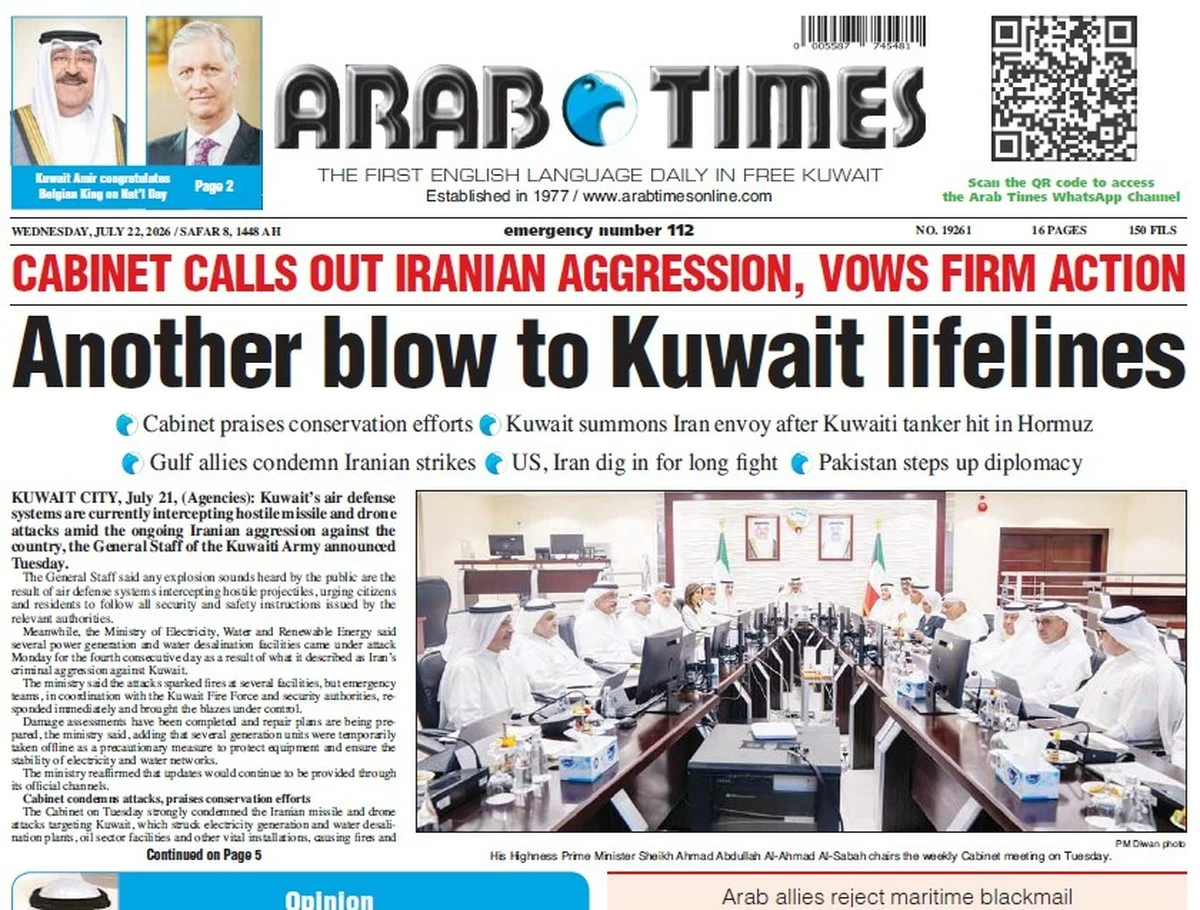
KUWAIT CITY, May 30, (Agencies): Kuwait’s Ministry of Foreign Affairs on Thursday strongly condemned Iranian missile and drone attacks targeting its territory, describing them as a dangerous escalation and a blatant violation of the country’s sovereignty, security, and territorial integrity. In a statement, the ministry said the attacks posed a direct threat to civilians and vital facilities and came amid ongoing regional and international efforts to de-escalate tensions. It stressed that such actions undermine diplomatic initiatives aimed at preserving regional security and stability, calling on Iran to immediately and unconditionally halt its attacks and holding it fully responsible for the aggression.
The ministry affirmed that the strikes constitute a flagrant breach of international law, the UN Charter, and UN Security Council Resolution 2817 (2026), reiterating Kuwait’s full right to take all necessary measures to defend its territory and protect its citizens in accordance with Article 51 of the UN Charter. The attacks drew widespread regional and international condemnation. Saudi Arabia, Bahrain, the United Arab Emirates, Qatar, Jordan, and Egypt all denounced the strikes as violations of Kuwait’s sovereignty and threats to regional stability, expressing full solidarity with Kuwait and support for measures to safeguard its security and territorial integrity. In separate calls with his counterparts from Bahrain, the UAE, and Egypt, Kuwaiti Foreign Minister Sheikh Jarrah Jaber Al-Ahmad Al-Sabah discussed the developments, with all sides reaffirming Kuwait’s right to respond to the attacks and ensure the safety of its citizens and residents. Gulf Cooperation Council Secretary-General Jasem Al-Budaiwi condemned the continued attacks as a violation of international norms and principles of good neighborliness, reiterating the GCC’s full support for Kuwait
Arab League Secretary-General Ahmad Aboul-Gheit also strongly denounced the strikes, warning that Iran’s repeated actions undermine de-escalation efforts and threaten international peace and security, while affirming that Kuwait’s security is integral to Arab national security. The Organization of Islamic Cooperation, the Muslim World League, Iraq, and Palestine likewise condemned the attacks, calling for restraint, respect for sovereignty, and the pursuit of diplomatic solutions to avoid further escalation. The European Union joined the condemnation on Friday, describing the attack as a violation of international law and a serious threat to regional stability.
The EU urged full adherence to the UN Charter and the implementation of Security Council Resolution 2817, while reaffirming its support for de-escalation efforts. Elsewhere, U.S. President Donald Trump held a White House Situation Room meeting with his advisers on Friday but has not yet made a decision on whether to move forward with a deal to extend the Iran ceasefire and reopen the Strait of Hormuz. Iran said the agreement has not been finalized. Ahead of the meeting, Trump said he was looking to make a “final determination.”
A senior administration official later said the roughly two-hour meeting with national security aides had concluded without a decision. The official, who was not authorized to comment publicly and spoke on condition of anonymity, said Trump would only sign a deal that “satisfies his redlines” and curbs Iran’s nuclear ambitions. Trump confirmed the high-level talks the day after The Associated Press and other news outlets reported that U.S. and Iranian negotiators had come to terms on a tentative agreement. The deal would extend the fragile ceasefire by 60 days as new talks are held on Iran’s disputed nuclear program.
Trump wrote on social media that “Iran must agree that they will never have a Nuclear Weapon or Bomb.” He said the strait must be reopened for international navigation and all sea mines destroyed. Iran’s main negotiator said Friday that it has “no trust in guarantees or words,” only actions, underscoring lingering distrust after the U.S. and Israel have twice attacked Iran over the past year while it was engaged in nuclear negotiations. “No step will be taken before the other side acts,” Mohammad Bagher Qalibaf wrote on X. “We do not gain concessions through talks, but through missiles.” Later, but before Trump’s meeting concluded, Iranian Foreign Ministry spokesman Esmail Baghaei told a state broadcaster that the agreement “has not been finalized yet.” On Thursday, U.S. Vice President JD Vance suggested negotiators were trying to strike general terms on Iran’s nuclear program, with the specifics to be hammered out in the ensuing talks. Baghaei, however, said Friday that Iranian officials were “focused on the end of war and are not discussing the details of the nuclear plan at this point.” Iran also wants any deal to include a truce between Israel and Iran-backed Hezbollah militants in Lebanon, where fighting has intensified despite a nominal ceasefire. And the Islamic Republic has been seeking the release of billions of dollars in frozen funds.