


05/04/2026

Share:
05/04/2026
Share:
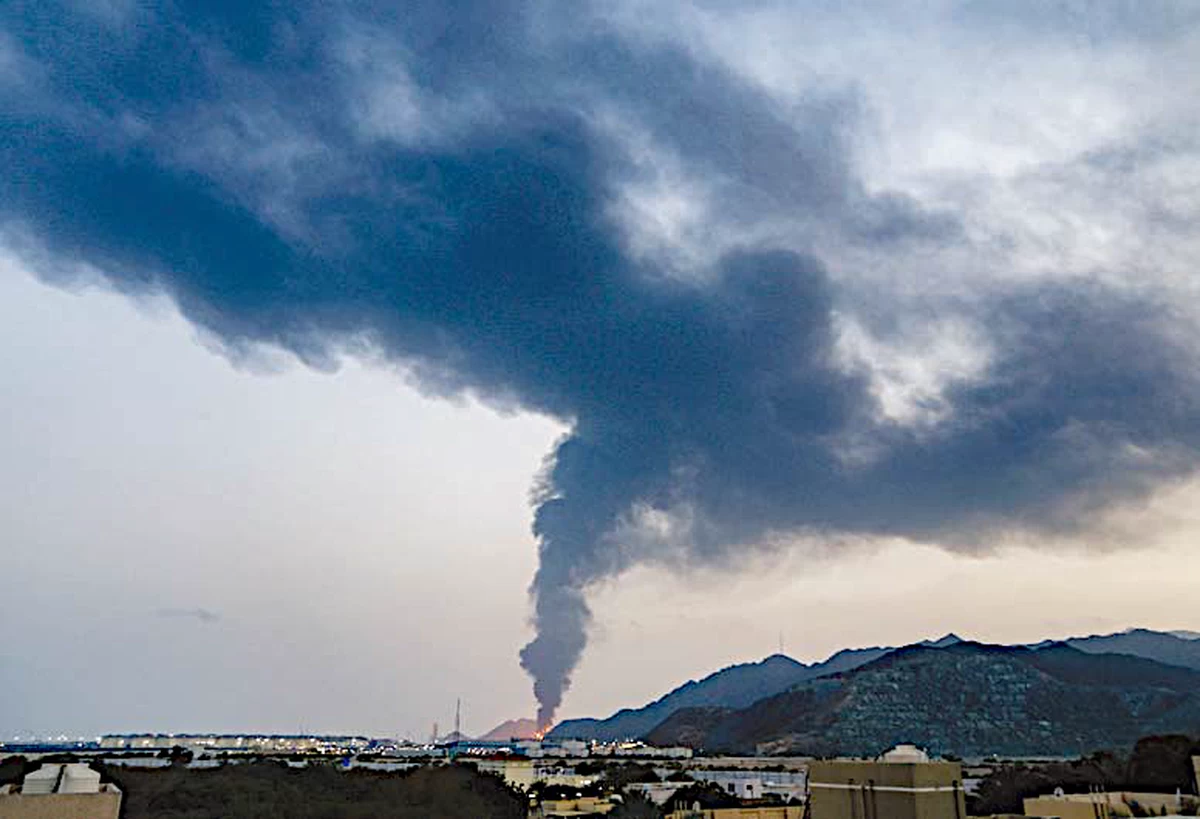
Fire and a plume of smoke is visible after, according to authorities, debris of an Iranian intercepted drone hit the Fujairah oil facility, in Fujairah, United Arab Emirates, March 3. (AP)

KUWAIT CITY, April 5: Iranian attacks on Kuwait’s oil sector have been recurring, targeting fuel tanks at Kuwait International Airport on multiple occasions, followed by attacks on the Mina Abdullah and Mina Al-Ahmadi refineries. The latest attack was reported by the Kuwait Petroleum Corporation (KPC) early Tuesday morning, stating that the Kuwaiti crude oil tanker “Al-Salmi” was directly targeted by Iran while anchored at Dubai’s port.
The fire was later brought under control, according to the Dubai Media Office on its official website. The daily consulted several oil and legal experts regarding who bears the cost of the successive losses to Kuwait’s oil sector. In this regard, economic and legal expert Athbi Al-Tahnoon confirmed in a press statement that international law obligates Iran to pay compensation for the damage inflicted on Kuwaiti oil facilities, as well as for the damage caused to the Al-Salmi tanker in Dubai waters. He explained that compensation is not limited to countries but also extends to companies, private property, and all damages incurred by citizens and residents, including compensation for deaths resulting from these attacks. Kuwait has the right to hold Iran accountable for the tangible damage caused to its oil sector and other affected parties, in accordance with international agreements. International courts recognize the principles of compensation for states responsible for destruction and loss of life and are authorized to impose additional measures, including international sanctions, as part of the compensation process. Meanwhile, oil expert Haitham Al- Azmi believes that repairing the oil and gas infrastructure in the Gulf Cooperation Council (GCC) countries, damaged by Iranian drone and missile attacks during the current war, will exceed Rystad Energy’s estimate of $25 billion. Al-Azmi explained that the costs of repair and restoring previous production levels could surpass $100 billion if the war continues for two months.
If it extends to three months, the costs could exceed $150 billion, due to rising global oil prices from the closure of the Strait of Hormuz. This would increase expenses for repair equipment, spare parts, and travel for companies carrying out the repairs. He emphasized the importance of factoring these considerations into future compensation estimates.
In addition, Dr. Madous Al-Rashidi, Professor of International Law at Kuwait University, affirmed that the cost of repairing the damage caused by Iran to the Kuwaiti and Gulf oil sectors continues to rise. He highlighted Kuwait’s right to seek compensation from Iran through international courts once the war ends, stressing that Iran defied and violated international law by targeting oil refineries and airport fuel storage tanks, as well as the Mina Abdullah and Mina Al-Ahmadi refineries with drones.
Dr. Al-Rashidi indicated that all Gulf states are expected to seek compensation for the damages they have suffered, particularly in light of Iran’s violations of international laws and norms and its disregard for good neighborly relations.
He explained that UN charters, international agreements, and international law criminalize aggression against neighbors unless justified. Iran will be required to pay compensation for all damages, including the halt of Gulf oil exports, damage to public and private property, and the recent damage to the electricity grid, which resulted in the death of an Indian employee of the Ministry of Electricity and Water. The scenario of compensation paid by Iraq to Kuwait following Saddam Hussein’s brutal invasion in the early 1990s is likely to be repeated with Iran, which has targeted Gulf states that did not attack Iran but merely intercepted missiles and drones.
By Najeh Bilal Al-Seyassah/Arab Times Staff