


02/04/2026

Share:
02/04/2026
Share:


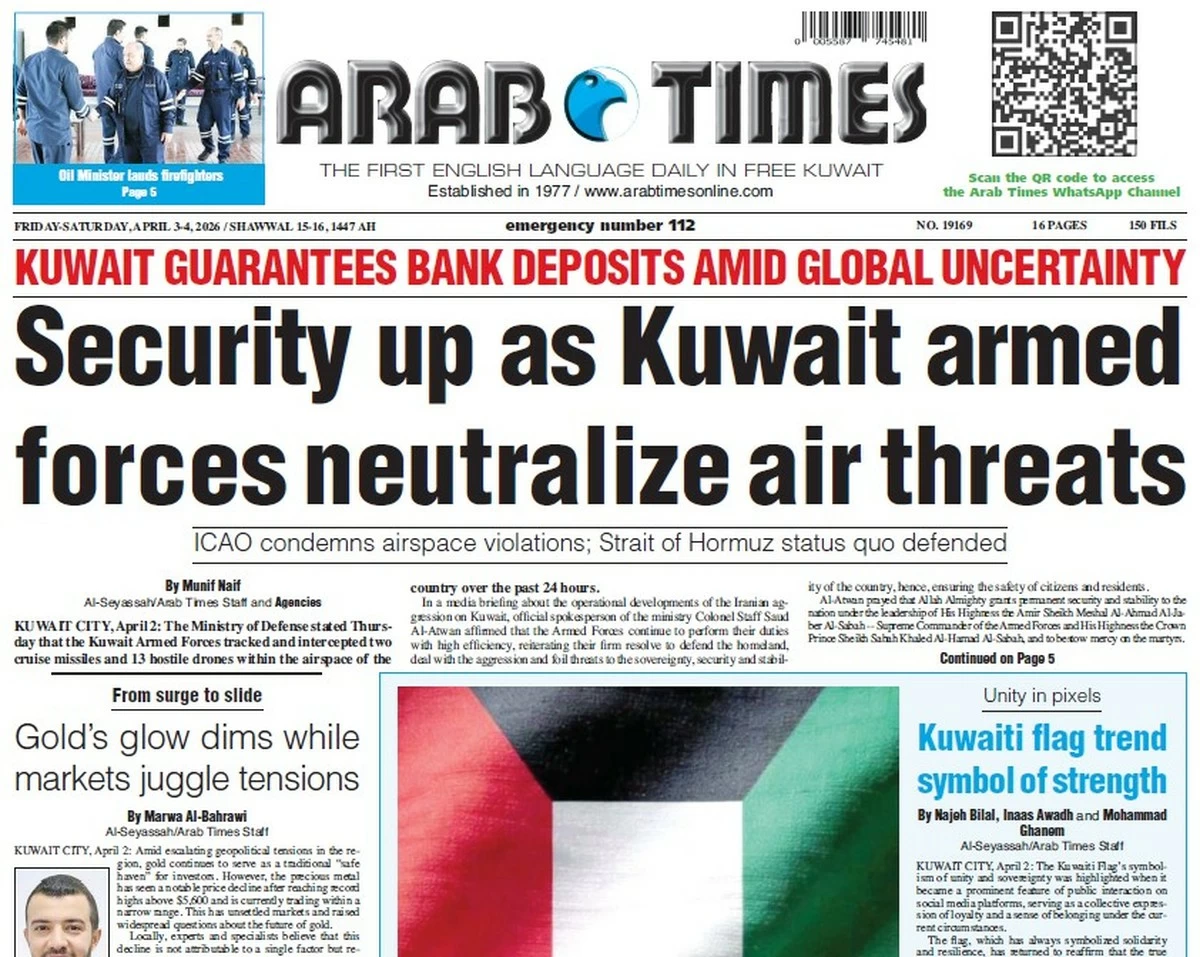
KUWAIT CITY, April 2: Amid escalating geopolitical tensions in the region, gold continues to serve as a traditional “safe haven” for investors. However, the precious metal has seen a notable price decline after reaching record highs above $5,600 and is currently trading within a narrow range. This has unsettled markets and raised widespread questions about the future of gold.
Locally, experts and specialists believe that this decline is not attributable to a single factor but results from a combination of economic, financial, and behavioral variables, along with global supply chain challenges.
Mohammed Hatab, Marketing Director at Dar Al-Sabaik, explained that the drop in gold prices is driven by several factors, primarily profit-taking, as investors bought gold ahead of escalating events and then sold afterward to realize gains. He predicted that gold will recover in the medium term, emphasizing that it will remain a safe haven, especially with continued global support. Hatab expects gold prices to reach higher levels in the coming period.
Hatab indicated that the shift in liquidity toward oil, particularly amid concerns about its supply and the potential closure of the Strait of Hormuz, played a major role in diverting funds from gold, leading to a decline in demand. Hatab noted that the stabilization of interest rates, rather than the anticipated reduction, along with rising US Treasury yields and a strong dollar, placed additional pressure on gold, given its status as an asset that does not generate periodic returns.
He emphasized that the biggest challenge facing the gold market in Kuwait lies in supply chains, as the market relies entirely on gold imports, particularly from the UAE and Switzerland. Hatab clarified that the closure of Kuwait International Airport since the beginning of the tensions has halted the flow of gold into the market. Coupled with increased demand, this has led to a decrease in the supply of certain types of bullion. He praised the efforts of the Ministry of Commerce and Industry in streamlining procedures and strengthening market oversight to curb negative practices by some traders.
Hatab noted that the shift toward land transport offers a viable solution, despite the logistical and security challenges involved. Meanwhile, gold expert Alamdar Al- Mousawi stated that the recent declines in gold prices, despite escalating geopolitical tensions, reflect a shift in market dynamics. He affirmed that gold maintains its status as a safe haven, though within a more complex equation than before.
Al-Mousawi explained that the traditional link between crises and rising gold prices is no longer absolute. Gold’s movements are influenced by multiple factors, including the strength of the US dollar, interest rate trends, global liquidity levels, and investor risk appetite. The recent surge in gold prices was driven by expectations of escalating tensions, followed by a market correction, with prices falling to levels between $4,100 and $4,500, reflecting profit-taking and risk reassessment. He described the current market situation as “pre-pricing,” where markets anticipate political and economic developments before restoring equilibrium despite ongoing uncertainty.
Al-Mousawi also highlighted the emergence of some unethical practices by a limited number of traders, including hoarding gold bars or offering them at inflated prices, exploiting the current uncertainty and supply shortages. He praised the government’s efforts in intensifying monitoring and inspection campaigns in markets in various governorates, which have contributed to stabilizing the market, curbing price manipulation, and protecting consumers. Al-Mousawi emphasized that the current supply crisis is one of the most significant challenges, particularly regarding air and sea freight, while efforts are underway to find alternatives through land transport. He noted that these circumstances may temporarily affect the availability of gold in the local market.
Al-Mousawi said global developments, including export restrictions imposed by Russia, are a supporting factor for prices in the medium term due to the potential for a global supply shortage. He predicted that gold will resume its upward trend in the coming period, driven by continued geopolitical tensions and increased investment demand. In addition, gold expert Hiba Al-Shammari stated that recent gold price movements have contradicted expectations of prices rising above $5,000. She explained that gold is currently experiencing a “temporary lull.”
This price drop has led some bullion traders to refrain from selling, either because they purchased their bullion at high prices or in anticipation of a price rebound. Markets are no longer driven solely by geopolitical events but are now significantly influenced by other rapidly changing factors, such as political statements and sudden shifts in political stances. One of the most significant challenges the market has faced recently was the closure of the Strait of Hormuz, which caused a rise in oil prices while gold prices declined, an unusual scenario that has puzzled analysts. Al-Shammari emphasized that geopolitical tensions have also contributed to a stronger dollar, which has negatively affected gold prices, noting that the market is currently experiencing a period of sharp fluctuations. She predicted that gold prices will recover in the coming period, suggesting that they could rise again to reach record levels of up to $6,000.
By Marwa Al-Bahrawi Al-Seyassah/Arab Times Staff