


10/02/2026

Share:
10/02/2026
Share:

Remote work has shifted from a temporary fix to a permanent part of how many professionals live. The hybrid and remote arrangements have become the norm in advanced economies, with employees working from home at least part of the week and expecting flexibility to stay.
The UAE has leaned into that shift. It now ranks among the world’s most attractive destinations for digital nomads and remote workers, placing second in a recent global index, thanks to its infrastructure, time zone, and lifestyle.
Against that backdrop, a lagoon-front community like Tiger Downtown Ajman is naturally starting to catch the eye of remote professionals who want more than a spare-bedroom desk in a crowded city. They want space, light, water, greenery, and reliable connectivity, while staying close enough to Dubai and Sharjah for office days or client meetings.
Tiger Downtown Ajman, backed by a reported USD 10 billion investment and developed by Tiger Properties in Al Alia, is being shaped very much with that new way of living in mind.
Why remote workers are looking beyond the big city core
Remote professionals still need access to major business hubs, but they no longer need to live directly on top of them.
Ajman has benefited from that shift. Official data from the emirate’s Department of Land and Real Estate Regulation shows that real estate transactions reached AED 12.4 billion in the first half of 2025, a 37 percent increase over the same period a year earlier, underscoring rising demand from residents and investors.
Market reports note that part of that momentum comes from people who work in Dubai or Sharjah but have chosen to live in Ajman for more space and lower costs. Moreover, the gross rental yields in the 8 to 10 percent range in several Ajman apartment communities make the emirate attractive to income-focused buyers as well.
Remote and hybrid professionals sit at the intersection of those two trends. They want a home that feels like a retreat, but they also think like investors.
That is precisely where Tiger Downtown Ajman is positioning itself.
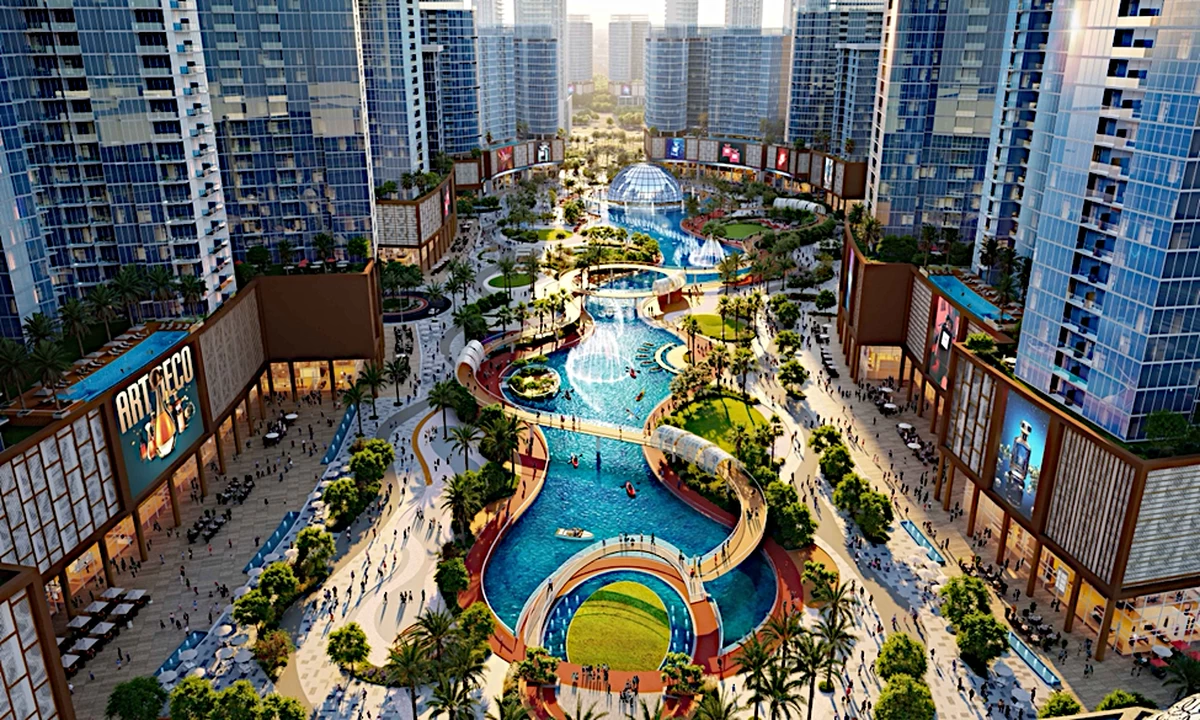
A lagoon-front community built around people
At first glance, Tiger Downtown Ajman reads like an amenities list: a 5 million square meter built-up area, 76 buildings, 20 lagoon-front towers, and a central water body measuring about 13,795 square meters with a 375-meter water edge.
If you look closer, it becomes clear that the plan is tailored to people who spend a lot of time at home:
- Pedestrian-first layout: External and internal jogging tracks, elevated walkways, and landscaped corridors connect clusters so you can move through the community on foot instead of relying on the car for every errand.
- Layered open spaces: The lagoon promenade, local parks, linear green corridors, and four dedicated children’s play areas create a network of outdoor “third places” where you can step away from the laptop without leaving the neighborhood.
- Everyday leisure: Swimming pools, a fitness center, paddle courts, an outdoor cinema, amphitheater-style seating, and food truck zones are planned as part of the standard amenity mix, not weekend add-ons.
If you’re working remotely, then it would naturally translate into a very simple but powerful shift: you can structure your day around short walks, quick runs, and real outdoor breaks instead of pacing between the kitchen and the sofa.
Location: close enough to the office, far enough from the noise
Location is often the make-or-break factor for remote professionals who still go into an office once or twice a week.
Tiger Downtown Ajman sits in Al Alia, near Sheikh Zayed Street, with quick access to major highways. According to the project brief we have and on the basis of our location map analysis, this project enables you to reach Sharjah and Dubai pretty easily, as it is:
- Around 10 minutes to Sharjah
- Roughly 15 minutes to Ajman Beach
- Approximately 20 minutes to Sharjah International Airport
- Around 30 minutes to Dubai International Airport
- An estimated 35 to 40 minutes to Dubai Downtown, depending on traffic
For hybrid workers, that means a realistic commute on office days, without having to pay central Dubai prices for a home they occupy full-time. For fully remote professionals who travel, the quick access to two major airports matters as much as the proximity to any single office.
Homes that actually work for work-from-home
If you’re a remote professional, you’d notice details inside the apartment like natural light, noise levels, flexible space for a desk, and reliable modern infrastructure.
Orchid Towers, the first phase of Tiger Downtown Ajman, tries to address those points through a mix of fully furnished studios, 1–3 bedroom apartments, 2–4 bedroom duplexes, and 6-bedroom penthouses, spread across six towers of 15 to 21 floors, all connected by a shared podium with retail and leisure areas.
Across these units, you’ll get:
- Wide windows and contemporary interiors, which support natural light and a more pleasant work environment.
- Efficient layouts, making it easier to carve out a dedicated work corner in a living room or bedroom, rather than working from the dining table indefinitely.
- Fully furnished fit-out, which means a remote worker relocating from another emirate or country does not have to furnish from scratch before getting back to their normal working rhythm.
The smaller furnished units in Orchid Towers start from around AED 420,000. This comes with a 70/30 payment plan that spreads the cost through construction and into the post-handover period.
For a remote professional who is also thinking about investment, that combination of ticket size, payment structure, and finish level is often a key part of the appeal.
Turning the workday into a waterfront routine
It is one thing to say a place is “good for remote work.” It is another to imagine the day.
In Tiger Downtown Ajman, a typical remote workday could look something like this:
- Early morning: A 20- to 30-minute jog or walk along the external track and the lagoon promenade before logging in, instead of sitting in traffic.
- Mid-morning break: Coffee at a café on the podium level or a short walk across a shaded park.
- Afternoon reset: A quick swim or gym session inside the community fitness facilities when energy dips.
- Evening: Strolling past the lagoon and outdoor cinema, meeting friends at a restaurant on the promenade, or simply sitting by the water.
Over time, that rhythm changes how a remote professional feels about working from home. The laptop is still central, but the environment around it is calmer, more active, and more social.
A lifestyle that reduces friction
One of the underappreciated aspects of remote work is friction: the small frictions of groceries, deliveries, childcare, medical appointments, and social life that can erode the benefits of skipping the commute.
Tiger Downtown Ajman tries to reduce those frictions by integrating:
- Retail and daily services at street level, supported by around 77,000 square meters of retail and 41,000 square meters of commercial space in the wider project, which are expected to host shops, cafés, clinics, and offices.
- Community facilities such as nurseries, health centers, mosques, libraries, and a community center, which keep many everyday tasks within the neighborhood.
- Family-friendly planning, with multiple play areas and green spaces so that parents working from home can take children out quickly without getting into the car.
The investor lens on “waterfront-from-home”
You, as a remote professional, are not just users of this kind of community; many are also potential buyers.
Recent real estate reports highlight Ajman’s rise as a high-yield, growth market, with apartment prices rising across key districts and yields in the 8 to 10 percent range in well-positioned projects. For a remote worker earning in dirhams or a foreign currency, a furnished unit in Tiger Downtown Ajman can serve two roles at once:
- A primary residence that supports their current work-from-home lifestyle.
- A future income asset, where the same qualities that make it good to live in (amenities, lagoon, connectivity) help support tenant demand and occupancy if they decide to rent it out later.
“A community for the flexible generation”
The way Tiger’s leadership describes Tiger Downtown Ajman reinforces that this is not just a conventional project.
In line with comments made during the launch of the development, CEO of Tiger Properties, Eng. Amer Waleed Al Zaabi has emphasized that the company is building communities for a new generation whose lives do not follow the old five-day commute pattern. Summing up the intent behind Tiger Downtown, his position is straightforward:
“More of our residents now build their week around a laptop rather than a fixed office desk. With this resort-like multi-billion project, we wanted to give them a place where that reality works in their favor by combining a calm lagoon front setting, strong connectivity, and homes that are ready to live and work in from day one.”
For remote professionals weighing up where they want to base themselves for the next five or ten years, that is a clear proposition.
From work-from-home to waterfront-from-home
Remote work has given people more freedom to choose where they live. The question now is how to use that freedom well.
If you want to stay plugged into the UAE’s major business centers but escape the intensity of central Dubai, a lagoon-front district in Ajman with fully furnished homes, strong amenities, and a realistic commute begins to look compelling.
Tiger Downtown Ajman sits exactly in that space.
It offers the possibility of waterfront-from-home: a work life framed by water, greenery, and walkable streets, with a major city still comfortably within reach.