


17/08/2026

Share:
17/08/2026
Share:

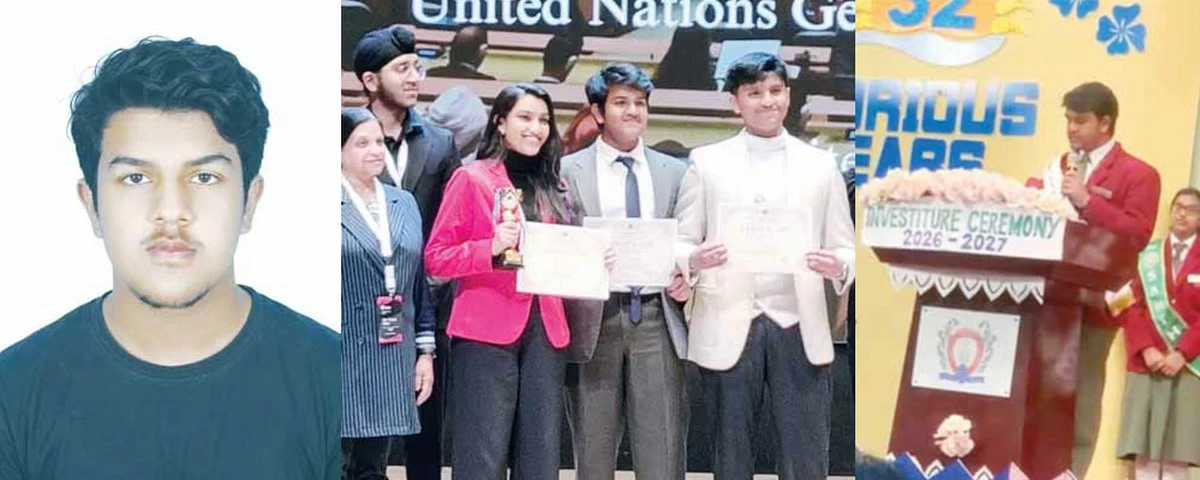
(Left) Mahir Aiman (Center) Mahir Aiman winning the Best Position Paper Award (FMUN24). (Right) Mahir Aiman being sworn in as the Vice Head Boy of Gulf Indian School.
KUWAIT CITY, Aug 17: At just 17 years old, Mahir Aiman, a Class 12 student at the Gulf Indian School in Kuwait, has already found his voice in the world of writing, journalism, and diplomacy. He is currently involved with the news portal “Indians in Kuwait,” where, as a youth reporter, he has covered stories on society, the environment, and current affairs.
In an interview with the Arab Times, Aiman reflected on his experience growing up as a Kuwait-born Bangladeshi and how his upbringing and socialization as a child sparked his interest in politics and global affairs.
Growing up surrounded by people from different cultures and backgrounds, he was able to witness something that would leave a lasting impression on him - the value of respectful dialogue, understanding, and tolerance among Kuwait’s diverse expatriate communities.
For Aiman, this multicultural upbringing offered more than just exposure to different traditions and perspectives. It taught him the importance of listening to others and looking beyond differences. “Slowly the realization hit me that conflict cannot solve anything. We need to have proper discussions and gain the point of view of different cultures. That really helped me analyze different cultural issues.”
It was this unique experience of growing up in Kuwait’s rich cultural tapestry that nurtured his curiosity about the world around him, and encouraged him to learn about other nations and understand their challenges and issues.
In his initial request to the Arab Times, Mahir stated that one of the objectives of his interview was to portray how education can pave the way for activism and advocacy. He himself has walked this path through his participation in various debate competitions and Model United Nations events, receiving several accolades, including a Best Position Paper award at an MUN.
When asked how these experiences had shaped his outlook and mindset, he emphasized the importance of proper education and his community of teachers, who motivated students at Gulf Indian School to participate in inter-school events for the valuable experiences they offered.
Recalling an instance from his first Model UN, Mahir spoke about a particularly respectful and peaceful debate between two representatives, taking place amid the usual overlapping conversations, interruptions, and arguments between candidates. “At the end of the conference the two delegates actually listening to each other ended up snatching the awards. After speaking to one of the chairs at the MUN, they confirmed that their mutual respect was one of the main reasons why they had won.”
According to Mahir, that anecdote changed his perspective on conversations and instilled in him the importance of respecting an opponent and objectively understanding their perspective, which he sees as an essential part of diplomacy in resolving conflicts surrounding sensitive issues. When asked about his recent endeavour - an upcoming feature with KTV2’s “The Untold” podcast, which he sees as a point of consolidation in his journey so far, from his initial interests to school events, writing columns, and eventually authoring books - he described his journey as quite challenging.
“Growing up, and even now, I never really fit into the standards set by society regarding looks. The younger version of myself was more insecure and lacked confidence. I knew what I wanted to do, knew my passion, but I felt shy talking about it or really reaching out. You know, the whole thing of ‘what will people think?’ That made my journey a bit more turbulent.”
As his first step towards overcoming that fear, Mahir drew inspiration from the popular Hindi line, “Kuch toh log kahenge, logon ka kaam hai kehna,” which roughly translates to, “People are going to talk about you no matter what you do; it’s their job to talk.” He credits this thought with inspiring him to take action, explaining that moving forward, his goal would become fodder for those people to talk about, but at least it would mean that he had done something worthy of their gossip.
He considers his MUNs the second step in this process, opening him up to activism and environmental issues. The experience led him to constantly rethink the arguments made by delegates and the topics discussed, ultimately strengthening his confidence in what he knew and what he was doing. Mahir additionally credits his teachers for supporting him throughout this journey.
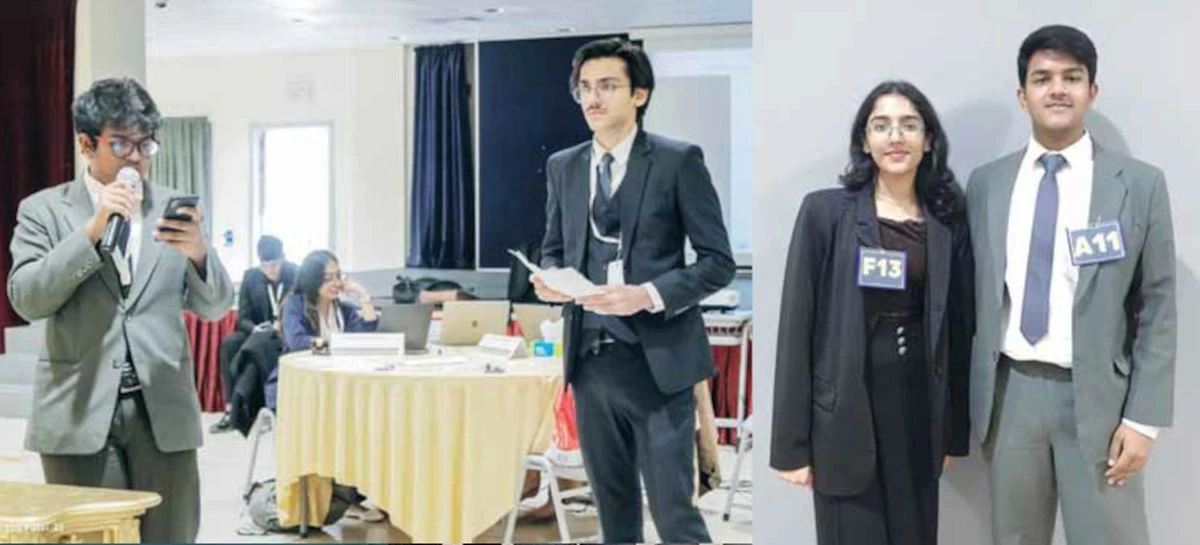
(Left) Mahir Aiman presenting a resolution at a MUN conference. (Right) Mahir Aiman at the debate competition “Battle With Words”.
Mahir Aiman: I had a Geography and Political Science teacher, Dr. Farinda Khan. She really helped me throughout my journey. I remember whenever I felt nervous, she used to tell me, “Mahir, just let it be. No matter if you win or not, we are here to learn from the experience. Enjoy the experience. You shouldn’t go back with regrets that you did not enjoy the experience.” Then came my English teacher, Mrs. Savita Prasad. She really amplified and brought out the love for literature I had in me, and about a year later, I wrote my first book.
Arab Times: Is there something from both your journey and overcoming your fears that perhaps the readers could learn from?
Aiman: I would like to say to the readers that your educators, your family, your friends, and the people you surround yourself with can have the power to make you or break you. So, be respectful to the people who are around you, including your educators, your peers, your juniors, your seniors, and more than that, choose the people you surround yourself with, because they are going to have a direct impact on the work that you do or the ambitions that you may pursue. I would also say that you need to have patience. Not everything happens overnight. You may begin a project now, and you may complete it now or a year later. It was one of my wildest dreams to be called on national television for a podcast, and it really happened very randomly. I remember my second book, “When a Generation Spoke,” which is about Gen Z’s activism around the world. About two weeks after it came out, I got a message from KTV saying, “We are planning to invite you to the podcast. Would you be up for it?” And before I knew it, I was at the studio. I still cannot comprehend that because I am just a student trying to bring attention to issues. It wasn’t overnight; it took a few years. But following my passions made the time go by quite leisurely.” When discussing his first book, “The Memoirs of 13 Days of War,” and his choice to conclude each chapter with a poem, Mahir points to the traumatic sentiments of those thirteen days and their impact on the people of Kuwait. “Anyone who was in Kuwait at the time remembers those days very peculiarly.” He explains that his choice to use poetry was a reflection of each particular day through the eyes of ordinary people, focusing on the human stories rather than the political turmoil. “Every night, I would sit, and I would finish a chapter dedicated to that particular day. I feel the lines that I have selected are authentic in depicting the emotions that I felt.”
AT: Now, you described a bit of your writing process. Let’s dive deeper into that. Particularly, is there something that you think young individuals reading this can themselves apply to their work ethic?
Aiman: I feel that with every project that you undertake, you should have the strength to not listen to praise and simply keep going. Learn to live without validation, because there’s a whole world out there that will not commend you for an accomplishment, and you should learn to be okay with that. I was told by someone really close to me, “Keep doing your work. The fame, if you do get some, or the recognition, if you do get some, is just a byproduct. The main goal here is to follow your passion so that when you grow up, no matter if you have flourished in that certain field, at least it is justified to you and you can make yourself understand that I gave it a try.” More than that, I feel you should have the capability to make certain sacrifices. I say that because sometimes I’ve not gone out with my friends or not taken a break to go on social media that day because I was busy with my project. I am one of the top four leaders at my school’s student council, there is a lot of work that depends on me, I have courses ongoing, and I have my academics. So, to the readers, I’d say, pick your passion and ask yourself if you can sacrifice something for it. Tomorrow, if you need to skip an outing with your friends, would you be willing to do that? Would you be disciplined enough to instead get your task done? You should really train your mind to see that project as the primary task, so you won’t even have the thought of putting it aside.
AT: Let’s talk about your future aspirations. You’ve mentioned that you aim to become a human rights lawyer and work alongside the UN. Would you say there is a focal point in your plan from which you intend to achieve a particular outcome?
Aiman: Yes, there is quite a lot I’d like to achieve by becoming a human rights lawyer. Terrible things are happening around the world, and although great advocates and lawyers are fighting against them, I don’t see enough traction from people simply as humans. Before being an activist or a journalist, you are a human being, before your occupation or whatever you do in your life. So, I feel that as humans, there are not enough voices rising against injustices such as the Palestinian cause. There is no clear channel for us to raise our voices to support them. They are being denied food, defense, and basic human necessities, yet there still aren’t enough voices speaking out against that. There is a fire in me about wanting to work towards bringing them to justice. Your voice is your closest friend and your most powerful tool that can be used against injustice. Secondly, across the entire Indian subcontinent, women face domestic violence daily, and it has been normalized when it is really unacceptable. I would like to work in the human rights sector to hopefully be a part of making better policies that safeguard these women and protect these victims.
AT: In “The Battle with Words” debate competition, you participated in a debate on the topic, “Is cultural diversity an asset to a nation?” It’s certainly a very relevant topic. What sort of awareness is required on this topic today that readers should consider?
Aiman: I feel that cultural diversity is an asset to a nation only if the government knows how to handle it. We witness a lot of governments looking generously towards one community and forgetting the other, which can later lead to clashes and fuel the argument that diversity is a liability. But I feel that a nation where people have mutual respect is one of the greatest assets to humanity. It teaches you that no matter where you or the other person is from, mutual respect must always exist. I feel that readers will relate to this if they have grown up in a country like Kuwait or anywhere in the GCC, because we see people from different cultures bonding everywhere around us, even at school, where there is so much cultural diversity, whether that is Indians, Bangladeshis, Pakistanis, Palestinians, or Arabs. I feel that it is a blessing for any child to grow up surrounded by all these cultures. I truly believe that this is one of the greatest assets we can have as human beings.
AT: You have had your opinions voiced by several different outlets before. What is it in particular that you wish to achieve by having this interview with the Arab Times?
Aiman: I feel that Arab Times is doing a great job of promoting the youth and giving them a voice, and I’m really grateful for that. I simply sent the email thinking, “Okay, let’s give it a try, maybe someone will see it,” and I actually got a response. I also don’t want my age to matter when it comes to the work that I do. Being a part of this nation’s youth is enough reason for me to speak about things, but I still need credibility. If I end up going somewhere for an investigative article or perhaps to research another book, the first thing I might be asked is, “Who even are you? You’re barely an adult,” or “Who gave you the authority to do this?” So, being featured in Arab Times will help me gain that recognition and amplify the work that I do. More than that, I’ve noticed that recently, Gen Z has been going back to newspapers. I see more and more young people picking up newspapers nowadays. So, if through Arab Times I can positively impact even one young person’s life, I would feel that sense of satisfaction and success for myself.
AT: So finally, to these young people who are hopefully reading, what would you like to say or urge them to do?
Aiman: I would like to say that Mother Nature provides us with a lot. It has taken care of us, so learn to take care of it too. Learn to take small, meaningful actions, even if someone else is not doing them, because your actions, combined with those of other people, can create a much bigger positive impact. For example, when we go to small shops, the bakalas, and buy something, we can refuse the plastic bags they offer to carry our things. It may seem insignificant, but now imagine a thousand young people doing the same. The plastic pollution in this country and the issues surrounding plastic could go down drastically. So, I feel that learning to be selfless and taking actions that may help nature and the environment around you is important. Also, growing up, I faced bullying a lot, and as I’ve gotten older, I’ve noticed that people are becoming meaner in a way that can make a child hesitant to talk about the things they like or the things they have achieved. So, to anyone reading, I’d like to tell them to choose kindness. Maybe a child’s achievement has nothing to do with your interests. Fine, say congratulations and move on, or have a small conversation and move on. There is no need to be mean. It is a very serious issue, and I say this because I have a younger sibling who sometimes tells me about children saying things such as, “What’s the point of studying? Won’t you just end up married in the end?” I feel that hearing something like this from another child is a big statement, and this stigma needs to be broken. I have also seen many children, even as a joke, undermine the abilities of women and fail to give them the respect they deserve. I feel like there are many concerning habits and mindsets among young people today. So, to the readers, I would say once again: choose kindness. Sometimes, even the smallest act of kindness can make a difference in someone else’s life.
By Reem Javed Baloch
Special to the Arab Times