

25/11/2026

Share:
25/11/2026
Share:

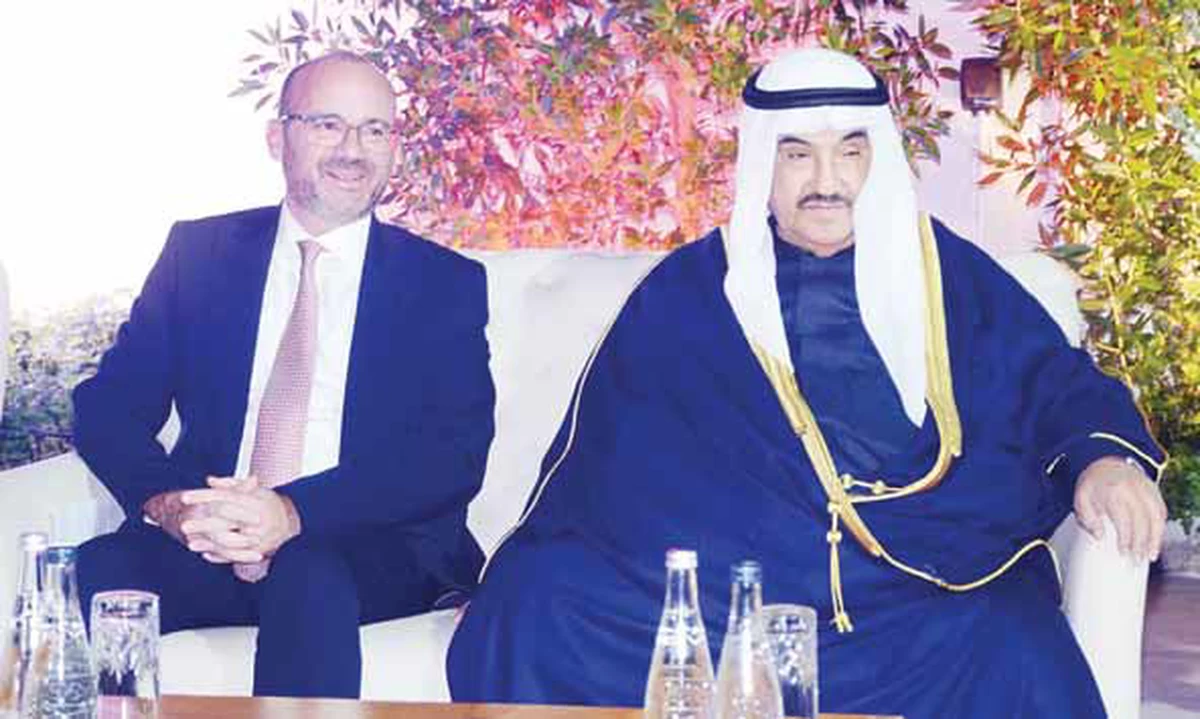
The event gathered ambassadors of Organisation Internationale de la Francophonie (OIF) member states, members of the diplomatic corps, a representative of the International Committee of the Red Cross, delegates from government bodies, cultural institutions and the private sector, as well as politicians, writers, artists and media representatives. It featured a piano performance by Sharifa Al-Atiqi, a student at Al- Jazaer School, who presented an original composition, followed by the violin performance of Maria Artinian.
Sheikh Nasser indicated that although Kuwait is not yet an official member of the OIF, it maintains a rich, active and longstanding relationship with the French language. He said this year’s celebration coincides with the 38th International Francophonie Day and the 56th anniversary of the organization’s establishment, stressing that the continuation of such celebrations for an extended period is an achievement in itself. He pointed out that Kuwait’s observance of the occasion has developed into an annual tradition dating back to the turn of the millennium. He stated that in the last two decades, the celebrations have grown into a month-long program of activities, featuring spelling competitions, film screenings, sports tournaments and panel discussions at Kuwait University. He also recalled that during the term of French President Jacques Chirac, Radio France Internationale (RFI) began broadcasting in French to Kuwait via satellite.
He revealed that the Francophonie has recorded remarkable achievements, foremost among them is the steady expansion of the global French-speaking population. He stressed that Africa has emerged as “the beating heart of the Francophonie and the primary driver of its expansion,” signaling a gradual shift in the movement’s center of gravity from the banks of the Seine in Paris to the heart of the African continent. He also talked about the organization’s 20th summit, held this year in Phnom Penh -- the Cambodian capital, with the theme, “Reinvesting in Peace for Shared Prosperity and Sustainable Stability.” He said the theme is a reflection of Cambodia’s own experience of overcoming conflict and embarking on a path of reconstruction. He added that the organization’s achievements extend to the political, educational and economic fields. He disclosed that one of its landmark initiatives was the adoption of the Bamako Declaration in 2000 which, for the first time, formally linked membership in the Francophonie with a commitment to champion democracy and human rights. He indicated that the organization also monitors elections, mediates conflicts and has established a voting bloc within the United Nations in the interest of developing countries. He went on to say that in the academic and media fields, the organization established the Francophone University Agency (AUF), which brings together more than 1,000 universities and research institutions in over 110 countries, as well as the TV5Monde television network that reaches hundreds of millions of households worldwide. “Within UNESCO, the organization played a leading role in efforts to secure the adoption of the 2005 Convention on the Protection and Promotion of the Diversity of Cultural Expressions. Its other initiatives include organizing the Francophone Games every four years, implementing teacher-training programs in Africa, and supporting entrepreneurship and digital transformation,” he elaborated. He emphasized that the French language has played a significant role in shaping the concepts of the modern state and its constitutions, while helping establish the principles of freedom, citizenship and human rights.
He stated that French has provided the intellectual backdrop for major developments in modern philosophy, ranging from existentialism to postmodernism, while contributing to the emergence and flourishing of the Theatre of the Absurd and the French New Wave in cinema. He confirmed that the language also embraced the Négritude Movement, which helped restore recognition of and appreciation for African identity. He explained that the French language, with its precise grammatical rules, rigorous structure and rationalist heritage rooted in Cartesian philosophy, has preserved its prominent position in diplomacy and international treaties. “It continues to play an important role within the United Nations and the International Olympic Committee,” he added. He asserted that although English has become the dominant language of finance, business and technology, French retains a distinguished place as a language of intellectual inquiry, critical analysis, philosophy and literature. He stressed that proficiency in French, along with English, is a valuable cultural and professional asset, opening more opportunities in regional and international institutions. He said the Francophonie should not be viewed as just a legacy of the past, but rather as a dynamic and evolving space for communication, creativity and the exchange of knowledge. He also indicated that in view of the worldwide expansion of the Anglophone sphere, the Francophonie does not intend to compete with or displace English, as it rather promotes a model of linguistic and cultural complementarity.
“Linguistic and cultural diversity enriches humanity, while dialogue among civilizations remains essential to building a more open, understanding and peaceful world,” he added. On the other hand, Gauvin affirmed that the Francophonie in Kuwait has become a reality, manifesting the depth of the historical and cultural ties between the two countries. Recalling the historic pearl trade between Kuwaiti seafarers and French jewelry house Cartier, he said the jewelers of that era could hardly have imagined that Kuwait, a hub of commerce and tolerance, would one day become “a sanctuary for a different kind of gem -- the French language.” Ambassador Gauvin praised Sheikh Nasser Al-Mohammed’s efforts to intensify the presence of the French language in Kuwait, asserting that the Francophonie is far more than an institutional framework, as it depicts a story of friendship and affection connecting the French language with the people who speak it. He also commended the Kuwaiti authorities for their commitment to giving French a distinguished place within the country’s educational system. He acknowledged the efforts of the Ministry of Education and Anwar Al-Radwan, Director of the Technical Guidance Department for the French Language, whose contributions have helped expand French language education to include the Grade 10, beginning with the current academic year. He confirmed that the scale and scope of French language education in Kuwait are particularly remarkable compared with other countries in the region. He clarified that the global Francophone community currently consists of more than 400 million people, a figure expected to rise to 600 million by 2050. He revealed that the Francophonie provides a platform for cooperation in education, culture, economics, innovation and digital technology, creating new opportunities for young people in higher education and employment. He said these efforts are based on the principles of solidarity, tolerance, justice and inclusivity. He also discussed the diverse program of events throughout the Francophonie Month, which included activities covering sports, literature, cinema, poetry and culinary arts, in addition visits to public schools by ambassadors and representatives from Tunisia, Canada, Belgium, Switzerland and Armenia.
Furthermore, Anwar Al-Radwan affirmed that the celebration is an opportunity to recognize and honor French language teachers, describing them as bridges between peoples who transmit languages, cultures and values, while helping prepare a generation that is open to the wider world. She expressed her appreciation to Sheikh Nasser Al-Mohammed for attending the event, to the French ambassador for extending the invitation, and to the administrations of secondary schools for their warm reception of the Francophone delegation. She said the French language cannot always be translated literally, explaining that its meaning must be understood within its cultural context. She pointed out that this is one of the aspects, which makes learning foreign languages so beautiful and enriching. It is worth noting that the number of French speakers worldwide has reached 396 million, up from previous estimates of 321 million, and it is projected to rise to 590 million by 2050. French is competing for fourth place among the world’s most widely spoken languages, along with Arabic and Hindi, following English, Mandarin Chinese and Spanish. More than 170 million people in five continents are currently learning French. Africa accounts for 65 percent of all French speakers, while nine out of every 10 new French speakers in the future are expected to come from the continent.
The Democratic Republic of the Congo, with 68 million French speakers, is the world’s largest Francophone country, surpassing France. On March 20, 1970, the Niamey Convention paved the way for the establishment of the Agency for Cultural and Technical Cooperation -- the predecessor of the current OIF. The initiative was spearheaded by Habib Bourguiba, Léopold Sédar Senghor, Hamani Diori and Prince Norodom Sihanouk, with the support of Charles de Gaulle and François Mitterrand. French has been taught in Kuwait for about six decades, following its introduction into public secondary schools in the 1960s. In 1969, an agreement on educational, cultural and scientific cooperation led to the establishment of the Voltaire Institute, which served as the forerunner of today’s French Institute. The French Lycée, a school established in the 1980s, now accommodates more than 1,000 students of various nationalities. More than 50,000 Kuwaiti students study French every year, supported by around 1,400 teachers, whereas the Kuwait University has the French Language Department.