

24/10/2026

Share:
24/10/2026
Share:

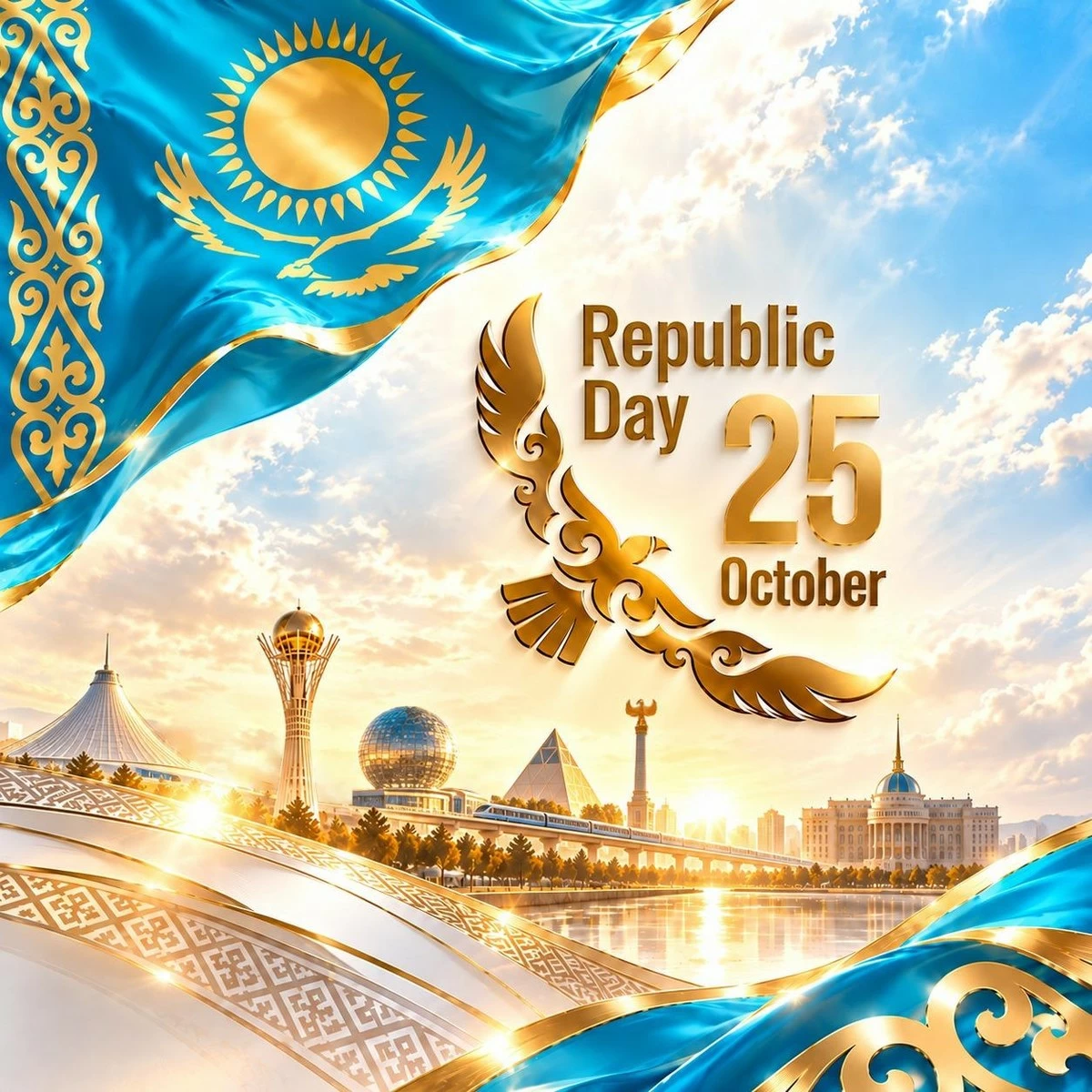
KUWAIT CITY, Oct 25: Republic Day, celebrated on 25 October, commemorates Kazakhstan’s 1990 Declaration of State Sovereignty. On 16 December 2026, the country marks 35 years since declaring independence in 1991. Together, these milestones mark Kazakhstan`s path from the declaration of sovereignty to full independence. Over those 35 years, Kazakhstan has developed from a newly independent republic into a sovereign state with established national institutions, Central Asia’s largest economy and an active international diplomatic presence.
This factsheet outlines that progress through state-building, economic and social development, nuclear disarmament, international cooperation and technological modernisation. It also considers the country’s future priorities. The institutions, economic foundations, international relationships and human potential developed since independence provide a basis for the next stage: a more diversified economy, stronger innovation and further improvements in people’s lives.
Republic Day and the road to independence
· The 1990 Declaration asserted territorial integrity, the supremacy of republican law and independent decision-making within the Soviet Union, laying foundations for independence. Republic Day’s national holiday status was restored in 2022.
· The Constitutional Law on State Independence, adopted on 16 December 1991, established an independent republic, completing Kazakhstan’s transition from asserting sovereignty to full independence.
· Kazakh statehood has roots in the Kazakh Khanate, founded by Kerey and Zhanibek in the fifteenth century, conventionally dated to 1465–1466, and Eurasian steppe traditions.
· Kazakhstan joined the United Nations on 2 March 1992, adopted its flag and coat of arms on 4 June 1992, and introduced the tenge on 15 November 1993, creating its own monetary system.
Building a modern sovereign state
· Independence brought national government institutions, armed forces and a diplomatic service. The first post-independence Constitution was adopted in January 1993; the August 1995 Constitution guided development for three decades.
· The capital moved from Almaty to Akmola on 10 December 1997. Renamed Astana in 1998, the city developed into an administrative and diplomatic centre.
· Following the 2022 constitutional reforms, the Constitutional Court began operating in January 2023, allowing citizens to challenge legal provisions affecting their constitutional rights.
· The new Constitution, adopted by referendum on 15 March 2026 and in force from 1 July, retains a single seven-year presidential term and explicitly protects personal data, including in digital services.
· The new 145-member, single-chamber legislature, the Kurultai, was elected on 23 August 2026 and opened its first session on 28 August. The vice-presidential office introduced by the Constitution was filled on 31 August.
Economic transformation and global markets
· Since independence, Kazakhstan has become Central Asia’s largest economy and upper-middle-income status. GDP reached $306 billion in 2025; the economy grew by 6.5% that year, adjusted for inflation.
· Foreign investment has supported energy, mining, manufacturing and services. By July 2026, Kazakhstan’s accumulated net foreign direct investment had exceeded US$150 billion.
· Kazakhstan joined the World Trade Organization in November 2015, committing to internationally agreed trade rules.
· Manufacturing contributed more to GDP than mining in 2025: 12.8%, compared with 11.7% for mining and quarrying. Manufacturing grew by 7% after adjusting for inflation, showing progress in diversification alongside continued reliance on natural resources.
· Kazakhstan is a major oil exporter and the world’s leading uranium producer, supplying roughly 40% of global uranium mine output in 2025. Copper, zinc and other minerals also support international industry and opportunities for further processing.
- Grain and flour exports reached 15.5 million tonnes, measured as grain equivalent, in the 2025–2026 marketing year. Supplies to Central Asia, the Middle East, North Africa and Europe contribute to food security beyond Kazakhstan’s borders.
International diplomacy and global security
· Kazakhstan closed the Semipalatinsk nuclear test site on 29 August 1991, before independence, and relinquished the inherited arsenal, then the world’s fourth largest. It joined the Nuclear Non-Proliferation Treaty as a non-nuclear-weapon state in 1994; all nuclear warheads were removed by 1995.
· Kazakhstan helped establish the Central Asian Nuclear-Weapon-Free Zone. Since 2017, it has hosted the International Atomic Energy Agency’s Low Enriched Uranium Bank, a reserve of fuel for peaceful nuclear energy.
· Kazakhstan’s balanced and pragmatic foreign policy maintains partnerships with Russia, China, other Central Asian countries, the European Union, the United States and partners worldwide, balancing national interests with international cooperation. Kazakhstan is recognised as a responsible middle power and a bridge between regions, cultures and economic systems.
· Kazakhstan chaired the Organization for Security and Co-operation in Europe and hosted its Astana Summit in 2010. In 2017–2018, Kazakhstan served as a non-permanent member of the UN Security Council, becoming the first Central Asian country to do so. Kazakhstan proposed the Conference on Interaction and Confidence Building Measures in Asia in 1992. Since 2017, Kazakhstan has hosted talks on Syria under the Astana Process. It also hosted talks between the Armenian–Azerbaijani foreign ministers in Almaty in May 2024.
· Its first independent national peacekeeping contingent deployed to the UN mission in the Golan Heights in 2024, contributing directly to international security.
· The UN Regional Centre for Sustainable Development Goals for Central Asia and Afghanistan, launched in Almaty in August 2025, strengthens regional development cooperation.
Connecting Europe and Asia
· Covering approximately 2.7 million square kilometres, Kazakhstan is the world’s ninth-largest country and largest landlocked state. Its position between China, Russia, Central Asia and the Caspian Sea makes it a strategic link in Eurasian trade.
· Investment in railways, roads, border terminals and the Caspian ports of Aktau and Kuryk improves international market access for Kazakhstan’s producers and supports goods moving through the country.
· The Middle Corridor links China and Europe through Kazakhstan, the Caspian Sea and the South Caucasus. This additional transport route helps businesses diversify supply chains and reduce dependence on a single corridor.
Society and human development
· Kazakhstan is home to more than 100 ethnic groups and 18 registered religious denominations. Kazakh is the state language; Russian is also used officially alongside Kazakh in state institutions and local self-government bodies.
· National culture combines steppe traditions with contemporary arts. UNESCO recognition of dombra music, yurt-making skills and the shared Nauryz spring festival highlights Kazakhstan’s living cultural heritage internationally.
· Astana has hosted the Congress of Leaders of World and Traditional Religions since 2003, providing an international platform for dialogue between faiths.
· Kazakhstan’s Human Development Index rose by 21.5%, from 0.689 in 1990 to 0.837 in 2023. The 2025 UNDP report ranks it 60th among 193 countries and territories, in the very high human development category.
· Life expectancy reached 75.97 years in 2025, reflecting progress in population health.
· Kazakhstan is expanding access to international higher education through the opening of foreign university campuses and branches. More than 30 foreign university branches operate in the country, including Cardiff University and Coventry University Kazakhstan. In the 2025–2026 academic year, Kazakhstan’s universities hosted 35,075 international students from 88 countries, an 11% increase on the previous year. These developments strengthen Kazakhstan’s role as a regional education hub, broaden access to international qualifications and support the development of skills for a modern economy.
· The Bolashak international scholarship programme, established in 1993, has trained more than 13,000 professionals abroad. University partnerships and research cooperation are helping develop skills for economic diversification.
Digital transformation and artificial intelligence
· Kazakhstan ranked 24th among 193 countries in the 2024 UN E-Government Development Index. Around 90% of public services were available online by the end of 2025, improving access.
· IT service exports rose from $33.5 million in 2020 to $1.142 billion in 2025. Astana Hub helps technology businesses grow through training, startup support and access to international markets.
· The Alem.ai international artificial intelligence centre opened in 2025. Together with the Alem.Cloud national supercomputing cluster, it supports AI education, research, startups and access to powerful computing.
Environmental recovery and sustainable development
· Soviet-era nuclear testing and river diversions that depleted the Aral Sea left severe damage. Environmental restoration, water security and climate adaptation remain long-term responsibilities.
· Completed in 2005 with World Bank support, the Kok-Aral dam helped restore Northern Aral Sea water levels, reduce salinity and revive fishing. This recovery shows what sustained environmental investment can achieve, although wider basin challenges remain.
· Renewable sources, excluding large hydropower, supplied 8.5% of electricity in the first nine months of 2026, compared with 7% in 2025. Kazakhstan’s strategy targets carbon neutrality by 2060, requiring further investment and changes to the energy system.
· In December 2025, President Tokayev proposed establishing an International Water Organisation as a specialised agency within the UN system. Kazakhstan argues that the fragmented global water architecture needs a coherent institution able to coordinate policy, science, finance and assistance. The first international consultations on the proposal took place at the Regional Ecological Summit in Astana in April 2026; the organisation remains a proposal under discussion.
Priorities for the next stage of development
· The economy and infrastructure developed since independence provide a platform for diversification. Kazakhstan aims to raise productivity and create skilled jobs by expanding manufacturing and agricultural processing, attracting investment and strengthening private enterprise and competition.
· Building on digital services and a growing technology sector, Kazakhstan seeks wider AI adoption, stronger research and more technology exports. Better education, healthcare and vocational training will help people benefit from this modernisation.
· Established institutions provide a basis for improving public administration and the rule of law. Implementation of the new constitutional framework remains a priority.
· International partnerships and experience in multilateral diplomacy support Kazakhstan’s ambition to act as a constructive middle power.
· Together with its economic resources and human potential, these foundations position the country to pursue further growth while deepening regional cooperation and international connectivity.