

24/10/2026

Share:
24/10/2026
Share:


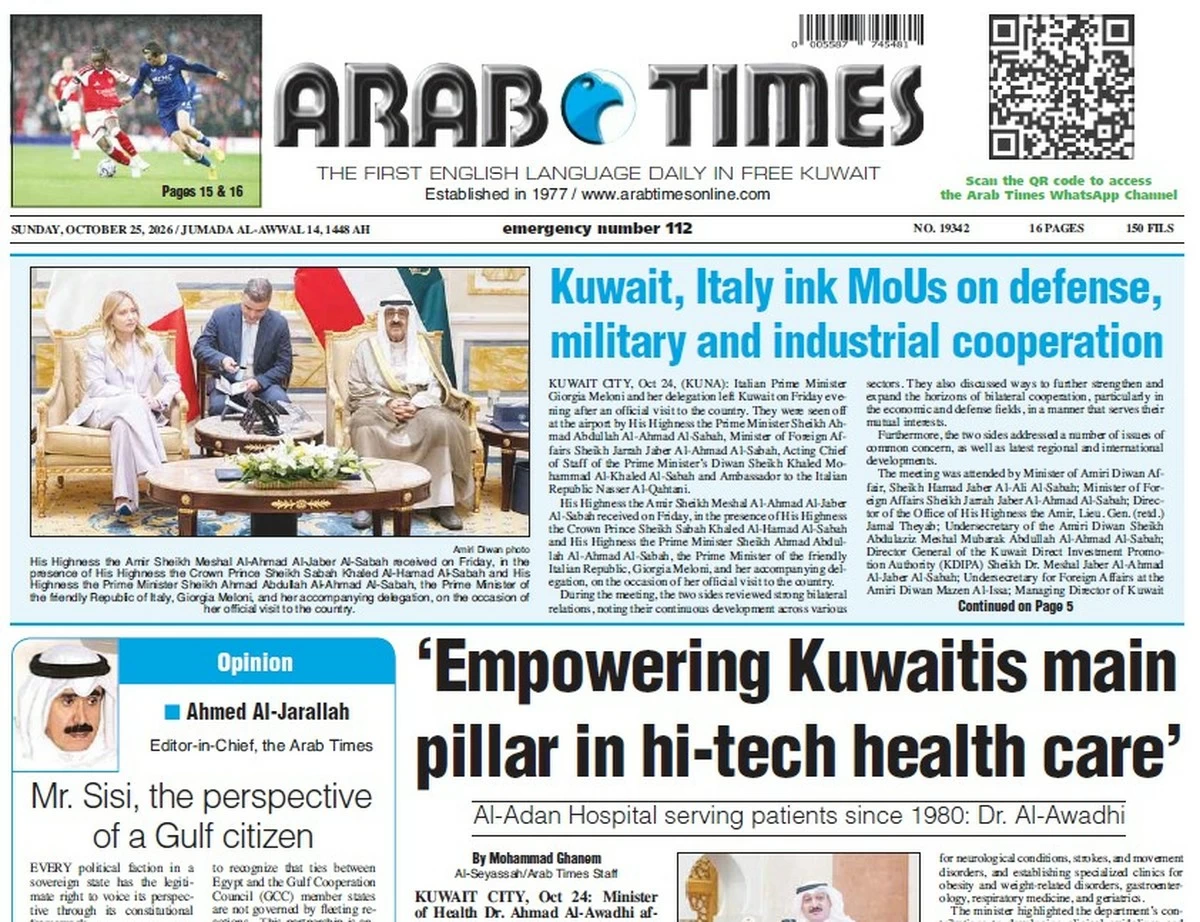
KUWAIT CITY, Oct 24: Minister of Health Dr. Ahmad Al-Awadhi affirmed that developing specialized services, modernizing healthcare infrastructure, and promoting collaboration across medical specialties are fundamental pillars for improving the quality of healthcare in the country. He emphasized the importance of investing in the national workforce and empowering its members to keep pace with scientific advancements and modern medical technologies. In his speech at the opening of the second conference of the Internal Medicine Department at Al-Adan Hospital, Dr. Al-Awadhi explained that scientific conferences provide a vital platform for exchanging knowledge and expertise among physicians and specialists.
Such events help foster a culture of scientific research and continuous medical education, ultimately advancing clinical practice and improving patient outcomes. Al-Adan Hospital has a long-standing history of serving patients and the community. The hospital began providing healthcare services in 1980 and was officially inaugurated in 1988. The hospital has gradually developed its facilities, services, and medical specialties over the years. Throughout this process, the Department of Internal Medicine has been a core component, playing a pivotal role in patient care, the training of medical professionals, and the integration of scientific advancements. The department has made significant progress in its services and sub-specialties, thanks to the efforts of its medical, nursing, and technical staff.
These advancements include enhancing hematology and nephrology services, developing care for neurological conditions, strokes, and movement disorders, and establishing specialized clinics for obesity and weight-related disorders, gastroenterology, respiratory medicine, and geriatrics. The minister highlighted the department’s contributions to developing clinical guidelines and protocols, as well as its participation in early detection and disease prevention programs, all of which support patient safety and improve the quality of healthcare services. Dr. Al-Awadhi emphasized that progress in healthcare institutions is measured not by buildings alone, but by the qualitative advances achieved in patient care and clinical outcomes. He underscored that developing and empowering the national workforce, both scientifically and professionally, remains a priority in the strategy to advance healthcare services. The minister went on to explain that holding the second edition of the conference, following its inaugural edition in January of last year, reflects the organizers’ commitment to promoting scientific research and continuing medical education, while providing a professional platform to discuss the latest developments in the diagnosis and treatment of internal medicine conditions. Rapid advancements in fields such as precision medicine, digital technologies, and artificial intelligence highlight the vital role of scientific conferences in bridging the gap between knowledge and clinical practice.
Such forums enable physicians to benefit from the latest scientific developments, ultimately improving patient care and the quality of healthcare services. A well-qualified physician, capable of sound clinical judgment and effective decision-making, is an indispensable cornerstone of healthcare. Investing in the scientific and professional capabilities of healthcare personnel is therefore fundamental to sustainable development. In this spirit, the Ministry of Health continues to support scientific initiatives and training programs that enhance the competence of the national workforce while reinforcing the principles of quality, patient safety, and evidence-based medical practice. Dr. Khalil Al-Shuwaiker, Head of the Internal Medicine Department at Al-Adan Hospital and Chair of the 2nd Internal Medicine Conference, emphasized the importance of scientific conferences in promoting communication among physicians across various specialties. He noted that such events facilitate the exchange of expertise and discussion of the latest medical developments, thus positively impacting the quality of healthcare provided to patients.
Dr. Al-Shuwaiker expressed his pleasure at organizing the conference for the second consecutive year, as well as his hope that it would become a regular scientific event bringing together physicians and experts while contributing to a culture of continuous learning and advancing medical practice. He also expressed his gratitude to the Minister of Health, Dr. Ahmad Al- Awadhi, for his patronage and attendance, as well as his continued support for scientific activities and medical education programs. He commended the administration of Al-Adan Hospital for its support and for providing the necessary resources to ensure the conference’s success. Dr. Al-Shuwaiker explained that the initiative to organize the conference stemmed from the desire to create a platform where physicians from various specialties could exchange expertise, learn from professional experiences, and discuss the latest medical advancements. He stressed that medical practice, regardless of a physician’s level of experience, requires continuous learning and keeping pace with scientific progress, as this directly improves patient care and enhances the quality of healthcare services.
Dr. Al-Shuwaiker noted that the value of such gatherings extends beyond lectures and scientific sessions to include strengthening professional connections, exchanging ideas, and benefiting from colleagues’ diverse experiences, all of which contribute to the continued development of medical practice. He commended the efforts of the scientific and organizing committees, as well as the working groups involved in preparing the conference. He expressed his gratitude to the Association for Medical Artificial Intelligence and Informatics, the Internal Medicine Association, and the Kuwait Medical Association for their cooperation and support of this scientific event.
Furthermore, Dr. Al-Shuwaiker acknowledged the support of the conference’s sponsoring companies and thanked the speakers, session chairs, and participants for dedicating their time to sharing knowledge and engaging in discussions despite their daily responsibilities and commitments. He expressed his hope that the conference sessions would be highly beneficial to participants and that the scientific discussions would enrich their expertise, generating new ideas and insights that could be applied in daily medical practice to better serve patients and improve the quality of healthcare in Kuwait.
By Mohammad Ghanem Al-Seyassah/Arab Times Staff