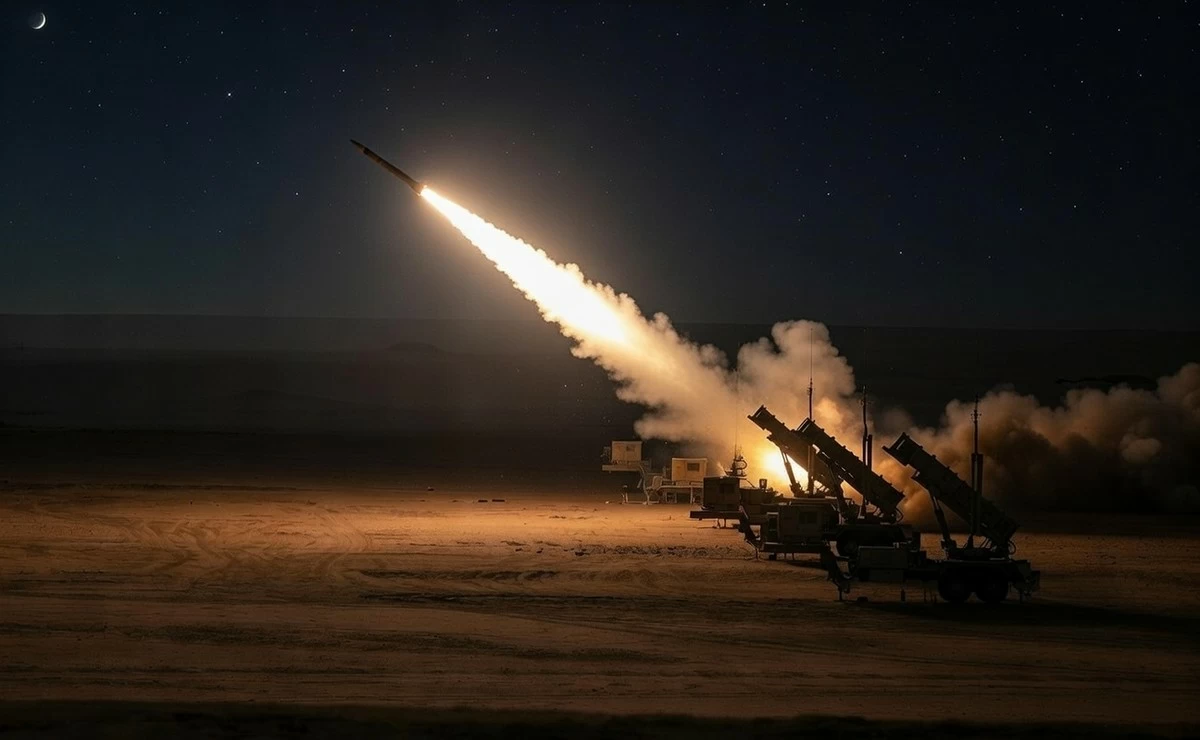
KUWAIT CITY, June 28, (Agencies): Kuwait’s Armed Forces intercepted two hostile ballistic missiles in the country’s airspace on Sunday, the Ministry of Defense announced, as a wave of regional condemnations followed renewed Iranian attacks targeting Kuwait and Bahrain.
In a statement, Ministry of Defense spokesperson Colonel Staff Saud Al-Atwan said the missiles were detected and neutralized in accordance with approved operational procedures, confirming that no casualties or material damage were reported. He stressed the Armed Forces’ continued readiness to safeguard national security and protect citizens and residents.
Kuwait strongly condemned the attacks, describing them as a flagrant violation of its sovereignty, a direct threat to national security and a breach of international law. The Foreign Ministry said the escalation undermines regional and international efforts to de-escalate tensions and reaffirmed Kuwait’s right to take all necessary measures in line with international law and the UN Charter. Kuwait also denounced renewed Iranian drone attacks on Bahrain for a second consecutive day, which caused damage to civilian facilities. The ministry described the strikes as a dangerous escalation and reiterated full solidarity with Bahrain, emphasizing that the Kingdom’s security is integral to that of all Gulf Cooperation Council (GCC) states.
Saudi Arabia, the United Arab Emirates, Qatar and Oman issued strong condemnations of the attacks, rejecting them as violations of international law and affirming full support for Kuwait and Bahrain. The statements warned that continued escalation threatens regional security and called for restraint and diplomacy.
GCC Secretary-General Jassem Al-Budaiwi described the attacks as a direct threat to regional stability and said they undermine ongoing efforts to restore security. He reaffirmed the bloc’s backing for all measures taken by Kuwait and Bahrain. Jordan, Egypt and Lebanon also condemned the strikes, stressing their impact on sovereignty and regional stability. Le
banese President Joseph Aoun urged swift international action to prevent further escalation, while Egypt called for adherence to diplomatic efforts to reduce tensions. Arab and international organizations echoed the condemnation. Arab League Secretary-General Ahmed Aboul Gheit called for an immediate halt to what he described as Iranian aggression, warning of its impact on regional peace efforts. Arab Parliament Speaker Mohammed Al-Yamahi rejected the attacks as an unjustified escalation threatening Arab security.
Yemen described the strikes as part of a broader pattern of destabilizing behavior, warning of risks to regional and international security, including air and maritime navigation. The Muslim World League also condemned the attacks, calling them violations of international law and humanitarian norms.
Iran launched drone and missile attacks Sunday targeting Bahrain and Kuwait in response to U.S. airstrikes that hit the Islamic Republic, and threatened a “complete halt” in negotiations to end the war if Washington continues its attacks. Efforts to reopen the Strait of Hor- GCC energy The ADNOC delegation included several of the group’s senior executives, while the Kuwaiti side was represented by Sheikh Nawaf, Kuwait Oil Company CEO Ahmad Al- Eidan, and several chief executives of KPC subsidiaries and KPC managing directors.
Kuwait debt This came during Al-Sumait’s meeting with six working groups tasked with reviewing debtors’ files, in the presence of Undersecretary of the Ministry of Justice Awatif Abdul Latif Al-Sanad, acting Assistant Undersecretary for Technical and Administrative Affairs Nouf Al- Qabandi, and several officials from the ministry and the General Department of Sentences Enforcement.
Minister Al-Sumait explained that the Ministry of Justice, in cooperation with the head of the General Department of Sentences Enforcement Counselor Abdullah Al-Qasimi, has developed a mechanism for reviewing cases by forming six working groups tasked with studying files according to governorates, in preparation for presenting them to execution judges for review and to ensure they meet the required conditions.
The approved regulations require the existence of an active enforcement file and a valid enforcement order, with priority given to the most needy cases, particularly those facing imprisonment or arrest warrants, alimony cases, private housing rent cases, and personal debts. Consideration is also given to the seniority of the enforcement file and the value of the debt, with the amount allocated to each debtor not exceeding KD 10,000, whether in one file or multiple files. Minister Al-Sumait expressed his gratitude and appreciation to all domuz without Iran’s direct oversight sparked the crossfire now gripping the region and have imperiled negotiations for a lasting ceasefire. A multinational maritime body overseen by the U.S. Navy said Saturday that it would expand a route near Oman for both inbound and outbound traffic, setting up a new flashpoint with Tehran.
The global community has long considered the strait an international passageway, despite its sitting in Iran and Oman’s territorial waters.
recent days, Iran has twice attacked vessels going through a route on the Omani side of the strait backed by a United Nations agency. Iran insists that it alone must govern the strait, the narrow mouth of the Arabian Gulf that once carried a fifth of the world’s oil and natural gas.
Iranian Foreign Minister Abbas Araghchi reiterated the claim during a state visit to Iraq on Sunday. “Any interference in this matter, any attempt to establish new or separate arrangements from those currently being carried out by the Islamic Republic of Iran, will only lead to further complications, delay the reopening of the Strait of Hormuz, and increase the level of tension, just as over the past two nights we witnessed incidents in the Strait of Hormuz that led to an increase in tension and confrontation,” he said in Baghdad.