



15/03/2026

Share:
15/03/2026
Share:
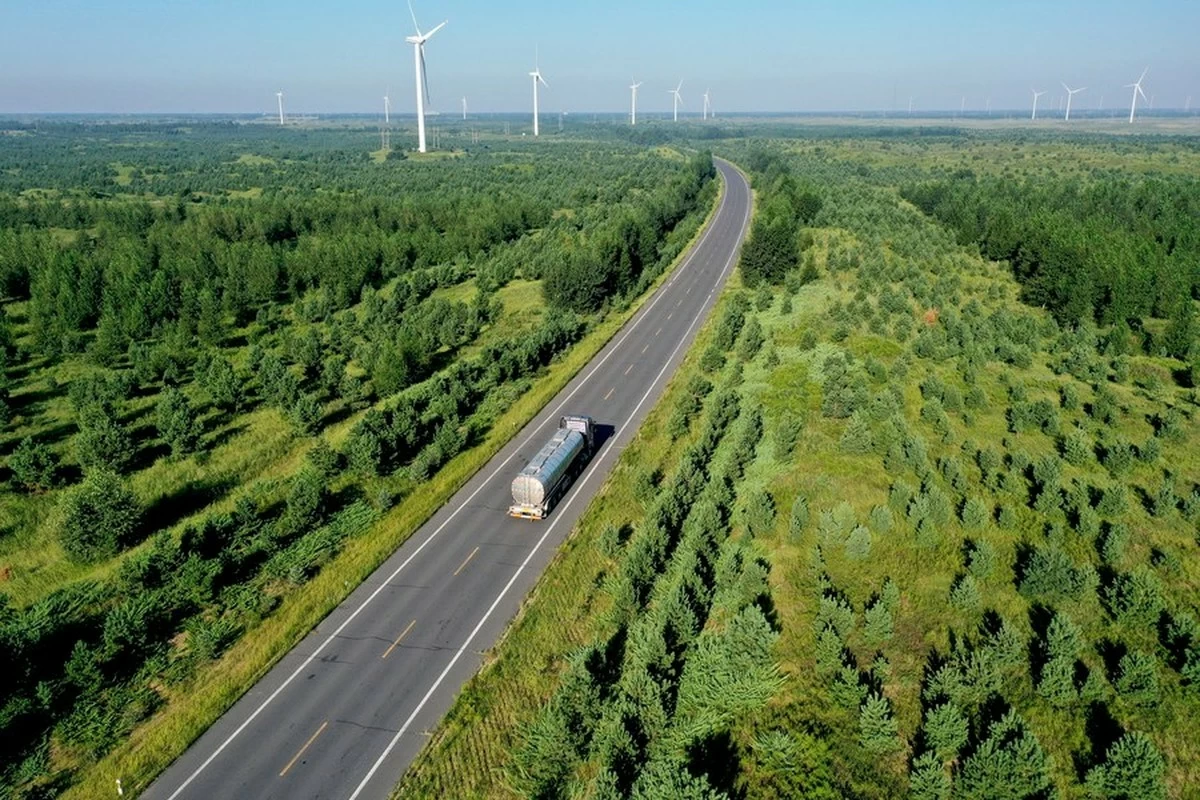
Aerial photo taken on Aug. 16, 2022, shows a truck traveling on a road surrounded by forests in Horqin Left Wing Rear Banner, Tongliao City, in northern China’s Inner Mongolia Autonomous Region. (Xinhua)

HOHHOT, March 15: On the northern edge of Maowusu, the fourth largest sandy area in China, Zhang Zhanjiang, a veteran local farmer, found himself faced with unfamiliar modern planting techniques. He did not expect that tree planting nowadays would involve such precise work. Overhead, drones were buzzing as they conducted monitoring and transportation of supplies, while on the ground, planting machines had largely replaced manual labor, with technicians using remote sensing data to track planting results.
Zhang was among more than 100 beginners to join the local afforestation campaign this spring in a township of the city of Ordos, north China’s Inner Mongolia Autonomous Region. Watching a technician’s demonstration, Zhang crouched on the sand to adjust depth and angle in employing the planting machine to drill suitable holes for inserting branches of a desert plant, Salix mongolica, while also tamping the sand with his shovel. He then went to check on his work via remote sensing data displayed on the technician’s tablet computer. Zhang carefully studied data such as soil moisture and made fine adjustments to planting spacing based on the feedback, as these factors can affect the survival rate of the seedlings. “In the past, this sandy area produced shifting sand. Nothing planted could survive,” he said, while gesturing at the freshly planted rows of willow cuttings. “Now we’re learning how to fix it.”
As the group of trainees operated machines for planting, drones airlifted bundles of straw, which were to be used in weaving grass checkerboards to protect small trees. This, notably, is the front line of China’s 2026 campaign to fight desertification. As the country marked its 48th National Tree Planting Day on Thursday, the National Greening Commission reported that China’s forest and grass coverage rate has exceeded 56 percent thanks to its greening efforts. Meanwhile, local authorities in desertification-prone areas have embarked on this year’s greening drive armed with mobilized manpower, decades- long experience of afforestation innovations and intelligent equipment. China is among the countries with the most severe desertification globally, with its desertified areas mainly located in northwest, north and northeast China, which are dubbed the “three-north.”
The country in 1978 initiated its landmark ecological project, the Three-North Shelterbelt Forest Program, which has become the world’s largest afforestation endeavor. Scheduled to be completed by 2050, the program has the aim of rehabilitating and greening desert-prone lands and desertified areas in the “three-north.” To boost these efforts, Inner Mongolia, ranking top among the country’s provincial- level regions by accomplishing a total of 123 million mu (about 8.2 million hectares) of ecological construction and 66.88 million mu of sand prevention and control during the 14th Five-Year Plan period (2021-2025), plans to continue three major afforestation campaigns this year, expected to green a total area of 40 million mu, said Wu Guoqing, deputy director of the regional bureau of forestry and grassland.
One of the battlefields is located in the Alxa League, where smart equipment is playing an important role in the fight. Drones disperse grass seeds and seedlings from the air, while largescale desert control machinery traverses the sandy terrain. Tong Keting, director of the rural revitalization office in Alxa High-Tech Zone, said that by combining mechanical operations and manual work, vegetation coverage in the targeted area has been increased from less than 5 percent to over 40 percent, while annual sediment inflow into rivers had decreased from 500,000 tonnes in 2016 to 300,000 tonnes in 2025, demonstrating tangible results (Xinhua)