



12/05/2026

Share:
12/05/2026
Share:

“The question is no longer if India innovates, but who will innovate with India.” Emmanuel Macron, President of France (Mumbai, February 2026)
By Paramita Tripathi, Ambassador of India to Kuwait
India made history on 23 August 2023 as the first nation to successfully land a spacecraft near the unexplored lunar south pole. The success of ambitious projects such as the Chandrayaan lunar mission, the Mangalyaan Mars mission, and the Aditya L1 solar mission, the 2024-2025 SpaDeX docking experiments, and cost-effective satellite launches has established India as a major player in the space sector.
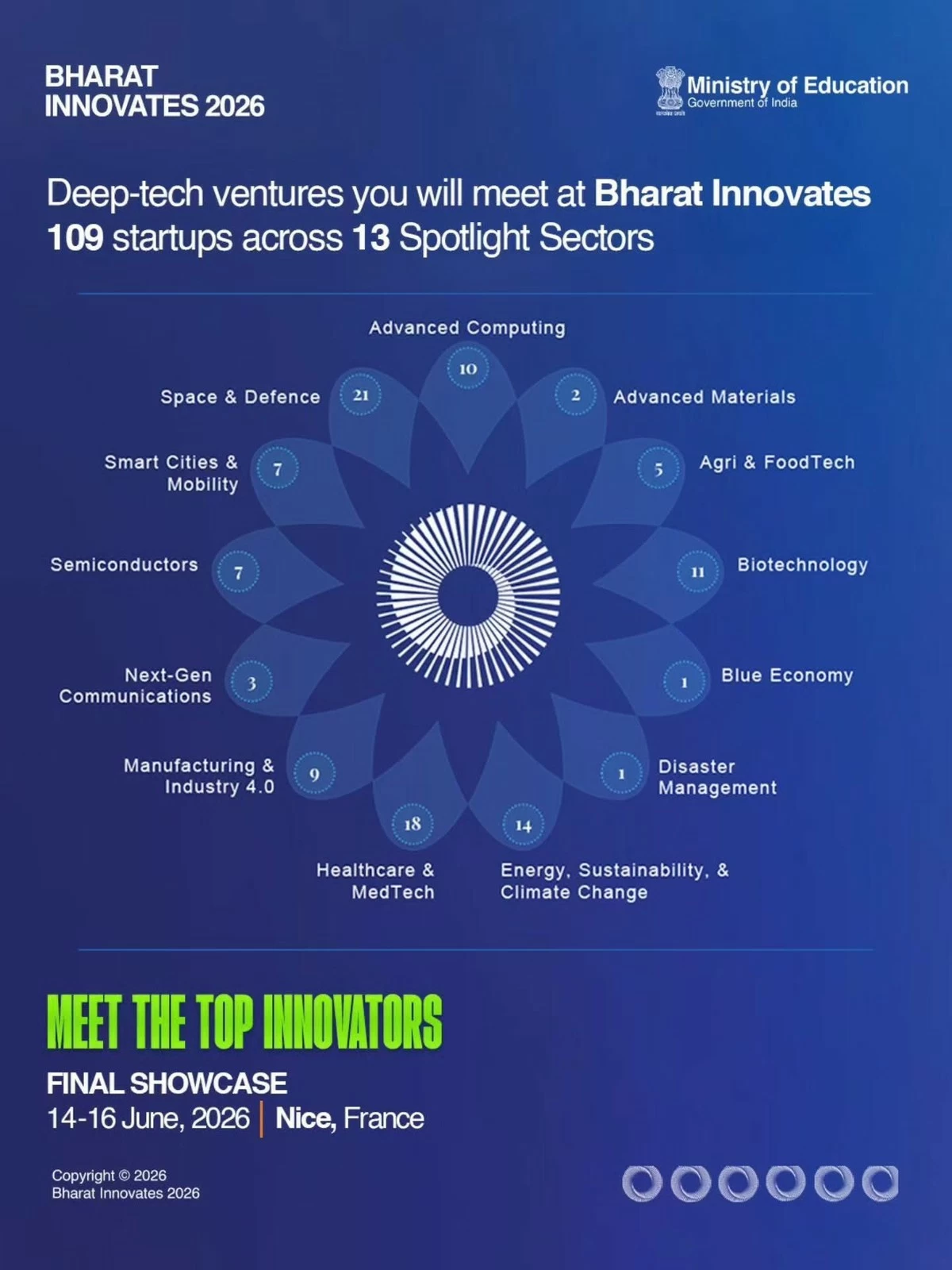
India’s success in space programmes and in consumer technology and digital landscape is now expanding into its thriving deep tech ecosystem, a key driver of the future. A new generation of Deep Tech startups constitutes a substantial share of India's 10,000+ startup ecosystem. These startups are tackling challenges in areas such as artificial intelligence, quantum computing, semiconductors, clean energy, space and defence technologies, advanced materials, healthcare, medtech, and biotechnology.

India’s Deep-Tech Ecosystem
With one of the world’s largest pools of STEM graduates, strong institutions, and an active research culture, India is strongly positioned to translate cutting-edge research into commercially viable solutions. India’s deep-tech landscape may be best understood through a few concrete examples of companies that have moved beyond the lab and into markets:
- AI & Enterprise Automation – GreyOrange deploys AI-driven robotic systems for warehouse automation and supply chains; solutions are used by major global retailers in the US, Europe, and Asia; demonstrating India’s ability to build industrial-grade AI platforms for global deployment.
- Space Technology – Skyroot Aerospace successfully launched Vikram-S, India’s first privately developed rocket, while Agnikul Cosmos is developing customizable small satellite launch vehicles using 3D-printed engines; regulatory reform in India by opening up the space sector has unlocked private innovation.
- Semiconductors – Saankhya Labs develops software-defined radio and semiconductor solutions in communications, defence, and broadcasting, representing India’s growing capability in chip design and strategic electronics.
- Climate Tech – Ather Energy designs and manufactures electric scooters and proprietary battery and charging infrastructure; tackling clean mobility at scale.
- Biotechnology – String Bio uses methane to produce high-value proteins and chemicals through biotechnology, offering sustainable alternatives for agriculture and industry.
- Quantum & Advanced Computing – QNu Labs is working on quantum-safe cybersecurity solutions, addressing future risks to data security.
India’s Incubation Ecosystem: Catalysts of Transformation
The role of deep-tech accelerators and incubators, which bridge laboratory research and market deployment, is important for nurturing startups. Some examples of these are:
- T-Hub (Hyderabad): One of India’s largest innovation hubs, a partnership between the Government of Telangana, three academic institutes in Hyderabad and the private sector, T-Hub has supported startups in AI, robotics, and mobility.
- IIT Madras Research Park (Chennai): India's first university-based Research Park, partnering with IIT Madras is a leading example of academia-industry collaboration, incubating deep-tech startups in automotive engineering, energy systems, and robotics.
- Centre for Cellular and Molecular Platforms (C-CAMP) (Bengaluru): A premier biotech incubator set up by the Department of Biotechnology, Government of India, in 2009 forming the Bangalore Life Sciences Cluster (BLiSC) with the National Centre for Biological Sciences (NCBS) and the Institute for Stem Cell Science and Regenerative Medicine (inStem), supporting startups in healthcare, diagnostics, and life sciences.
- NASSCOM CoE for IoT & AI: Announced by Prime Minister Shri Narendra Modi in 2015 as part of the Digital India Initiative, it is focused on AI and IoT startups.
Bharat Innovates 2026: An Opportunity for Kuwait
Bharat Innovates 2026, to be held in Nice, France, on 14-16 June 2026, will showcase India’s technological innovation prowess emerging from the research and innovation ecosystem of higher education. It will curate and present more than 100 promising and path-breaking technological innovations at various stages of development to a global audience comprising industry representatives, investors, policymakers, potential collaborators, and technology partners.
Bharat Innovates 2026 signifies India’s shift from a leading digital economy to a global hub for deep-tech innovation, shaped by strategic initiatives such as the India Semiconductor Mission 2.0, space sector liberalisation, National Green Hydrogen Mission, and IndiaAI Mission. In addition, regulatory reforms and public-private partnerships are accelerating commercialisation pathways, making India a source of innovation and a scalable market.
For Kuwait, which is diversifying its economy under Vision 2035, this is a strong opportunity to partner with India’s rapidly maturing deep-tech ecosystem by investing in deep-tech startups, particularly those aligned with Kuwait’s priorities in energy, cybersecurity, fintech, healthcare and medtech, agritech, sustainability, and advanced industries. Bharat Innovates 2026 invites investors in Kuwait to join India’s deep-tech journey, shape solutions that will define the next decades, and co-create values that transcend borders.
Bharat Innovates 2026 | 14 – 16 June, 2026 | Nice, France | https://bharatinnovates.in/
Register to participate: https://bharatinnovates.accubate.app/ext/survey/17742/apply
For queries/information, e-mail at [email protected]