


16/10/2026

Share:
16/10/2026
Share:

KABUL, Oct 16: “I expect them to be beaten, but there is nothing I can do about it. And at 14, they will be pregnant.”
The heartbreaking words of an Afghan mother capture the desperate choices confronting families as drought, crushing poverty and dwindling humanitarian assistance push parents to promise their young daughters in marriage — some before they are even old enough to understand what marriage means.
Gul Bobo, a mother living in the rural village of Tayz Nāwah in Afghanistan’s northwestern Badghis province, said she and her husband had agreed to marry off their daughters, aged two and five, because they could no longer make ends meet.
Her husband works as a farmer, relying on increasingly unreliable rainfall to earn enough to feed the family, buy seeds and rent a tractor or donkey to cultivate land belonging to wealthier farmers.
As droughts have become more frequent and harvests less dependable, the family has struggled to survive. Promising their daughters in marriage became, in their eyes, a desperate means of securing money.
“As a mother, I cried a lot, but I knew my husband had no choice,” Gul Bobo said.
“I know they are too young to be engaged, but we had no choice — otherwise we would have waited until after 18.”
Her words reflect a devastating reality: children who should be playing, learning and growing up under their parents’ protection are instead being drawn into arrangements that could determine the rest of their lives.
Gul Bobo said the prospective groom of her five-year-old daughter, Nazila, is 15. She expects the girl to leave home and live with him within the next two or three years.
For the mother, the prospect offers little hope.
“I expect them to be beaten,” she said, describing the future she fears for her daughters. “And at 14, they will be pregnant.”
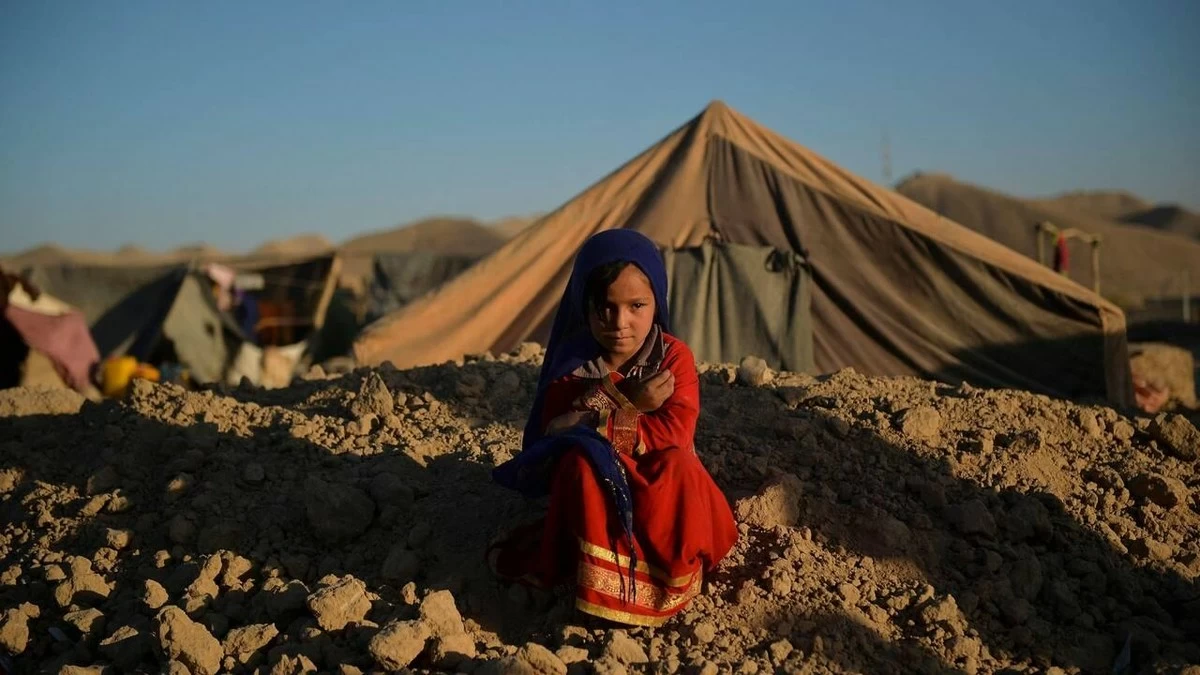
Her fears are not isolated. Across Badghis, families struggling with failed harvests, unpaid debts and a lack of basic necessities are increasingly resorting to child marriage as a survival strategy, according to a report by The Guardian.
Drought turns poverty into a family crisis
In Badghis, where approximately 95 percent of the population depends on rain-fed agriculture and livestock, prolonged water shortages have devastated livelihoods.
The province endured a historic drought in 2018, while recurring water shortages since 2021 have damaged crops and left livestock struggling to survive.
For families dependent on farming, the consequences extend far beyond lost income. When crops fail, parents can no longer afford food, rent, medicines or transport to hospitals. Debts accumulate, and some families turn to marriage arrangements involving their daughters to obtain money or settle what they owe.
Many have abandoned their rural homes in search of work in cities. Others have travelled to Herat, Afghanistan’s third-largest city, hoping to find relief in displacement camps.
At the Shahrak-e-Sabz camp, tens of thousands of displaced people have sought shelter and assistance. But humanitarian support has dwindled, leaving many families without the help they desperately need.
International aid cuts have further deepened the crisis. The United States, once Afghanistan’s largest aid donor, has sharply reduced its assistance, while other countries, including the United Kingdom, have also cut funding.
The United Nations has warned that Afghanistan is receiving substantially less aid than it did previously, leaving vulnerable families with fewer options to survive.
For some parents, the price paid for survival is the childhood of their daughters.
‘I would have preferred her to be dead’
Bana, the mother of 11-year-old Gulalai, told The Guardian that she had been forced to promise her daughter to a shopkeeper in his late 40s because she and her husband owed him money.
The prospect of her young daughter being married to a man decades older has left her devastated.
“I would have preferred for her to be dead rather than be married off to such an old man,” Bana said.
Her husband, Niaz Mohammad, defended the decision as a sacrifice necessary to save the rest of the family.
“We have to sacrifice a family member to save the others,” he said.
The words reveal the brutal calculations some impoverished parents believe they must make when faced with hunger and debt. Yet for the girls involved, these arrangements can mean losing their freedom, education and childhood, often before they have the ability to understand or challenge the decisions made for them.
Married at 15, pregnant at an age she cannot comprehend
Darellah was 15 when she described the reality of her marriage to a 30-year-old man.
Her family had left their rural village in 2018, and she was later married. Now pregnant, she told The Guardian during a visit to her family that she still felt like a child.
“I am still a child … it cannot be a good decision to be married at that age,” she said.
Her experience highlights the dangers faced by girls pushed into marriage before they are physically and emotionally ready for adult responsibilities and pregnancy.
Her younger sisters, nine-year-old Bibi Zat and 11-year-old Rahimah, have also been promised in marriage, although they continue to live with their parents.
Their childhoods remain overshadowed by arrangements already made on their behalf.
Five daughters married off to settle debts
In the village of Khoshkian, eight years of poor harvests forced Abdul Aziz to promise five of his daughters in marriage to settle outstanding debts.
According to the report, he received between 90,000 and 150,000 Afghanis for each daughter, equivalent to approximately £1,000 to £1,750 at the time cited.
One of them, Mazari, left home at the age of 12 or 13. Now 16 or 17, she lives with her husband, who is in his 40s, and their two-year-old son and newborn baby.
Looking back on her childhood, Mazari said the transition into married life had been difficult.
“Getting married at 12 was really hard; when I came to his home, I wasn't able to cook, but my husband and in-laws have been really kind,” she said.
Her account illustrates how early marriage can force a child into domestic responsibilities and motherhood long before she is ready.
Her younger sisters, aged between three and 13, are still at home. Their future remains tied to the payment of bride prices arranged for their marriages.
Even in these circumstances, some parents delay handing their daughters over to the prospective husbands’ families for as long as possible, hoping to keep their children at home while they struggle to survive.
A bride price that could not save a family
Sara, who moved to the city of Qala-e-Naw after fleeing drought in 2021, promised her 12-year-old daughter Aisha in marriage to a 20-year-old man to help repay family debts.
But the money did little to ease the family’s hardship.
They had fallen two months behind on rent of just 1,000 Afghanis, and their landlord eventually evicted them.
When Sara gave birth to her youngest child, she could not afford transport to the hospital and had to walk there before delivering the baby.
Despite her circumstances, she continues to delay asking her daughter's prospective in-laws for the remaining bride price, fearing that receiving the money could mean Aisha would have to leave home.
“I try not to contact the in-laws to ask them for the rest of the bride price, so that Aisha will not have to leave,” she said.
For Sara, delaying the payment is one of the few ways she can hold on to her daughter for a little longer.
A two-year-old promised away to pay for cancer treatment
Perhaps the most distressing case concerns Khomakha, 30, whose husband agreed to marry off their daughter Fatemah when the child was just three months old.
Fatemah is now two.
The family’s desperation was driven by the medical needs of their eight-year-old son, Ehsanullah, who has blood cancer and requires weekly transfusions.
His parents struggled to afford even the small fee for shared transport to take him to hospital.
The marriage arrangement was made against this backdrop of poverty and the desperate effort to keep their son alive.
Khomakha said her daughter’s future home would be a 15-hour drive away. Once the girl leaves, the mother fears she may never be able to visit her again because she cannot afford the journey.
“I will not be able to afford transport to visit my daughter once she leaves,” she said.
A mother who should be watching her toddler take her first steps is instead facing the possibility of a permanent separation.
Aid cuts leave families with fewer choices
Mark Calder, advocacy director for Afghanistan at World Vision International, warned that early marriage exposes girls to potentially life-threatening health risks, while the health facilities meant to treat them are disappearing as aid is reduced.
“Early marriage exposes girls to potentially deadly health risks, but the clinics treating them are disappearing as aid is cut,” he said.
The crisis illustrates how drought, displacement, debt and declining humanitarian assistance can combine to push already vulnerable families towards decisions with lifelong consequences for their children.
For girls promised in marriage at two, five, nine or 11, the immediate crisis may be their families’ inability to afford food, shelter or medical treatment. But the consequences can last well into adulthood, exposing them to early pregnancy, health complications, interrupted education and potential abuse.
Their parents describe the arrangements as sacrifices made in the struggle to keep the rest of the family alive. The children, however, are the ones who must bear the consequences.
Behind every promised bride is a childhood put on hold — and a future being decided by poverty before the child herself has a voice.