


22/04/2026

Share:
22/04/2026
Share:
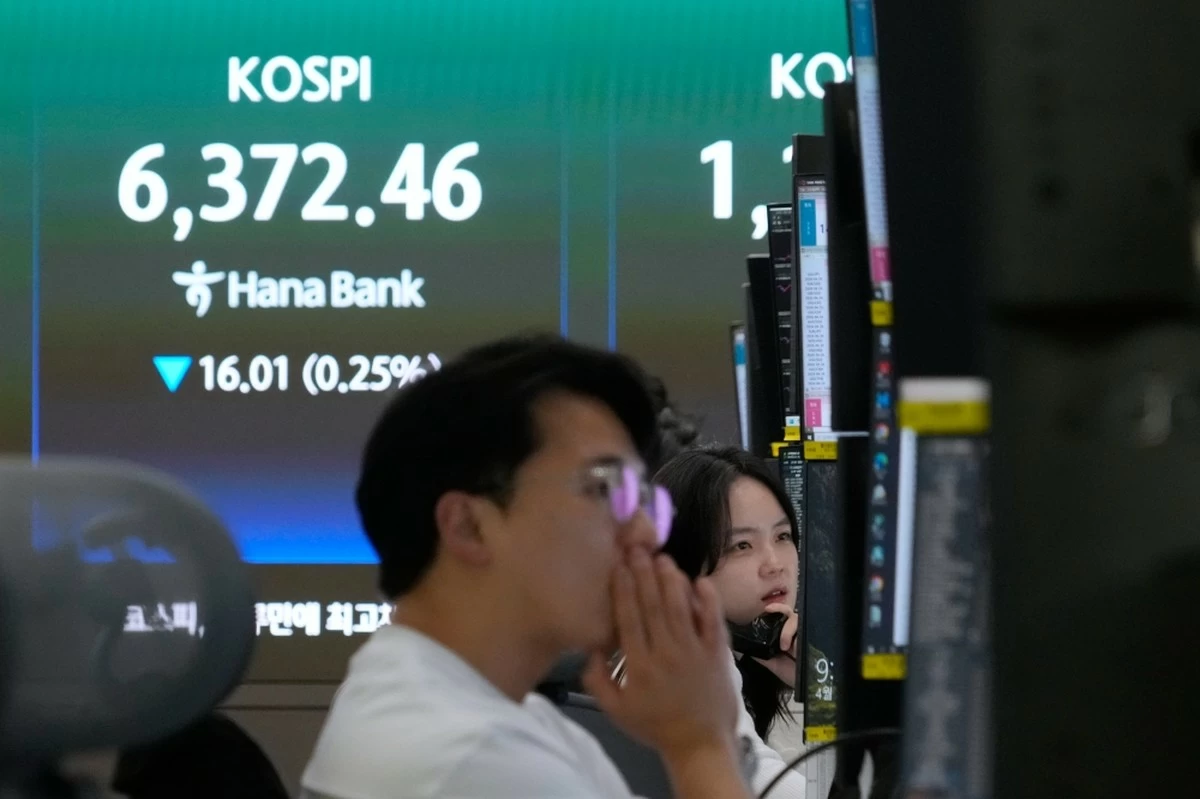
A currency trader talks on the phone near a screen showing the Korea Composite Stock Price Index (KOSPI) at the foreign exchange dealing room of the Hana Bank headquarters in Seoul, South Korea on April 22. (AP)

TOKYO, April 22, (AP): Asian shares were mixed in cautious trading Wednesday, as investors watched for next steps in the US-Iran conflict after President Donald Trump extended a ceasefire that was set to expire.
Japan’s benchmark Nikkei 225 rose 0.3% to 59,530.64. Australia’s S&P/ASX 200 declined 1.2% to 8,841.00. South Korea’s Kospi added 0.4% to 6,413.62.
Hong Kong’s Hang Seng lost 1.3% to 26,140.05, while the Shanghai Composite gained 0.3% to 4,096.59.
On Wall Street, the S&P 500 erased an early rise to fall 0.6% after US Vice President JD Vance called off a trip to Pakistan, where he was expected to lead US negotiators in talks with Iran to extend the ceasefire. It closed at 7,064.01.
The Dow Jones Industrial Average dropped 0.6% to 49,149.38. The Nasdaq composite also slipped 0.6%, to 24,259.96. Less than 10 minutes after the US stock market finished trading for the day Trump said he would extend the ceasefire to give Iran time to submit a proposal to end the war.
Oil prices have been wavering. In Asian trading Wednesday, benchmark US crude fell 19 cents to $89.48 a barrel. Brent crude, the international standard, lost 12 cents to $98.36.
The moves were milder than the vicious swings that rocked Wall Street earlier in the war, when the price for a barrel of Brent crude briefly topped $119 and the S&P 500 dropped nearly 10% below its prior all-time high.
The U.S. stock market remains near its most recent record, which was set Friday, indicating investors remain optimistic that the United States and Iran will avoid a worst-case scenario for the economy.
Much of the tension in financial markets has focused on what will happen to the Strait of Hormuz, a narrow waterway off Iran’s coast that oil tankers use to exit the Persian Gulf. Japan, for instance, imports just about all its oil, and much of it previously came through the strait. The government has released its oil reserves and is working on alternative routes.