



14/04/2026

Share:
14/04/2026
Share:
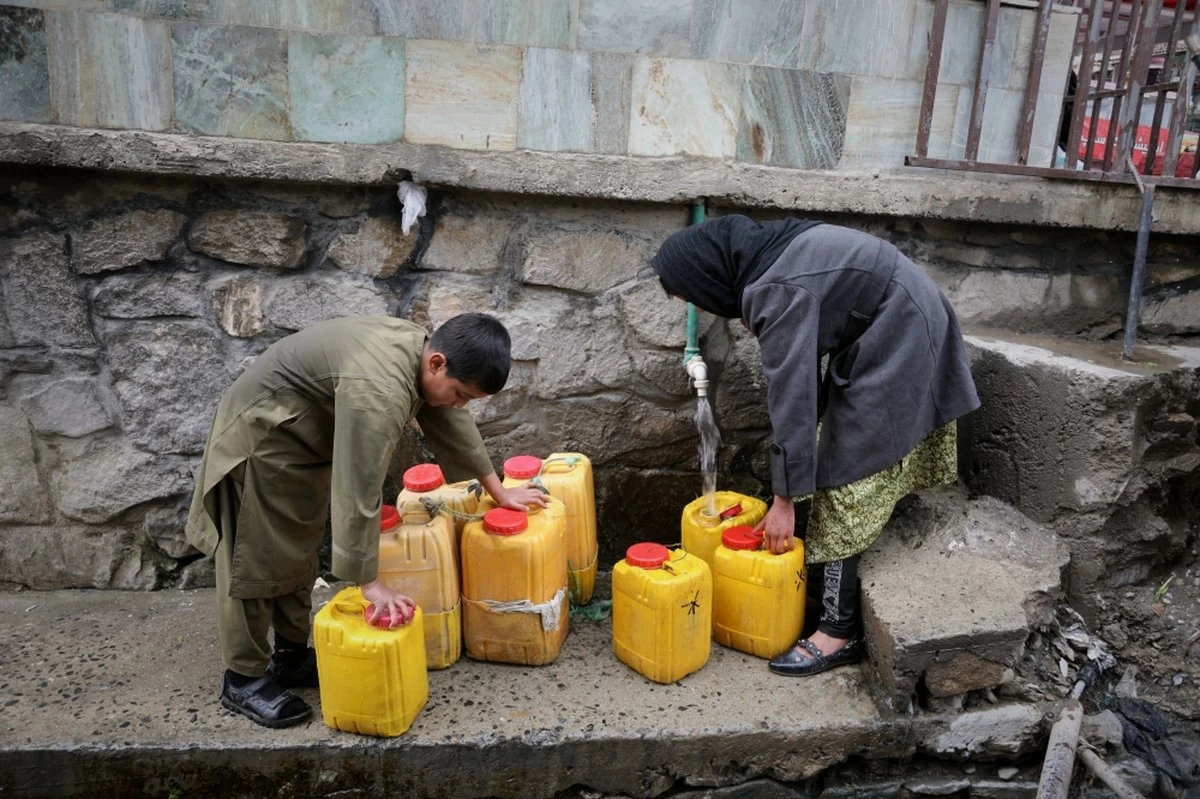

KABUL, Afghanistan, April 14, (AP): The woman was furious. Standing in the muddy lane sloping up the hill in one of the Afghan capital’s poorer neighborhoods, she pulled her headscarf aside to reveal thick grey-white hair. "You see this hair? Even I with my white hair, I have to carry water,” said Marofa, 52, a resident of Kabul’s Deh Mazang neighborhood who, like many Afghans, goes by one name.
"These containers are heavy. We have no strength left in our backs, no strength left in our legs.” A mosque down the hill has its own well that provides free water, but it is undrinkable - yellow and brackish - and has to be carried. Potable water is trucked into the neighborhood on three-wheeled motorcycles and sold. For many, the price is too steep. "We have no money for food.
How can we get water?” said Wali Mohammad, 90, another local resident who didn’t hide his rage. Both said that a few months after the Taliban seized power in Afghanistan in 2021, the new authorities cut pipes some residents had laid to siphon water from a communal well to their homes. "They cut off our water. They are powerful and they don’t even give us a reason why,” Mohammad said.
But another resident, 32-year-old Najibullah Rahimi, said the pipes to people’s homes made the well’s water level drop, leaving those living higher up the hill with no water at all. "So the government came and cut the pipes.” Nestled in a high-altitude valley of the Hindu Kush mountains, Kabul is rapidly running out of water. Its population relies mostly on groundwater extracted from wells.
But the groundwater has been receding at an alarming rate, and some wells have to be dug as deep as 150 meters (nearly 500 feet) to reach it. An April 2025 report by the aid group Mercy Corps said the level of Kabul's aquifers had plunged by 25-30 meters (about 80-100 feet) over the past decade. Aquifers hold massive amounts of water deep under land surfaces.
Water in them collects slowly over years as precipitation seeps in. Too much extraction from aquifers, or changes to the climate bringing less water, leads to depletion. "Without large-scale changes to Kabul’s water management dynamics, the city faces an unprecedented humanitarian disaster within the coming decade, and likely much sooner,” it said.
Climate change, mostly caused by the burning of gasoline, oil and coal, has played its part. Repeated droughts have reduced snowfall, whose gradual melting can replenish groundwater. Instead, Kabul sees more sudden, heavy rainfall that leads to flooding but not enough of it reaches the aquifer.