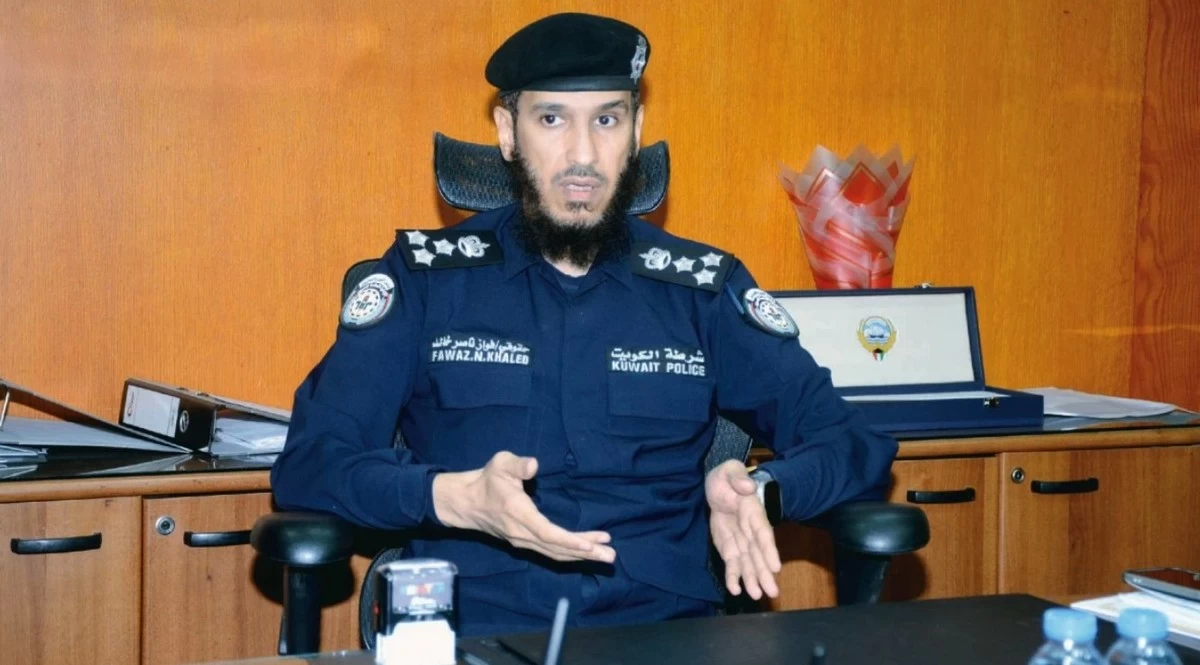
Brigadier Fawaz Al-Osaimi, Director of the Violations Investigation Department at the General Traffic Department
KUWAIT CITY, Sept 12: Brigadier Fawaz Al-Osaimi, Director of the Violations Investigation Department at the General Traffic Department, confirmed that approximately 150 people have applied for the home impoundment system, which was launched last Sunday, noting that no issues or violations involving breaches of the impoundment terms have been recorded. In an interview with the daily, Brigadier Al-Osaimi explained that the home impoundment system does not cover violations related to reckless driving or excessive exhaust noise. Violators whose vehicles have already been impounded may visit the impound yards in Doha or Jleeb Al-Shuyoukh to request a transfer to the home impoundment system. He outlined the home impoundment procedure: the violator fills out the necessary forms and completes the required steps, after which a smart device is installed on the vehicle, and it is impounded at a location of the owner’s choosing, such as their private residence.
Once the device is installed, the violator receives a notification. The vehicle must not be moved more than 100 meters, as doing so triggers a notification to the operations room, resulting in a KD 50 fine and the return of the vehicle to a standard impoundment facility. Tampering with or damaging the device results in a case being filed against the violator for damaging state property. Brigadier Al-Osaimi reiterated that owners of vehicles currently under impoundment may complete the remainder of their mandated impoundment period at home. He noted that impoundment durations vary based on the type of violation, with the device installation fee set at KD 10, plus a charge of KD 2 for each day of impoundment.
Brigadier Al-Osaimi also pointed out that the General Traffic Department has observed a significant decline in serious traffic violations, including those causing accidents, injuries, and fatalities. He highlighted that the stricter penalties introduced under the new traffic law amendments have had a notable impact on reducing fatal accidents. Brigadier Al-Osaimi emphasized that the objective of these measures and penalties is to protect lives and property, safeguard young people from the dangers of traffic accidents, and curb driving behaviors that threaten the safety of road users. He stated that judicial rulings involving imprisonment, fines, and vehicle confiscation were issued against approximately 30 individuals during July and August.
Brigadier Al-Osaimi urged violators to take the initiative to pay their outstanding fines, noting that Article 41 of the Traffic Law requires fines to be paid within two months of the violation. He stressed that failure to pay results in the case being referred to court, while also highlighting a strong response from violators in settling their outstanding fines. Brigadier Al-Osaimi revealed a 45 percent decrease in traffic violations during the first half of 2026 compared to the same period in 2025.
The details of the interview are below:
Question: How many people have benefited from the home impoundment system since its implementation began?
Answer: Approximately 150 people have been subject to the home impoundment system since it was launched last Sunday, and we have not yet recorded any issues or violations involving breaches of the impoundment terms. This system allows violators to keep their impounded vehicles at their own residences.
Q: Which violations are not covered by the home impoundment system?
A: Violations involving reckless or careless driving and excessive exhaust noise are not covered by the home impoundment system.
Q: How is the home impoundment procedure carried out?
A: The violator provides the necessary details at the impoundment facility. The device is then installed on the vehicle, which is impounded at a location of the person’s choosing, specifically at their private residence, as impoundment in public places is not permitted.
Q: Can someone with a currently impounded vehicle complete the remainder of the impoundment period at home?
A: Indeed, anyone with a currently impounded vehicle can complete the remainder of their assigned impoundment period at home. Impoundment durations vary depending on the type of violation. They can visit the impoundment facilities in either Doha or Jleeb Al- Shuyoukh to request the home impoundment option; the process takes only a few minutes.
Q: What are the conditions?
A: They must first pay any outstanding fines, excluding the specific fine that led to the vehicle’s impoundment, and then pay that specific fine once the home impoundment period concludes.
Q: What is the cost of home impoundment?
A: The cost is KD 10 for device installation, plus KD 2 for each day of impoundment.
Q: What rules must be followed after the device is installed?
A: Once the device is installed on the vehicle, the violator receives a notification, and the vehicle must not be moved more than 100 meters from the front of the house.
Q: What happens if the vehicle is moved more than 100 meters?
A: If the vehicle is moved beyond the permitted distance, a notification is sent to the General Traffic Department’s operations room. A patrol is then dispatched to the location to issue a “violation of impoundment” citation against the offender, carrying a fine of KD 50.
Q: What is the penalty for tampering with or damaging the impoundment device?
A: Tampering with or damaging the device results in a case being filed against the offender for damaging state property.
Q: Have any violations involving breaches of home impoundment been recorded since its implementation?
A: To date, we have not recorded any issues or violations related to breaches of home impoundment.
Q: Has the toughening of penalties in the new traffic law impacted accident rates?
A: We have observed a significant and notable decrease in the number of serious violations that cause accidents, injuries, and fatalities. The stricter penalties introduced in the new traffic law amendments have had a marked impact on reducing fatal accidents. The goal of these measures is to protect lives and property and safeguard young people from the dangers of traffic accidents, especially given that, in the past, we witnessed young people in the prime of their lives falling victim to traffic accidents or sustaining severe injuries. Today, however, these accidents have begun to decline sharply. The number of traffic violations dropped by 45 percent during the first half of 2026 compared to the same period in 2025.
Q: Have any court rulings been issued against those who committed serious violations?
A: Yes, rulings were issued against approximately 30 individuals during July and August. These included prison sentences, fines, and vehicle confiscation.
Q: What should a person do if they believe a traffic violation issued against them is incorrect?
A: Anyone who believes a violation issued against them is incorrect can request an investigation. There are six violation investigation units distributed across the traffic departments of the six governorates. Anyone can visit the unit in their governorate to submit a complaint and explain the grounds for their objection. These channels are open to everyone.
Q: What happens after the complaint is submitted?
A: The violation is investigated. If it is proven to have been issued incorrectly, it is dismissed, and the necessary legal measures are taken against the officer who issued it.
Q: Is there a way to verify the validity of a violation if there is a dispute between the motorist and the traffic officer?
A: The governorate-level violation investigation units are responsible for determining the validity of the violation. Additionally, all patrol vehicles are equipped with cameras that can be used for verification.
Q: Do traffic officers undergo training on using the “Rased” application to issue traffic violations?
A: Yes, traffic officers undergo specialized training courses on how to use the “Rased” application to issue violations, operate the app correctly, and categorize the different types of violations.
Q: What happens to vehicles that remain in the impound lot for an extended period?
A: If a vehicle remains in the impound lot for three months, it is put up for auction. The proceeds from the sale are used to settle the outstanding violation fines and impoundment fees owed by the owner.
Q: And what if the vehicle’s value is less than the total amount of fines and fees owed?
A: For example, if a vehicle is sold for KD 500 while the outstanding fines and impoundment storage fees owed by the violator total KD 800, the KD 500 proceeds from the sale are collected. The remaining KD 300 remains a debt owed by the violator and is recorded as an outstanding government liability. Consequently, the individual cannot complete any official transactions until the balance is paid.
Q: What measures are taken against juveniles who drive vehicles?
A: Legal action is taken against them, and they are referred to the Juvenile Prosecution. Additionally, the vehicle is impounded for a period not exceeding two months.
Q: What is your message to parents regarding their children driving vehicles?
A: We urge parents not to allow their children to drive vehicles, as doing so exposes the parents to legal liability. Furthermore, the vehicle is impounded, the juvenile is referred to the Juvenile Prosecution, and a criminal record is established against the juvenile following the court ruling.
Q: What message do you have for violators with outstanding fines?
A: We call upon violators who have incurred fines to take the initiative to pay the amounts due. Article 41 of the Traffic Law requires fines to be paid within 60 days of the violation date. Failure to pay results in the case being referred to court. We have already seen a significant number of violators proactively paying their outstanding fines.
Meanwhile, Brigadier Al-Osaimi confirmed that directives have been issued by Acting Prime Minister and Minister of Interior Sheikh Fahad Al-Yousef, Ministry of Interior Undersecretary Major General Abdulwahab Al-Wuhaib, Assistant Undersecretary for Public Security Affairs Major General Hamad Al- Munifi, and Head of the Traffic and Operations Sector Brigadier General Ahmed Al-Azmi to enforce the law equally upon everyone. He emphasized that there is no room for favoritism regarding the early release of impounded vehicles. Brigadier Al-Osaimi said vehicles involved in serious violations, such as excessive speeding, reckless driving, negligence, and causing excessive noise, are impounded for a period of 60 days. He stated that any driver exceeding speeds of 200 km/h will face formal charges and be referred to the Central Prison pending further legal proceedings. Brigadier Al-Osaimi noted that some violators have been sentenced to perform community service and are assigned to various government entities, including the General Traffic Department, to fulfill these sentences. He clarified that vehicles involved in overtaking violations are impounded for two months, and he urged motorists to strictly adhere to traffic rules and regulations.