


05/05/2026

Share:
05/05/2026
Share:

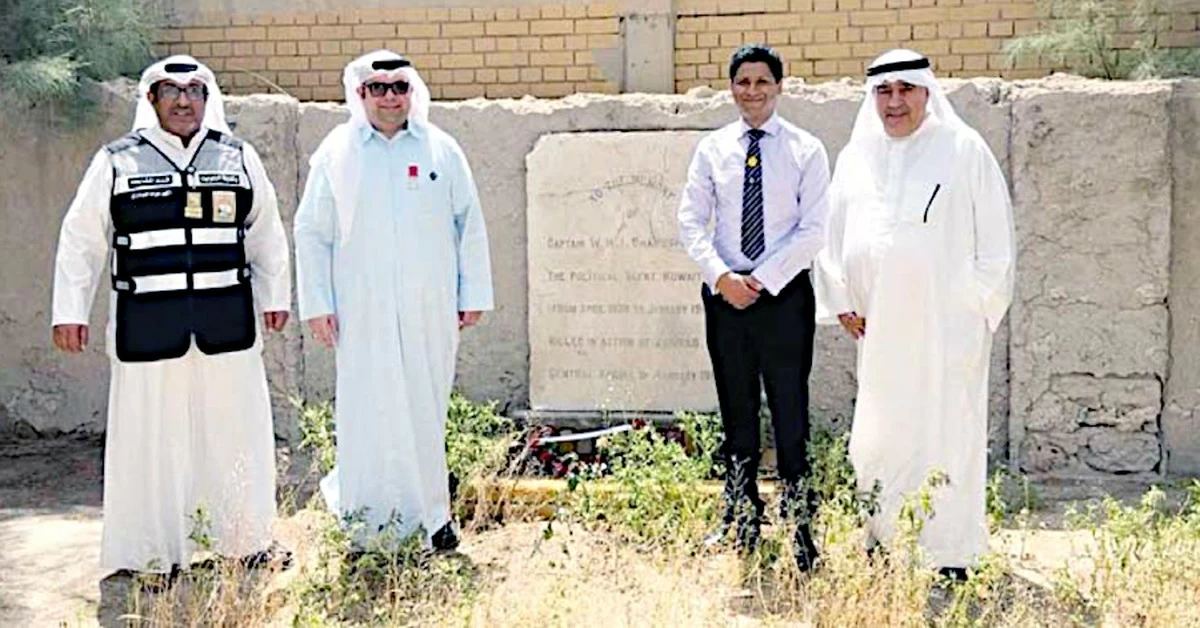
British Ambassador to Kuwait Qudsi Rasheed (second right), with Issa Dashti and Ahmed Behbehani
KUWAIT CITY, May 5: British Ambassador to Kuwait Qudsi Rasheed visited the old cemetery in Sharq on Monday, affirming this is a valuable opportunity to learn about the significant aspect of the shared history between the two countries. In a press statement during the visit, Rasheed disclosed that the cemetery was established more than 100 years ago in an area that was then located on the outskirts of Kuwait City, before becoming part of the modern city center. He stated that it contains the remains of several British citizens who made notable contributions to Kuwait during that historical period, whether in the political sphere or through their work in the oil sector, particularly during the 1950s.
He added that among the most prominent figures buried at the cemetery is Captain William Shakespeare, who served as the second British Political Agent in Kuwait from 1909 to 1915, succeeding Captain Stuart Knox. He was keen to see Shakespeare’s grave and learn more about that period in the history of bilateral relations. He emphasized that these historical milestones reflect the depth of the ties between the two countries. He stated that he also learned about the personal friendship between Shakespeare and Sheikh Mubarak Al-Sabah, known as ‘Mubarak the Great’, and how this relationship embodied the close ties between the British side and the ruling family in Kuwait, as well as the broader relationship with Kuwaiti society.
He pointed out that these close ties did not end with that era but continued throughout the development of Kuwait -- from the period of independence to the present day, refl ecting the enduring historical partnership between the two nations. He stressed that the United Kingdom and Kuwait share a common history, deep-rooted bonds, and mutual interests. “We continue to work together. I believe that under the current circumstances, understanding this shared history, what it represents for us today, and what it can mean for the future of our relationship is of utmost importance,” he added.
Era
He concluded by affirming that British-Kuwaiti relations remain strong and resilient, and that revisiting these historical roots helps reinforce them and drive greater cooperation in the future. On the other hand, Kuwaiti-British relations researcher Issa Dashti stated that the first Christian cemetery in Kuwait (the Old Christian Cemetery), located in Sharq, contains the graves of several Christians who have lived in Kuwait since the early 20th century. He revealed that the cemetery includes the graves of several prominent historical figures, such as the memorial tomb of British Political Agent William Henry Shakespeare and the grave of Dr. Millary, a doctor at the American Hospital. He said the cemetery was established in 1913 by British Political Agent William Shakespeare, after two Christians in Kuwait passed away and there was no Christian cemetery available for their burial.
He concluded by affirming that British-Kuwaiti relations remain strong and resilient, and that revisiting these historical roots helps reinforce them and drive greater cooperation in the future. On the other hand, Kuwaiti-British relations researcher Issa Dashti stated that the first Christian cemetery in Kuwait (the Old Christian Cemetery), located in Sharq, contains the graves of several Christians who have lived in Kuwait since the early 20th century. He revealed that the cemetery includes the graves of several prominent historical figures, such as the memorial tomb of British Political Agent William Henry Shakespeare and the grave of Dr. Millary, a doctor at the American Hospital. He said the cemetery was established in 1913 by British Political Agent William Shakespeare, after two Christians in Kuwait passed away and there was no Christian cemetery available for their burial.
“The land was granted to him by the seventh ruler of Kuwait, Sheikh Mubarak Al-Sabah, and the British government of India provided 1,000 rupees to construct a mud wall around the cemetery. The cemetery still retains its original form, along with a large portion of its original wall,” he added. He shared that “the William Shakespeare memorial was erected after his death at the Battle of Jarab in 1915. As Zahra Freeth recounted to me orally, based on the accounts of her parents, Colonel Harold Dickson and Violet Dickson (Umm Saud), after Shakespeare’s death, his bloodstained hat and shirt were sent to Sheikh Mubarak Al-Sabah, the ruler of Kuwait, who then handed them over to the British Political Agent in Kuwait to be buried in the Christian Cemetery.
British Political Agent William Geary buried these items and placed a locally made clay stone as a marker for the memorial grave. Later, British Political Agent Colonel Harold Dickson commissioned a memorial headstone for Captain Shakespeare’s grave made of fired clay to commemorate the 15th anniversary of his death. He also planted a memorial tree on that occasion, another to honor British soldiers who died in Kuwait, and a third tree later to commemorate the death of his friend, Dr. Millary, who passed away in 1952. All of these trees still stand in the cemetery today.”
By Fares Ghaleb Al-Seyassah/Arab Times Staff